
- 3 MONTHS AGO · ENERGYA 440-foot wall across a Tanzanian gorge backs up a reservoir rated for 1.5 million acre-feet more than Lake Mead, and the last of its nine turbines had been spinning for sixteen months before anyone cut the ribbon
- 2 WEEKS AGO · ENERGYA California hillside water battery is designed to hold 5 million gallons in its upper tank that only firefighters can touch and 80 megawatt-hours in roofed tanks instead of a dam, and the drill rig started boring the same day the utility cut power to 3,601 customers
- 1 WEEK AGO · ENERGYAn 11,000-volt ship connector packed into its own container just passed factory tests with outside inspectors watching, and it’s built to reel in a high-voltage cable from an offshore wind turbine, lock it in and let a service vessel charge its batteries without heading back to port
- 4 DAYS AGO · ENERGYA 23-foot-wide steel platform on three 90-foot piles driven 45 feet into the bed of a Massachusetts canal lowers tidal turbines up to 10 feet across into a 4-knot current on a lifting arm, then raises them back out of the water so engineers can service them dry
- TODAY · THIS ARTICLEA wall of turbines and ship locks that would hold back a 33-foot tide for 120 years has finally been told where to stand, on a 1.5-mile line across an English estuary from one bank to the other, and its planners now want up to 1,000 megawatts out of it instead of 700
Back in August, we ran a piece on Liverpool’s plan to build a tidal wall across the River Mersey, and it ended on a slightly awkward note. The city region had the studies and plenty of political enthusiasm, but it didn’t have a spot in the estuary to actually put the thing.
Well, now it’s picked one. Or at least it’s picked a stretch of river.
On Nov. 6, the Liverpool City Region Combined Authority backed what it calls Alignment B as its preferred corridor for the barrage. That’s 1.5 miles of the Mersey between Bromborough, on the Wirral side of the river, and Otterspool on the Liverpool bank. The same vote dropped a rival route, Alignment A, endorsed a funding model and signed off on more engineering work ahead of a planning application.
If you’re wondering what a combined authority is, it’s basically the regional government Liverpool shares with its neighboring boroughs, led by an elected mayor. That mayor, Steve Rotheram, has been pushing this barrage for years.
So what is this thing, again?
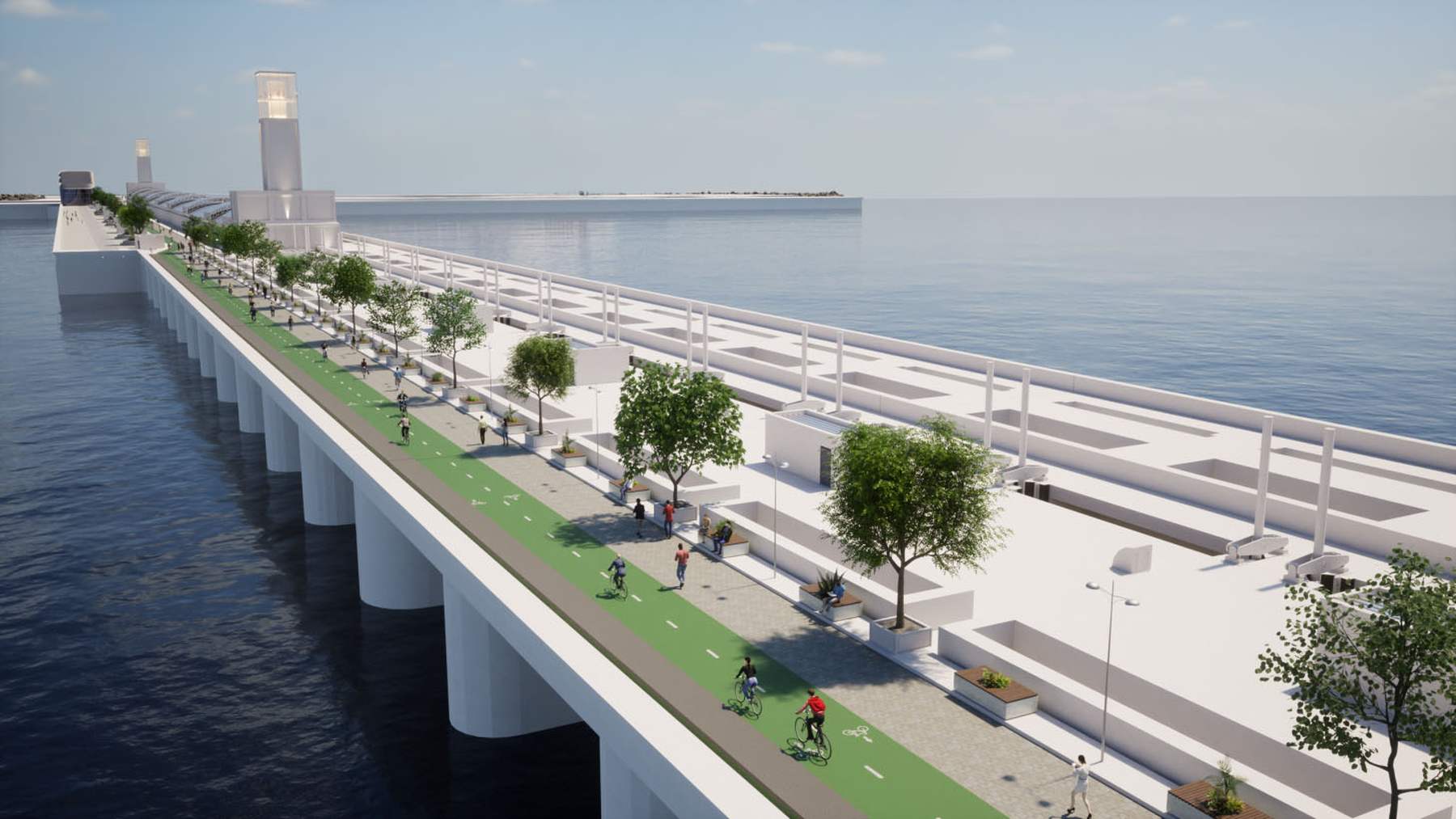
A tidal range scheme makes electricity from the height of the tide rather than the speed of the water. You build a wall across an estuary, let the sea pile up on one side as the tide comes in or goes out, then let it rush through turbines in the wall once the levels are far enough apart. If you’ve ever stood on top of a hydroelectric dam, you’ve got the basic idea, except here the sea refills the reservoir twice a day.
The Mersey version would run from one bank to the other with turbines and navigation locks built into it, so ships can still get in and out of the river. Barrages like this also lean on sluice gates to fill and drain the basin quickly, which is pretty much standard plumbing for the format. According to the authority, the Mersey’s tide can swing up to 33 feet, one of the biggest ranges in Britain, and that’s frankly the whole reason people keep coming back to this river.
So where exactly does the wall go?
This is where I’d pump the brakes a little. In the authority’s announcement, Alignment B is a preferred corridor that takes in 1.5 miles of river plus both banks, which is a looser thing than a line drawn on a map. The wall has to fit somewhere inside that stretch, and the authority hasn’t published its exact route yet.
The vote itself comes to me secondhand. The local news site Wirral Today reported it on Nov. 11, working from the authority’s published decision record, and that’s where the detail on Alignment A being taken out of the running comes from. I tried the official decision page and it wouldn’t load for me. Wirral Today also doesn’t say where Alignment A ran, so I can’t tell you what Liverpool turned down.
Still, picking a corridor is a pretty big deal for a project like this. Engineers can’t model what a wall does to the mudflats, the shipping channel or flood risk until they know roughly where it sits. The vote authorized exactly that work, from engineering studies to computer modeling of how the water would move. Rotheram said in that announcement that “Identifying where the barrage could be built is a major step forward,” which seems fair to me, if a little generous for a decision that doesn’t commit anyone to pouring concrete.
Is it 700 megawatts or 1,000?
When we covered the barrage in August, the design on paper came out at 700 megawatts. The authority now describes it as generating up to 1 gigawatt, or 1,000 megawatts, for 120 years. If you want a sense of scale, that’s roughly what one big nuclear reactor puts out, from a wall that runs on the moon’s schedule.
So did the target go up?
Honestly, I can’t find anything that says it did. The Planning Inspectorate’s project page already described a barrage rated at up to 1 gigawatt, and I haven’t seen a new turbine layout published alongside the location. Which means you should probably read the gigawatt figure as the ceiling the project is allowed to aim for. The 700-megawatt figure was the design drawn inside it back in August.
Who pays for a 120-year wall?
Money has always been the sticking point for big tidal projects in Britain. The government turned down a tidal lagoon in Swansea Bay on value-for-money grounds. So it’s arguably a smart move that the Nov. 6 vote picked a funding answer, at least on paper.
The authority picked a Regulated Asset Base model, or RAB, as its best bet for paying for something this size. Basically, a regulator lets investors earn a set return on a huge piece of infrastructure, and that money comes back to them through what customers pay over many years. Britain already uses the idea for things like water networks and nuclear power stations, so it’s a fairly well-worn path.
The authority is spending £2.5 million a year (about $3.3 million at the European Central Bank’s Nov. 13 reference rate) to get the planning application together, according to the regional property news site Place North West. Another £16 million (about $21 million) has to go into environmental surveys and related studies. The authority expects to have put £50 million (about $66 million) into the project by the time anyone makes a final investment decision, which is now penciled in for 2030. Nobody’s attached an official construction price to the wall in this round of documents, and I’m not going to guess at one.
The barrage still needs a national permit
Britain calls that permit a Development Consent Order, or DCO. It’s what the British government issues for nationally significant infrastructure like power plants, big rail lines and airports. Instead of going through local councils, the application is examined by the Planning Inspectorate and the final call is made by a government minister.
The barrage doesn’t have one yet, and nothing gets built until it does and the 2030 investment decision goes its way. Place North West reports the application is due in late 2028, though the Planning Inspectorate’s page still lists January 2028, so I’d treat the exact month as a moving target. Before then, the authority plans to go back to the public for another round of consultation in late 2027 or early 2028.
The wall has picked up a second job, too. The authority is designing it to help protect the estuary from sea levels that could rise somewhere between 2.6 and 3.9 feet by 2150. That’s a pretty long way to plan ahead, but then again, it’s a pretty long-lived wall. It’s also a different kind of tidal wall from the lagoon proposed for the Bristol Channel, which would loop out into open water instead of crossing a river.
There’s one last formality. Decisions like this can be “called in,” which is basically a window for a review committee to pull them back for a second look. According to Wirral Today, the authority’s record set that deadline for Nov. 13.
If nobody called it in, the Liverpool City Region Combined Authority’s pick of the Bromborough to Otterspool corridor took effect on Nov. 14, and the next public step on the calendar is that consultation in late 2027 or early 2028.
 A Dutch strawberry grower hung nearly 2,000 solar modules under the glass of a 2.5-acre greenhouse in four weeks without stopping the harvest, and they take only the heat-carrying part of the sunlight, because on bright days the berries overheat and come out smallEnergy · 3 hours ago
 A British company laid three fiberglass pipes 200 feet long up a Devon hillside and filled them with a fluid dense enough to float concrete, and the government’s final report says the plant hit 500 kilowatts but can hold that output for about 15 minutes, not the four hours it was built forEnergy · 5 hours ago
 A 705-megawatt reactor on the Danube came back after 99 days dark, then dropped off the grid three days later at 6 in the evening with a fault in its turbine condenser, and only reconnected on November 13, reaching full power the next day, after its twin had already beaten it backEnergy · 6 hours ago