
Sea mines are one of the oldest problems in naval warfare, and they have never stopped being a bargain. A mine sits on the seabed for years, costs a rounding error next to the ships it threatens, and closes a strait just by possibly being there. Navies have spent decades hunting them with ships deliberately built out of wood and fiberglass, because many modern mines don’t wait to be touched. They listen for engines and feel for the magnetic pull of a steel hull, and they fire when the signature matches.
Japan has been quietly building a different answer. Keep the steel warship, keep it well outside the minefield, and send in a 13-foot (4-meter) drone to do the part that gets people killed.
The drone is called the OZZ-5, it’s built by Mitsubishi Heavy Industries, and it just had a very visible summer. In July, one of the steel frigates designed around it spent two weeks hunting mines in Mutsu Bay alongside a US Navy ship whose hull is made of wood. Same job, two completely different theories of how to survive it.
Steel hulls and magnetic mines are a bad mix
The frigate in question belongs to Japan’s Mogami class. The designation is FFM, and according to Naval News, that M stands for mines and multi-purpose work. It’s the first escort ship class in the Japanese fleet to carry its own mine countermeasures gear, a job that had always belonged to dedicated minesweepers, and it remains a rare feature on frigates anywhere.
There’s an obvious catch. The Mogami is a steel ship, which makes it exactly the kind of target a magnetic influence mine is built to detect. Naval News spelled out the problem after a 2025 drill: the class is inherently more vulnerable to those mines than the wooden and fiberglass boats it’s meant to relieve.
So the ship doesn’t go into the minefield. The machines do. Twelve Mogami hulls have been launched, the last of them in December 2025, and the drones are the reason the concept works at all.
A 13-foot drone with a French sonar and Japanese ears
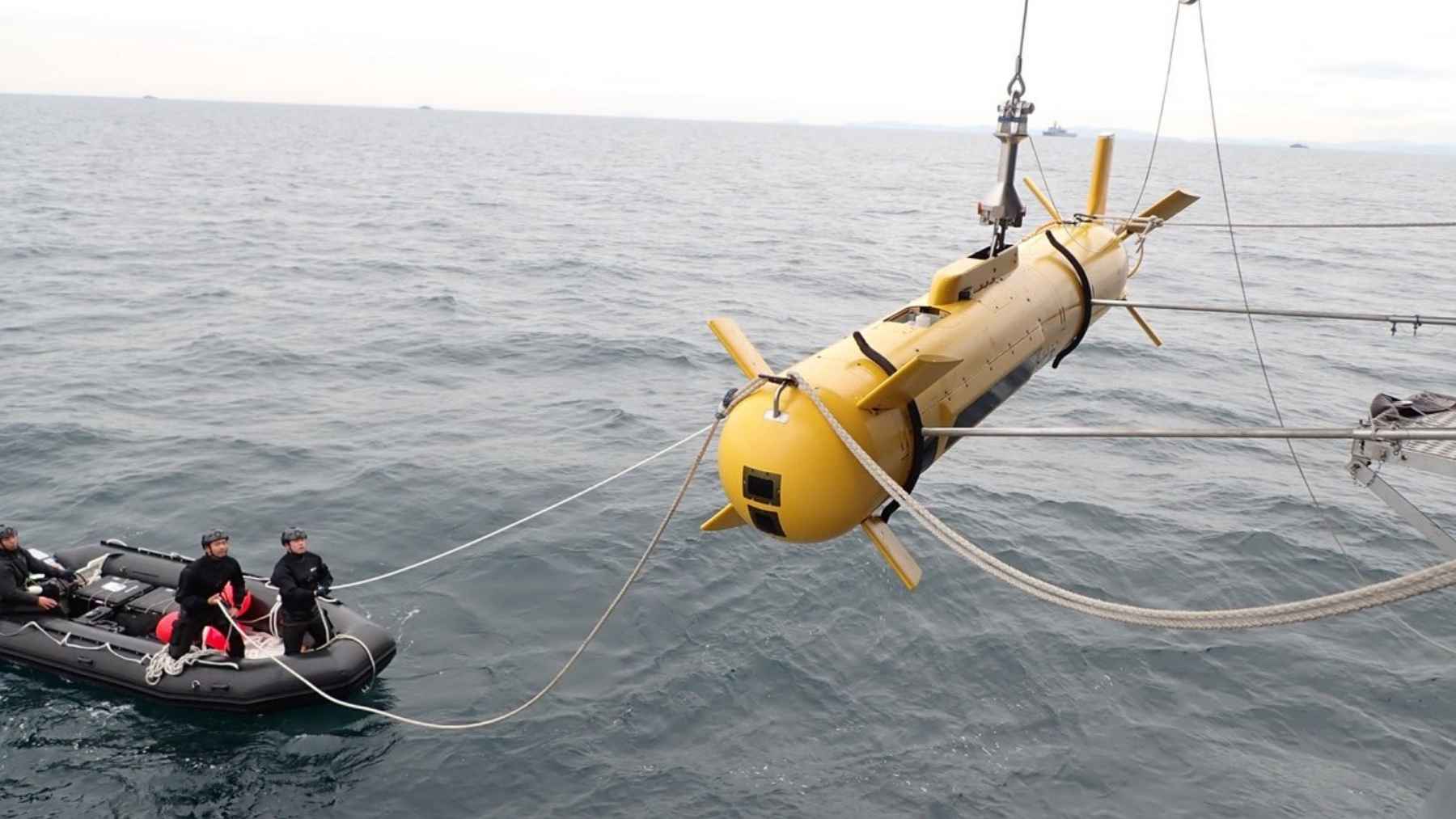
The OZZ-5 looks like a stubby yellow torpedo. Per Japanese Ministry of Defense figures reported by Naval News, it’s 4 meters long (about 13 feet) and 20 inches wide, runs for more than 9 hours on a charge, and tops out at 7 knots. X-shaped rudders at both ends let it steer precisely even when it’s crawling. The Diplomat puts its displacement at 950 kg, roughly 2,100 pounds.
The interesting hardware is inside. The OZZ-5 carries two synthetic aperture sonars stacked together: a Japanese-built low-frequency set from NEC and a French high-frequency set, the Thales SAMDIS. Low frequency finds mines that have buried themselves in the seabed. High frequency draws a picture sharp enough to tell a mine from a rock or a shopping cart.
SAMDIS has a party trick, too. It views each target from three different angles in a single pass, and it runs automatic detection and classification so a human isn’t squinting at every sonar return. Thales Japan’s CEO at the time, Cyrille Dupont, called the 2020 contract “the continuation of the ongoing Japan/France bilateral long-term cooperation,” and that thread kept going: in 2021 the two governments launched a joint project to sharpen the OZZ-5’s accuracy and let it analyze its own sonar data in real time, instead of hauling everything back to the ship for processing.
Deliveries started in March 2023, and Janes reported from the IMDEX show that year that the drones aboard Japan’s frigates wear yellow paint, the livery that marks them as operational kit rather than trials gear.
One machine finds the mine, a second one blows it up
The OZZ-5 only hunts. It swims its assigned search pattern, maps what it finds, and comes home with the data. Killing the mine is a different machine’s job.
That machine is a 36-foot (11-meter) unmanned surface boat, launched and recovered through a ramp in the frigate’s stern, under the flight deck. It carries expendable mine disposal charges and drives out to detonate whatever the hunt turned up. Janes identifies the boat as the Umikaze and notes it can also embark the OZZ-5 itself, so the little drone doesn’t even need the frigate to get a ride to work.
Japan proved the whole chain in public on June 15, 2025, when the frigate Mogami ran its first mine disposal drill with the surface boat off Iwo-To, the island Americans still call Iwo Jima. The ship found practice mines with its hull sonar and the OZZ-5, then sent the boat to finish them. A JMSDF official told Janes afterward, “We believe this has further enhanced our mine countermeasure capabilities,” which is about as much excitement as you’ll ever get out of a Japanese defense official.
If the layered-drones idea sounds familiar, it’s because everyone is converging on it. American builders are turning out three-ton drone submarines at 200 a year in Rhode Island for deeper, longer work. Japan’s approach starts smaller and closer to shore, and it’s already bolted to an operational fleet.
The wooden ships were in Mutsu Bay too
Which brings us to July. The US Navy and the JMSDF ran Mine Warfare Exercise 2JA in Mutsu Bay, at the northern tip of Honshu, from July 9 to 24. The American contribution included USS Chief, an Avenger-class ship with a wooden hull sheathed in fiberglass, built that way specifically so mines have less to detect. The Japanese side sent minesweepers, a tender, patrol aircraft, mine-hunting helicopters, and one very modern outlier: the Mogami-class frigate Niyodo.
So the exercise had both eras working the same water. Ships built to be invisible to mines, and a steel ship built to never get close to one. Capt. Scott G. Wells, the commodore of the US Navy’s Mine Countermeasures Group 7, called it “an honor and a privilege to work alongside our host-nation partner,” and the two navies ran hunting, sweeping and neutralization drills for 15 days. It was the second round this year, after a February exercise in the same series.
Mutsu Bay is not a random pond, either. Japan’s mine warfare force trains there because the scenario it worries about involves keeping its own straits and approaches open, the same chokepoint math that has US builders racing to field a 20-foot drone rated to cross the Taiwan Strait.
The same builder just went much, much bigger
Mitsubishi Heavy Industries didn’t stop at 2,100 pounds. The company behind the OZZ-5 handed Japan’s navy two far larger drone submarines this summer: a 20-ton, 33-foot model and a 30-ton design longer than a city bus, built for week-long intelligence patrols rather than mine hunting.
Those are different machines for a different job, and the OZZ-5 is the one with a combat-ready fleet wrapped around it. Japan plans 12 more frigates of an upgraded Mogami design for its own navy, and the drone handling is baked into all of them.
Australia bought the frigates. The drone toolbox is a separate question
On April 18, Australia signed with MHI for its first three upgraded Mogami frigates, the opening batch of a planned 11-ship fleet, with the first delivery due in 2029 and the remaining eight slated for construction in Western Australia. Multiple outlets put the initial contract at about A$10 billion, around $7 billion, and The Japan Times called it the largest defense export deal in Japan’s postwar history.
The Australian variant keeps the mission bay and the stern ramp, the plumbing that makes the drone concept work. What Australia hasn’t sorted is its own version of the toolbox. Naval News reported in March that Canberra’s dedicated mine countermeasures project, Sea 1905, was suspended in April 2024 and now sits in the queue for the early 2030s. The project number spells MCMV in Roman numerals, which is the most fun anyone has had with that program lately.
Rear Admiral Hughes, the two-star in charge of Australian naval capability, put the squeeze plainly to Naval News: “I have ageing platforms, systems that are costing me more.” The Australian Naval Institute has already published the obvious suggestion, arguing the country should simply adopt the unmanned boat Japan’s Mogamis carry rather than reinvent it.
None of that is settled. What’s settled is the concept the OZZ-5 proved: the wooden ships aren’t retired yet, but the reason they had to exist is becoming a solved problem. The solution is 13 feet long, painted yellow, and listens to the seabed in two frequencies at once.