
Radio does not work underwater. Most people know that much. What gets skipped is why: salt water conducts electricity, and a conductor absorbs radio waves instead of passing them along. The higher the frequency, the faster the signal dies.
Navies get around it with extremely low frequencies, antennas trailed near the surface, and transmitter sites covering square miles. None of that fits on an inspection robot.
So every flooded ballast tank, hydropower shaft and potable water tank on the planet gets checked one of two ways. A person climbs inside it, or a robot goes in dragging a cable behind it.
A Swiss company called Hydromea has spent about a decade arguing for a third answer, which is to talk to the robot in blue light. This June the argument collected two American receipts, three days apart.
On June 9, Florida Atlantic University and Hydromea won a 12-month, $1 million award from the AUKUS Maritime Innovation Challenge, the trilateral program run by the Pentagon’s Defense Innovation Unit with its Australian and British counterparts. The job is to build an underwater network that runs on sound and light at the same time.
On June 12, Houston equipment specialist MFE Offshore announced it had become an official distributor of Hydromea’s robots for offshore and maritime work in the US.
The machine at the center of it weighs 20 pounds and fits in a backpack. In the five years since it made headlines, it has also grown a cable back.
Salt water eats radio, and it isn’t close
Sound is the workaround the industry actually uses. A Houston company recently drove an untethered robot 7,500 feet down off Louisiana on an acoustic link, because sound is the one signal seawater lets travel far.
The trade is bandwidth. Acoustics buy range and a trickle of data.
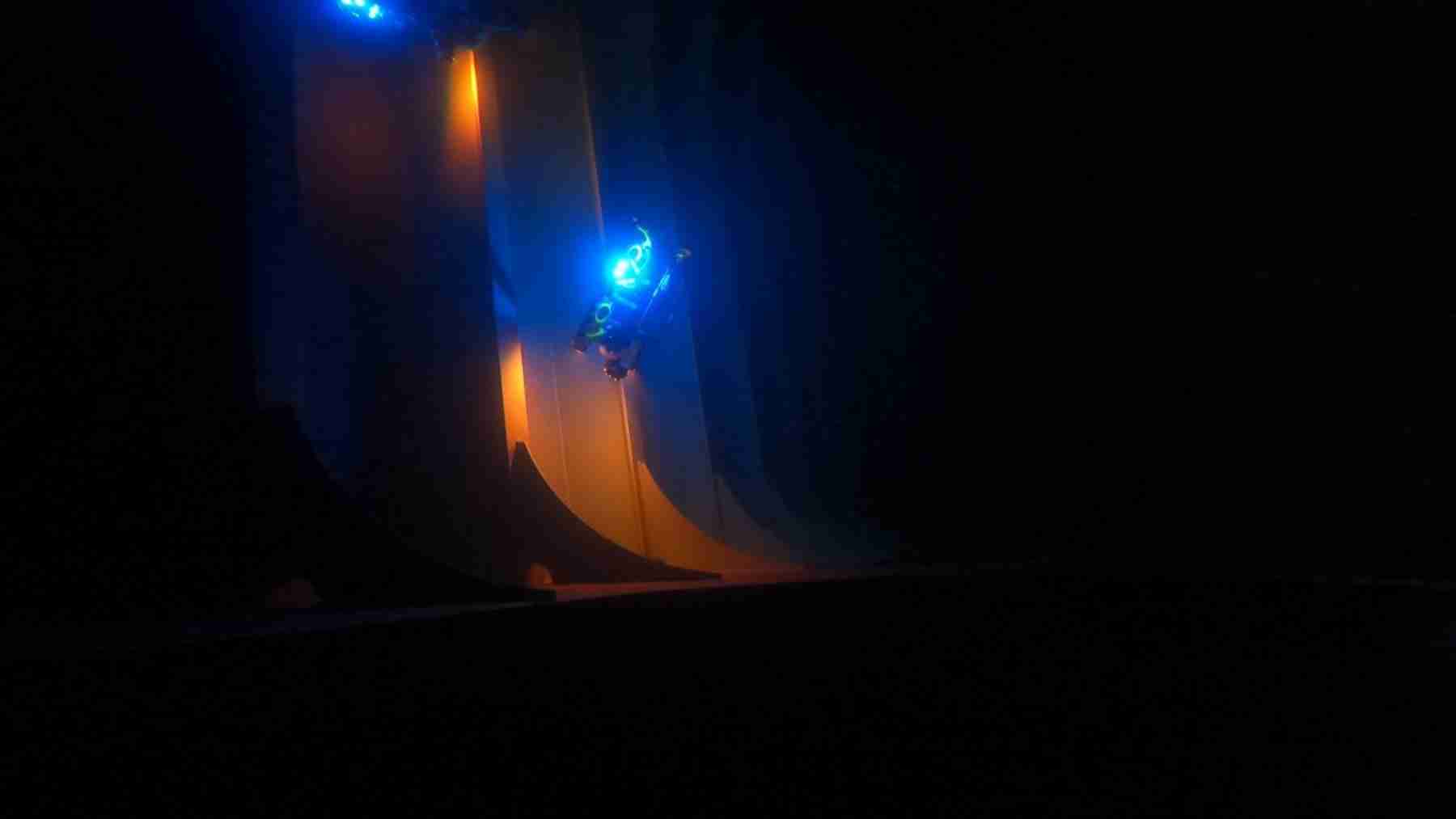
Light is the opposite bargain. Water swallows red almost immediately and lets blue-green through the furthest, so Hydromea’s modems, branded LUMA, blink a blue LED at each other. The spec sheet for the compact LUMA flex puts the wavelength at 475 nanometers.
The fastest modem in the family, the LUMA X, moves data at up to 10 megabits per second. That is enough for live HD video with no meaningful lag.
Ten megabits will not impress anyone who has used home broadband since 2009. Underwater it is a different animal. By Hydromea’s own numbers, its optical links run about 1,000 times faster than an acoustic modem, and about 1,500 times more efficient per bit moved.
The catch is the receiver. It is a photosensor, so it wants darkness. Hydromea’s documentation says LUMA performs best at light levels of one lux and below.
Hydromea puts direct sunlight at around 40,000 lux, roughly a million times the level its modems prefer. The company points out that the human eye adapts to brightness on an exponential scale, so that gap barely registers when you look at it. A photodiode reads it straight.
Which tells you where the technology belongs, and Hydromea says as much on its own product pages. Dark, enclosed, flooded spaces. The inside of a ship. For everywhere else there is a sunlight-tolerant variant, the LUMA X-UV.
The robot is 20 pounds and cleared to 656 feet
The prototype that made Hydromea famous appeared in May 2021, billed as the world’s first wireless underwater drone. As New Atlas reported at the time, it was 27.5 inches long, weighed 15 pounds, and ran seven hubless thrusters for six degrees of freedom.
It held a link out to 50 meters in clear water and total darkness. Co-founder Alexander Bahr was upfront that turbidity and daylight both cut that number down.
The shipping EXRAY, launched commercially at Oceanology International in London in March 2024, is a heavier machine with a longer spec sheet. Hydromea lists it at 9 kilograms, or 20 pounds, and calls it backpack-ready.
It is certified to 656 feet of depth and water between 32 and 104 degrees Fahrenheit, tops out around 2 knots in either direction, and runs about six hours on a charge. The rotating camera shoots full HD video and 4K stills with 2.5x to 3x optical zoom, onto 32GB of onboard memory plus a microSD slot.
Hydromea flags the endurance and speed figures as preliminary and subject to change. That line sits on its own spec page.
The cable came back, and Hydromea put it on its own spec page
The EXRAY you can buy today ships with a tether. Hydromea describes it plainly: 328 feet of ruggedized twisted copper pair, 4 millimeters across, extendable to 985 feet, with a single-mode fiber-optic option running out to 2,000 meters on a custom order.
The wireless part is an optional add-on called FLYOUT. In Hydromea’s own words, the tethered robot becomes a communication relay, and the FLYOUT swims off it on LUMA alone, out to 100 feet. The trade press covering the Houston deal now describes that relay role as the thing that sets the EXRAY apart.
That sounds like a retreat. Inside a ballast tank it isn’t.
Tangling is what kills these jobs, not distance. The robot threads between stiffeners and frames, the same tight-geometry problem that pushed Norway to build a six-meter robot snake for wellheads. A cable parked at the relay never follows it around a corner. Running one to the surface was never the interesting part.
The expensive part was never the robot
The business case is not the machine. It is everything the machine lets an operator skip.
A ballast tank inspection is not one guy with a flashlight. Before anybody goes in, the tank gets drained, dried and ventilated. Then comes scaffolding, a permit, an atmosphere test and a standby rescue team. The inspection itself is the short part.
Hydromea’s argument since its earliest trials has been that none of that is necessary if the tank simply stays full. No draining, no drying, no ventilating, no scaffolding. The robot swims in and the tank never has to become a room.
Class societies do not sign off on pretty video, which is where the real engineering shows up. Among the EXRAY’s optional payloads is an ultrasonic thickness sensor, so the robot can measure how much steel is actually left in a wall rather than photograph the rust and hope. That is what a class-approved inspection report is made of.
The sequence went the way these things usually go, slowly and with paperwork. In early 2022 Hydromea ran the robot inside a full ballast water tank on a TotalEnergies FPSO in the North Sea, on a project funded by Aberdeen’s Net Zero Technology Centre, with a pilot commanding it and receiving real-time 1080p video over no cable at all.
Later that year, Scottish contractor Air Control Entech signed on to commercialize it for ballast tank work on FPSOs in the North Sea and Latin America. In June 2023 ACE secured DNV class approval to use the EXRAY for visual remote inspection of flooded spaces on offshore floating platforms.
That approval is the whole ballgame. It is the paperwork that turns a clever machine into a billable service.
Defense money is chasing the modem, not the robot
The robot takes the pictures. The modem is what Hydromea sells to everybody else, and it has been selling well.
On March 4, Hydromea and Norwegian energy giant Equinor said they had pushed data from the seabed straight to the cloud in real time, wirelessly, using LUMA optical devices feeding Equinor’s DEEPNET network. Hydromea announced it as a first, and pegged the platform at up to 10 Mbps at depths reaching 6,000 meters.
Equinor is the same operator that backed the open seabed docking station now used by Saab’s resident Sabertooth drone. The point of that hardware is to stop paying for a ship to sit overhead while a robot works, and a data cable would defeat it.
Hydromea CEO and co-founder Igor Martin has a line he keeps returning to. His optics, he said when the AUKUS award was announced, are “the infrastructure layer the ocean has been missing.”
Then the defense money arrived. The Florida Atlantic award pairs the school’s Center for Connected Autonomy and AI with Hydromea for a year, to fuse long-range acoustic command links with high-speed optical data links inside one programmable box.
George Sklivanitis, the project’s principal investigator and associate director of the center, framed the problem the way an engineer would. “Today’s underwater communication systems typically force operators to choose between range and speed,” he said.
Neither signal wins alone. Sound reaches, light delivers, and the handoff between them is the actual engineering. Testing runs at Hydromea’s Swiss facility and FAU’s SeaTech campus in Dania Beach, then moves to field demonstrations off Australia with surface vessels, underwater vehicles and seabed systems.
There is a second reason a defense program cares about blue LEDs. An optical link is directional and short-ranged, which makes it hard to pick up from anywhere you are not already sitting. Hydromea calls that a low probability of intercept profile. A navy calls it the reason to buy one.
What you are actually buying
Strip away five years of press releases and the Hydromea story gets smaller and more useful than the headline it launched with. The physics has not moved. Salt water still beats radio, and sound still goes further than light over any distance worth calling a distance.
What is new is a 20-pound robot a contractor can run under a DNV class approval, exploiting that gap inside the one place the physics cooperates, which is a dark flooded box nobody should be standing in.
The cable never fully went away. It stopped following the robot around corners and started waiting at the door. For anyone whose job description includes climbing into a ballast tank, that is worth a good deal more than the word wireless.