- 2 MONTHS AGO · ENERGYA 5-gigawatt-hour stack of carbon blocks heated to 4,352 degrees by running current straight through them has fed a South Dakota ethanol plant 50 megawatts around the clock since May, and a 5.8-gigawatt-hour one is now signed for a second ethanol plant in Kansas
- 1 MONTH AGO · ENERGYA 710-foot dam on the Colorado River skipped the cold-water flush that stopped bass spawning two summers running, kept its eight turbines turning with the river below at 69 degrees, and a month later the lake behind it hit its lowest level since it first filled
- 2 WEEKS AGO · ENERGYA 726-foot dam on the Colorado River will test whether its 12 older turbines can run below the water level that’s supposed to wreck them, a first in the dam’s history, on limited hours and with frequent inspections, while its lake sits 4.9 feet above that line after the floods
- 7 DAYS AGO · ENERGYA 170-foot concrete tower in a California reservoir has had 40 feet cut off its top, ring by concrete ring from a crane on a floating barge, because the dam beside it was built 33 feet lower than planned and left the tower that is the lake’s only safe drain too tall for an earthquake
- TODAY · THIS ARTICLEA 602-foot dam in Northern California is showing again, for the first time since 2022, the steel tower that helped pour its concrete around the clock for four and a half years, now that the reservoir sits more than 94 feet below full, and buoys have been tied to it for safety
Most big construction jobs clean up after themselves. The cranes leave, the scaffolding comes down, and a few decades later you’d have a hard time figuring out how anyone built the thing in the first place. Shasta Dam didn’t quite get the memo.
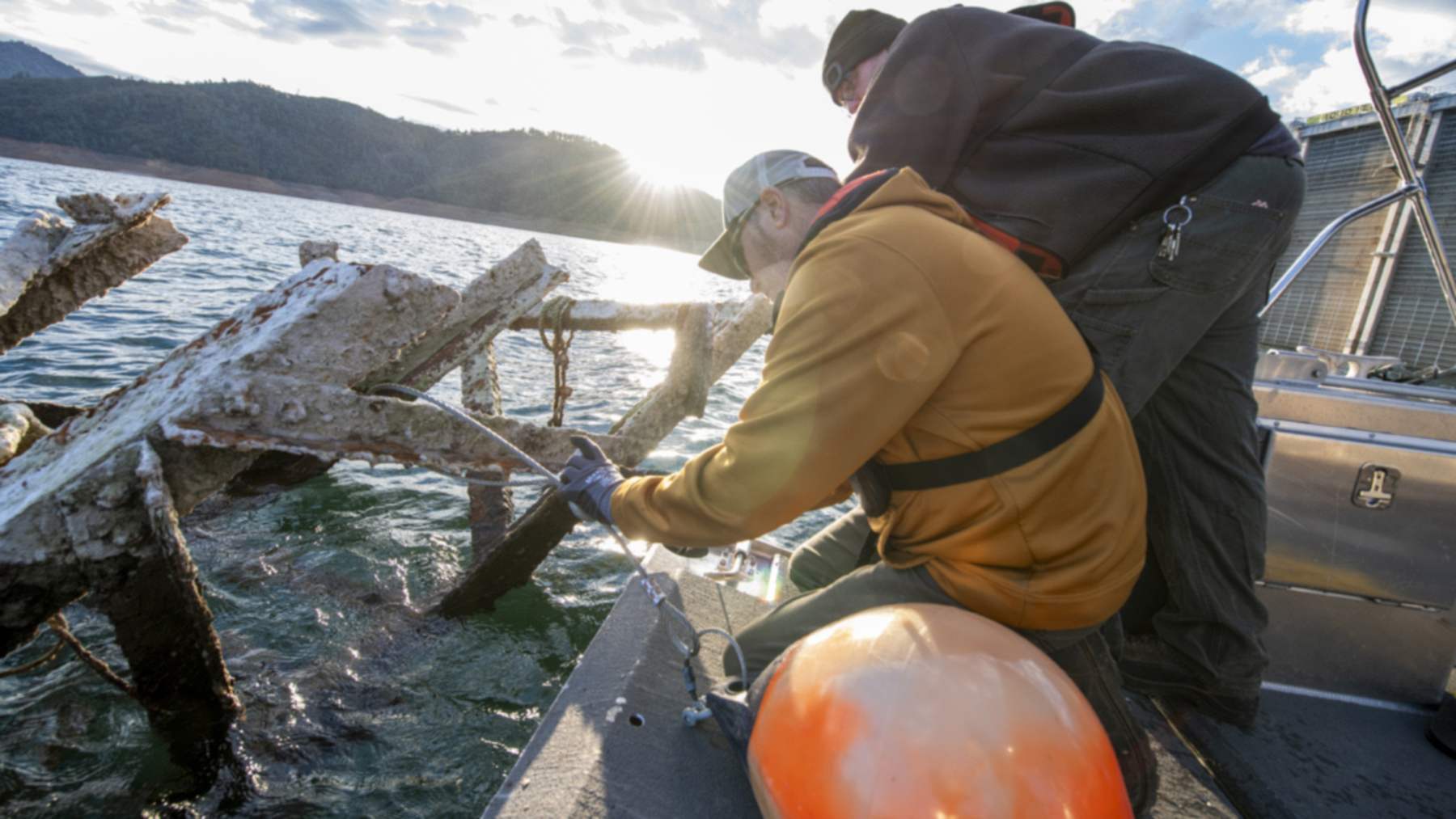
The base of the steel tower that helped build it is still standing in the reservoir. Most of the time you can’t see it. Right now you can. The Bureau of Reclamation says what’s left of the dam’s main construction tower is poking out of Shasta Lake again, and it hasn’t been visible since 2022.
Reclamation’s maintenance team has already been out there attaching buoys to it, and the public is required to keep 1,000 feet away. Which is fair. An old steel frame sitting in open water is pretty much the definition of something you don’t want to bump into.
Shasta Lake is low, and that’s normal
The tower starts to show once the reservoir drops 90 feet below full pool. If you’ve never run into that term, full pool is basically the reservoir’s “full” line, the level it’s built to hold when it’s topped off. So 90 feet below full pool means the surface sits 90 feet lower than that line, and the lake is now just over 94 feet down.
That sounds like a lot. It isn’t an emergency, though. Reclamation puts the lake at about 95% of its historical average, and Tom Patton, a hydrologic engineer with Reclamation’s Central Valley Operations, put it pretty plainly: “Fluctuating lake levels are part of the normal operations at Shasta Reservoir.”
The reason is pretty simple once you know what the lake is for. According to Patton, Shasta’s main job is to hold water through the winter and send it out over the rest of the year. So the level keeps dropping while that water goes downstream, and it climbs back once the reservoir starts storing again.
If you’ve been following our dam coverage, this is a very different story from Elephant Butte in New Mexico, which was still under 5 percent full in October even after hurricane remnants more than tripled its water. It isn’t a Lake Mead situation either, where a low enough lake could get 12 of Hoover Dam’s turbines into trouble. Shasta, from the looks of things, is just doing its job.
So what was the tower for?
Reclamation says the tower was one piece of a big setup of equipment that moved materials around and supported the workers while the dam went up. And it went up without a break. The concrete pours didn’t stop, day or night, for four and a half years, so this thing was basically part of a job site that never clocked out.
What the release doesn’t tell you is how tall the tower was originally, or exactly what it lifted. There are figures for that floating around online, but they don’t come from Reclamation, so I’m not going to repeat them here. We do know the top section came down once the 602-foot dam was finished. That’s why only the base is left, and why it spends most of its life underwater.
That’s what I find kind of wild, frankly. Scaffolding is supposed to be temporary. This is a steel frame from a 1940s job site that’s been largely submerged for decades, and it’s still solid enough to get its own safety perimeter. Reclamation says it’s one of several leftovers from building the dam that you can still spot today. I’d argue it’s the most interesting one, if only because it plays hide-and-seek with the water line.
Shasta Dam was a nonstop job
Work on Shasta Dam started in 1938 and wrapped up in 1945. Frank Crowe and a contractor called Pacific Constructors Inc. ran the job under contract with Reclamation, and the finished dam stands 602 feet tall.
It’s a pretty important piece of plumbing for California, too. Shasta is part of the Central Valley Project, and Reclamation lists water storage, flood control, hydroelectric power and recreation among the jobs the reservoir handles.
Elizabeth Hadley, the Area Manager at Reclamation’s Northern California Area Office, sees the tower as a reminder of how committed the people who built the dam were. She says the team that keeps the Central Valley Project running today carries that same commitment. A steel frame that’s held up for more than 80 years makes her point pretty well on its own.
So can you go see it?
Yes, from a distance. The 1,000-foot rule applies to everyone, so if you’re out on the lake in a boat, that includes you.
Reclamation says the best view is from the top of the dam anyway. According to the agency’s Shasta Dam visitor page, it runs free guided tours Friday through Tuesday, and they include a walk across the top. So you don’t need a boat, and you arguably get the better angle without one.
How long will the tower stick around?
Reclamation hasn’t put a date on that, and I don’t think anyone really could. The tower goes back under once the lake climbs above that 90-foot mark, and that depends on how much water the winter brings in.
Reclamation’s November 20 release put Shasta Lake at just over 94 feet below full pool, which means the water needs to come up a little more than 4 feet before the tower drops back out of sight.
 A heat-to-power generator sat on the seabed for two weeks and put out more than 20 watts of electricity, the first time this kind of Stirling machine has made power on the ocean floor, using electric heat in place of the radioisotope fuel still to comeEnergy · 13 hours ago
 A desert plant that can supply about a third of the enriched uranium U.S. reactors use filled its first commercial cylinder of uranium enriched past 5%, something the company says no other plant in the Western world offers, so existing reactors could run longer between refuelingsEnergy · 14 hours ago
 A 95-year-old hydro dam holding back a 4,000-acre Michigan pond has been officially downgraded to poor condition because its spillway can’t pass the biggest flood possible there, and the $350 million fix now hinges on a state vote due December 17Energy · 15 hours ago