You already know what happens when you shake a can of soda and crack it open. The gas in the drink suddenly has room to expand, and it drags everything else out with it. A lot of volcanoes work in pretty much the same way. Magma carries water and other gases, and when it gets close to the surface, those gases balloon and tear the molten rock into ash and chunks.
Geologists call what’s left behind pyroclastic rock, which basically means “fire-broken.” So you’d expect to find it on land or in shallow water, where there isn’t much pressing down on the magma.
That’s why a paper published Monday in Frontiers in Earth Science is a bit of a head-scratcher. A team led by Robert Stern, an emeritus professor at the University of Texas at Dallas, sent a robot down the side of the Mariana Trench and found pyroclastic rock more than 20,000 feet below the surface. According to the authors, it’s the deepest deposit of its kind anyone has found on Earth.
So how do you end up with what looks like blast debris in a spot where gas shouldn’t be able to expand like that?
So what’s a subduction zone?
The Mariana Trench sits in the western Pacific, east of the Philippines, and it’s what geologists call a subduction zone. In plain English, that’s a place where two of the giant slabs that make up Earth’s outer shell collide, and the heavier one slides underneath and sinks into the mantle.
Here, the Pacific plate is the one diving beneath the Mariana plate, and where it bends down, it carves a trench into the seafloor. Challenger Deep, at the southern end, bottoms out at roughly 36,000 feet below sea level, which makes it the deepest known spot in any ocean.
That sinking plate also drags water down with it, and the water helps melt the rock above, which then rises to feed volcanoes. In most subduction zones, the paper says, the strip between the trench and the line of volcanoes runs about 95 to 125 miles wide.
Pressure is supposed to keep a lid on all of this
Go back to that soda for a second. It stays perfectly calm while the can’s sealed, because the pressure inside keeps the gas dissolved. The deep ocean is basically a sealed can with the lid jammed on.
At the depths where these rocks turned up, the paper puts the pressure at more than 8,700 psi. Under that kind of squeeze, water coming out of magma doesn’t turn into steam the way it would at the surface. It becomes what’s called a supercritical fluid, a sort of in-between state that isn’t really a liquid or a gas. By the authors’ math, that fluid takes up about 3% of the space the same amount of water would fill as steam.
Which means there’s a lot less gas punch available to shatter the rock. Stern told Science News his team can’t actually say whether these eruptions were truly explosive, at least in the way we’d normally use the word. The working idea in the paper is that supercritical water still broke the lava apart, just far less violently, leaving dense, fragmented deposits that didn’t mix much with seawater.
I’ll admit that’s a slightly frustrating answer if you came here for an underwater volcano blowing its top. But it’s frankly the honest one, and the authors flag it as a hypothesis that still needs testing.
So what did the robot actually find?
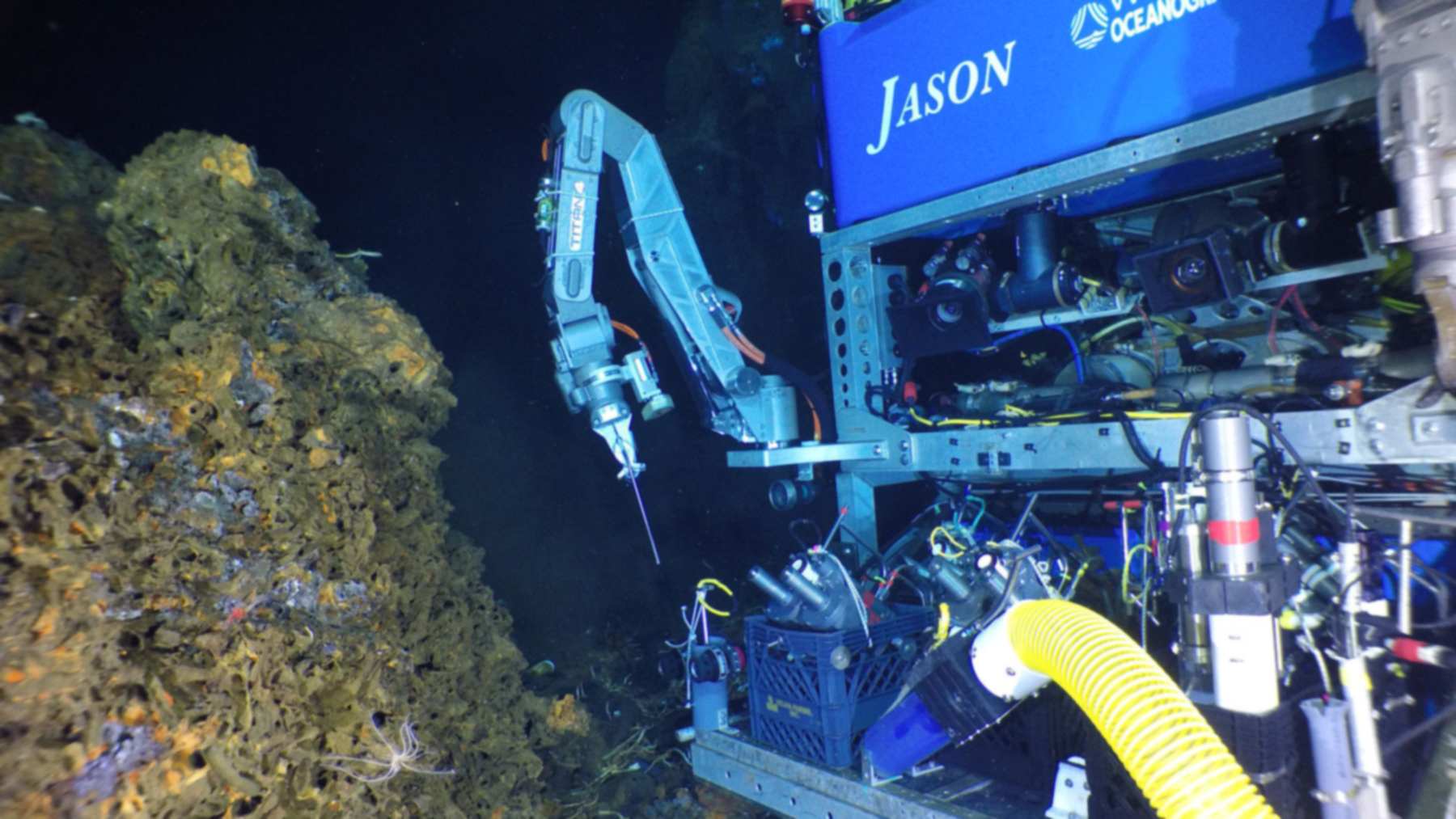
The robot in question is Jason, a remotely operated vehicle run by the Woods Hole Oceanographic Institution as part of the National Deep Submergence Facility, which the National Science Foundation funds. It’s about 11 feet long and weighs roughly 11,000 pounds in air, according to WHOI’s spec sheet, though it’s neutrally buoyant once it’s down there. Jason works with a second vehicle called Medea, which hangs off the ship’s cable and soaks up its motion so Jason doesn’t get yanked around on its tether. Together, they’re rated to about 21,300 feet.
We’ve covered robots in this part of the Pacific before, like the 15-ton drone ship that spent six months mapping the Mariana seafloor, but that one worked from the surface. Jason goes down and grabs rocks.
Stern’s team made three Jason dives along the western part of what the paper calls the Challenger Deep forearc segment, working from the research ship Thomas G. Thompson. Each one started at its deepest point and worked its way upslope, with starting depths between about 20,800 and 21,300 feet. The dives themselves happened a while before the paper did, which is pretty normal in geology.
On the third dive, Jason’s cameras caught two kinds of structure. At about 20,200 feet, there were lobe-shaped edges where a flow of hot fragments apparently stopped and cooled fast. A bit deeper, at about 20,800 feet, the robot found slabs of pyroclastic rock broken into regular, plate-like blocks, which the team thinks could mark separate pulses of an eruption. The samples are full of fresh volcanic glass, which the authors take as a sign the eruptions were geologically young.
William Chadwick, an Oregon State University geologist who wasn’t involved in the study, called the find “surprising and unprecedented” in comments to Science News.
Is the Pacific plate bending harder here?
Then there’s where these rocks turned up. Science News puts these deposits at roughly 60 miles from the trench. The paper gets a little tighter than that. It says the ridge in the stretch they studied sits about 25 to 60 miles north of the trench, and that the pyroclastic rocks they recovered lie much closer to the trench than the ridge does. Either way, it’s well inside that 95-to-125-mile gap you’d normally expect.
Stern’s team thinks a tighter-than-normal bend in the sinking Pacific plate could explain both oddities at once. If the plate curls down more sharply, it dips more steeply, and the melting that feeds volcanoes ends up closer to the trench. A plate bending that hard also sinks deeper, which would help dig a deeper trench. The paper leans on recent modeling by Zhang and colleagues, which found the slab under this stretch is more tightly curved than other slabs around the world.
It’s a pretty tidy explanation, and arguably the most interesting part of the paper. But the authors don’t oversell it. They write that Challenger Deep’s depth has several causes in both plates, including a weak grip between the sinking Pacific plate and the Mariana plate on top, which lets the Pacific plate sink and steepen more easily.
There’s a lot of trench left to look at
The team hasn’t pinned down where the vents that produced these deposits are. As far as I can tell from the paper, all they can say for now is that the vents must sit on the trench side of that ridge. They’ve also only explored about the eastern 190 miles of a forearc segment that runs roughly 340 miles.
Personally, I think the word “explosive” is the thing to watch here. The rocks look explosive, but at more than 8,700 psi the physics argues for something a lot gentler. It’s probably going to take a close look at what’s trapped inside that glass to sort it out.
That work is already underway. Stern and his co-authors say ion microprobe studies of the gas locked in the rocks are ongoing, which basically means firing a tight beam of ions at tiny spots in the glass to measure what it held. Their paper landed in Frontiers in Earth Science on November 23.