
The underwater drones getting all the attention this year have one thing in common: they swim. Germany’s BlueWhale glides through the Baltic for weeks at a time. Norway’s HUGIN Endurance cruises more than a thousand miles of seabed without surfacing. China showed off a manta-ray robot that ripples through a dark minefield with its fins. Genuinely impressive machines, all of them, and every one quits at the same place. The surf line. That violent strip a few feet deep where the ocean stops being ocean and starts being beach.
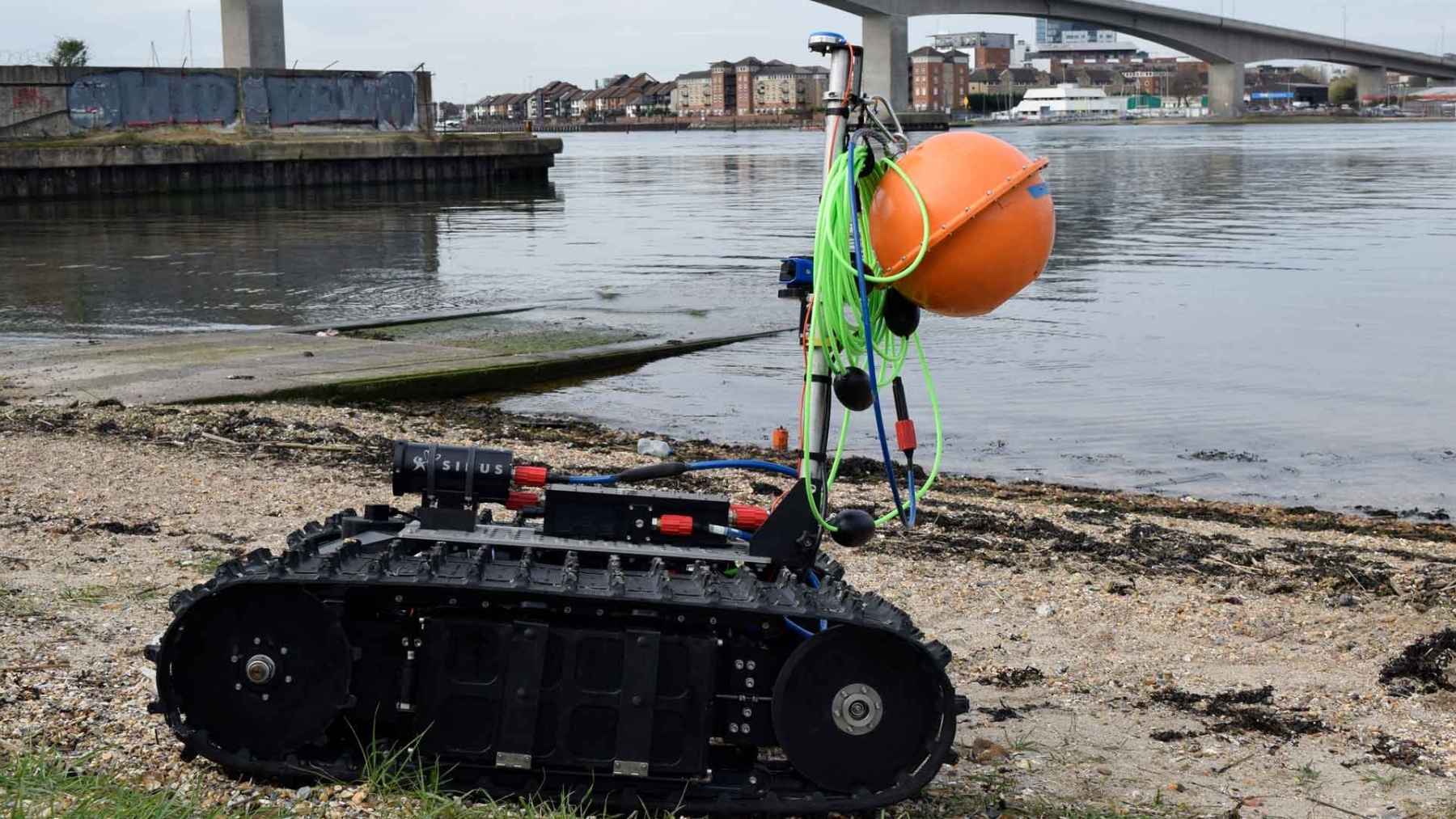
A swimming drone can’t work there. The water is too shallow to stay hidden in, the waves are too rough to hold a heading through, and the bottom is close enough to chew up a propeller. So a company in Richmond, Vermont built one that doesn’t swim at all. It has tracks, like a tiny tank, and it drives out of the deep, across the seabed, through six feet of breaking surf, and up onto the sand. Greensea IQ calls it the Bayonet, and its whole job is to hunt the mines waiting in the one piece of coastline nobody else’s robot can reach.
It drives along the bottom instead of swimming over it
The category name is a mouthful: Autonomous Underwater Ground Vehicle, or AUGV. The “ground” part is the point. An AUV swims; a Bayonet crawls. It launches from a boat or straight off the beach, sinks to the floor, and tracks along the bottom on a pair of treads, which is exactly why surf doesn’t bother it. A wave that would toss a free-swimming drone just passes over a machine that is already gripping the seabed and weighs a few hundred pounds.
It comes in three sizes, and they scale the way you’d expect. The Bayonet 150 is the two-person-portable one, 290 pounds, for lighter payloads and calmer water. The 250 is the workhorse in the middle, 390 pounds, with room for a 200-pound payload on its open deck. The 350 is the heavy, 600 pounds, built for the nastiest conditions and the biggest sensors. All three run on Greensea’s OPENSEA software and can be flown three ways: fully autonomous on a pre-set survey grid, on a tether, or over an RF link buoy.
Here is where the honesty starts, because the spec sheet has one number that looks bad until you understand it. The Bayonet tops out at 1.5 knots. That is slow. A brisk walk is faster. But you don’t want a mine hunter to sprint, because the slower a sonar moves, the more pings it puts on every square foot of bottom, and dense pings are how you tell a buried shell from a rock. The machine is built to be patient, not quick. It will sit on a single spot for up to 100 days running tidal and current measurements, reaches about 100 meters (330 feet) down, and covers 10 miles submerged or 24 across dry ground on a charge.
The surf zone has been a robot’s blind spot since World War II
To see why a tracked robot is a big deal, you have to look at the map of who owns what. Ground robots handle the land. Surface drones own the open water up top. Underwater drones work the deep. Each of those domains has had capable uncrewed machines for years now. The surf zone, the part that is half land and half ocean, fell through every crack, because it is too shallow to swim and too wet and chaotic to roll a wheeled vehicle across.
That gap matters most during an amphibious landing, where the surf zone is exactly the water an assault force has to cross, and exactly where a defender drops mines to stop it. The problem of clearing the route to a hostile beach goes back to the landings of the Second World War, and the standard fix has stayed grimly low-tech: send divers in to find the mines by hand.
Greensea’s EOD lead, retired Navy Senior Chief Dennis Doan, is blunt about where that puts a human being. His view is that divers belong at the end of a mine job, brought in once a machine has already found the danger, rather than walked into it blind at the start.
A diver is also a limited tool, and not because of nerve. Bottom time, decompression, cold water, fading visibility, and the air on their back all put a clock on the work. A Bayonet has none of those clocks. It runs for hours, collects a continuous record, and if something goes wrong, the thing that gets blown up is a few hundred pounds of replaceable hardware rather than a person.
The U.S. Navy is chasing the same idea from the deep-water side, working on drones meant to swim ahead of the mini-subs that carry SEALs toward shore. The Bayonet is the version for the last hundred yards, where the water runs out.
The Marines have now bought a batch of them
This stopped being a science project a while ago. In August 2025 the U.S. Marine Corps gave Greensea a $9 million task order for Bayonet 250 systems, on top of a smaller $5.36 million deal earlier in the year. The new order covers nine fresh robots, a refurbishment of six the Marines already had, and spare parts. It runs under a program with a very Pentagon name, the Littoral Explosive Ordnance Neutralization Family of Systems, and the contracting work traces back to Marine Corps Systems Command at Quantico, with delivery work scheduled to run all the way out to 2030.
The 250 didn’t win that contract cold. A few years back, the Defense Innovation Unit ran a competition for an Autonomous Amphibious Response Vehicle, and the Bayonet 250 was picked as a finalist out of 67 proposals, specifically for its shot at detecting and neutralizing mines in surf and beach landing zones. That is the kind of vetting that tends to come before a real check, and the check has now arrived. The Marines are buying the machine they already tested.
Eight acres, five days, one blizzard
The most convincing thing the Bayonet has done lately had nothing to do with a war zone. In March, Greensea took a Bayonet 350 to the former Maine Bombing Area, a stretch of coast inside Reid State Park that the military used as a live bombing range during World War II and never fully cleared. The seabed there is still salted with unexploded ordnance, the kind of leftover that keeps a chunk of public coastline fenced off decades later.
The robot towed a sensor sled built by White River Technologies, a three-dimensional electromagnetic array that reads the magnetic shadow a buried shell throws, and ran the survey on its own. The run lasted five days, including straight through a New England blizzard, and the Bayonet mapped roughly eight acres of surf, swash, and shoreline without a single failure that stopped the work.
The data went on to the U.S. Army Corps of Engineers to sort out which buried shapes are worth digging up. A diver team would have spent that blizzard on the beach watching the weather. The robot just kept driving.
It is not going to clear the Strait of Hormuz, and that’s fine
All of this is landing at a moment when mine clearance is suddenly the most talked-about job in the uncrewed business, and the reason is the Strait of Hormuz. With Iranian mines reported across the strait, every drone maker with a sonar is pitching a fleet to go sweep it, from German hydrogen submarine drones to a wind-powered American machine that also creeps along the bottom.
Greensea has leaned into the same wave, and the company calls the Bayonet the only robot you can buy today that will carry a mine-hunting job all the way from the beach down to the seafloor in one trip.
Take that “only” the way you’d take any line a manufacturer writes about its own product, because the strait is a different animal from a New England beach. Hormuz is deep-water clearance across a busy channel full of strong currents and clutter, and that is mostly a swimming-drone problem. A 1.5-knot crawler is not the tool you reach for to sweep miles of open channel in a hurry.
What the Bayonet owns is the part the swimmers can’t touch, the surf zone and the beach itself, and the genuinely useful spin-off of all this military money is civilian: there is a lot of WWII ordnance still buried under American and European beaches, and clearing it has always meant putting divers in the surf.
So skip the speed reading on the spec sheet and the marketing superlatives, both of which undersell what is actually new here. The Bayonet doesn’t go fast and it doesn’t go deep, and neither one is the point. It goes where every other robot in this very crowded race has to stop and turn around, which happens to be the exact strip of coast that has been killing the people sent to clear it since 1944.
A slow tank that drives onto the beach so a person doesn’t have to is not a flashy machine. It is just the first one that shows up to the right address.