- 2 MONTHS AGO · ENERGYA tungsten alloy held at 2,282°F for 100 hours shrank the crystals inside it by 60 percent without a single pass through a rolling mill, because two mismatched lattices build up strain while it sits there, doing to the metal what a steel mill does by crushing it
- 1 MONTH AGO · ENERGYGermany stood 64 solar panels upright along the fence of a public pool, facing the parking lot instead of the sky, because the back of each panel drinks the light bouncing off the cars, and they give up the middle of the day to take the early morning and late afternoon while the 90-year-old pool they feed heads for a teardown vote
- 3 WEEKS AGO · ENERGYA 100-foot earthen dam holding back a nearly 4,000-acre Michigan lake is one of 13 hydro plants up to 120 years old headed for a private buyer, and if state regulators kill the sale, the utility that owns them could tear them out and let the lakes drain
- 2 WEEKS AGO · ENERGYA downtown Ontario dam is getting stone packed beneath its concrete spillway and extensive grouting in an emergency repair to carry it through spring thaw flows, while the mill pond behind it stays low for two to three months and the permanent fix waits for a bigger rebuild
- TODAY · THIS ARTICLEA 95-year-old hydro dam holding back a 4,000-acre Michigan pond has been officially downgraded to poor condition because its spillway can’t pass the biggest flood possible there, and the $350 million fix now hinges on a state vote due December 17
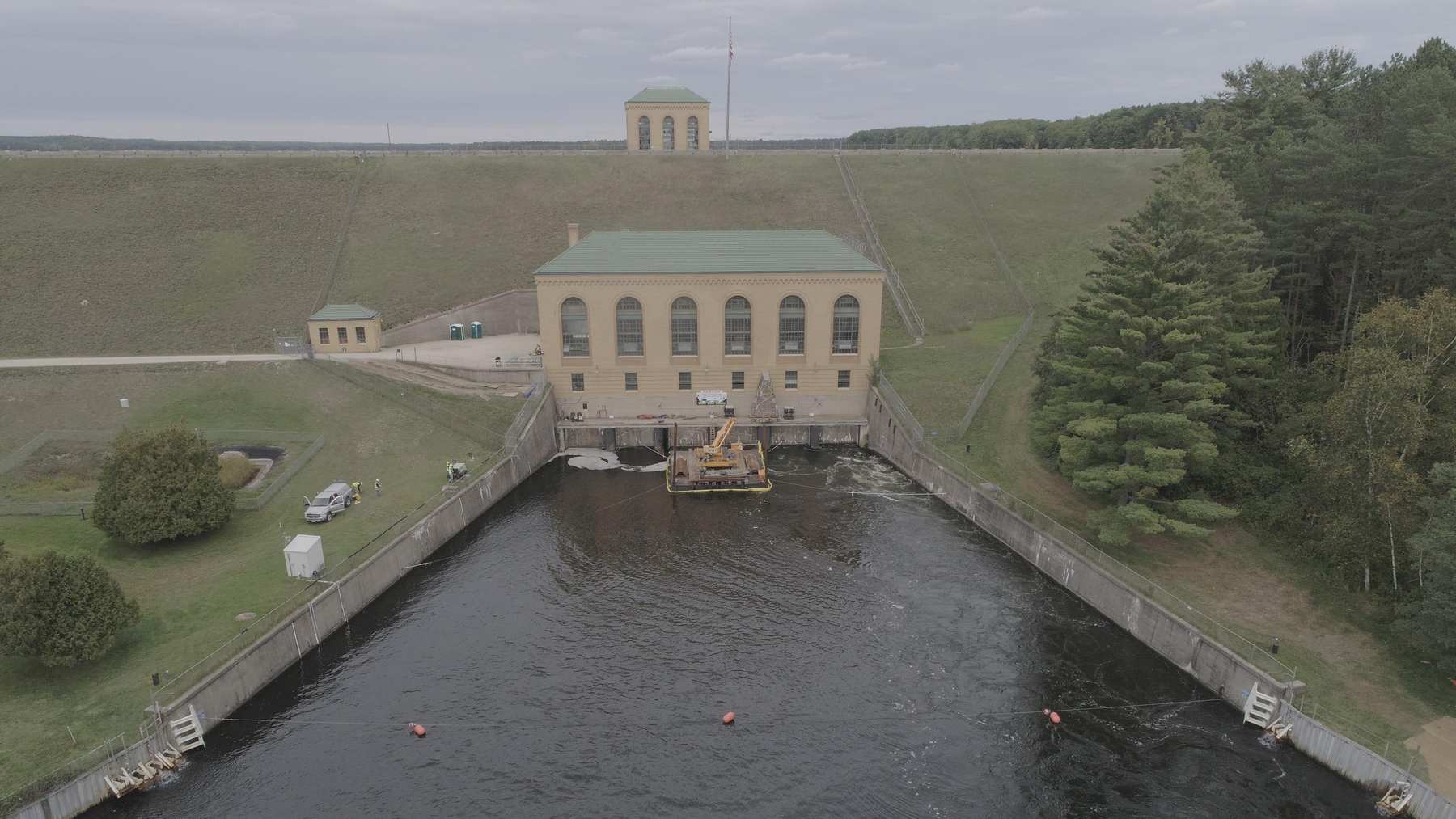
A “poor” on a report card usually means something went sideways during the semester. Hardy Dam, a 95-year-old earthen hydro dam on the Muskegon River in Newaygo County, Michigan, just got one. But the problem behind the grade isn’t new, and the dam’s still generating power.
According to MLive, an inspection report filed with the Federal Energy Regulatory Commission (FERC) on November 4 now lists Hardy in poor condition. It had a better rating before. The inspection took place in June 2025, and Consumers Energy, which owns the dam, says the report covers a period running through that August.
If the name rings a bell, we covered Hardy earlier this month as the biggest of the 13 Michigan hydro dams Consumers wants to sell to a private buyer, Confluence Hydro. I won’t rehash the deal, but you’ll want to know about the new rating before December.
Basically, the dam’s auxiliary spillway is too small. A FERC spokesperson told MLive it can’t pass what engineers call the probable maximum flood, and that the shortfall was identified back in 2014. The fix carries an estimated price tag of about $350 million.
So what’s a spillway, anyway?
A spillway is a dam’s overflow route. When the pond gets too full, water heads down the spillway instead of pouring over the top, which matters a lot for an earthen dam like Hardy, because moving water chews through dirt pretty fast.
The auxiliary spillway is the backup. It sits idle in a normal year and only comes into play when a flood is too big for the main spillway alone.
The probable maximum flood is the worst flood hydrologists think a particular watershed could realistically produce. Picture the heaviest storm that area could plausibly get, dumped on ground that’s already soaked. Federal standards say a high-hazard hydro dam has to be able to pass that flood. Hardy, for now, can’t.
Hardy also holds back more water than you’d guess from the word “pond.” It covers 3,971 acres at full pool and backs up about 25 miles of river, and the water drops a little over 100 feet from the pond surface to the river below the dam, according to a Michigan DNR fisheries report. MLive calls it the largest river hydro dam in the state.
High hazard is about who lives downstream
Hardy’s also classified as “high hazard,” and I’ll admit that label sounds a lot scarier than it is. FERC sorts dams into low, significant and high hazard purely by the consequences of a failure. A high-hazard dam is one where a failure or mis-operation would probably cost lives. How likely that failure is doesn’t enter into it.
In Hardy’s case, Bridge Michigan reported in March that tens of thousands of people live in the area a failure would flood, which reaches more than 30 miles downstream to Muskegon. So “high hazard” is really a description of what’s below the dam.
Condition is a separate grade, and that’s what just changed. Under the standard definitions used for the National Inventory of Dams, the scale runs satisfactory, fair, poor and unsatisfactory. “Poor” means a safety deficiency has been recognized for conditions that could realistically occur, and that remedial work is needed. Unsatisfactory, the bottom rung, is for problems that need immediate or emergency action.
I’d love to tell you exactly how far short Hardy’s spillway falls. I can’t. FERC treats detailed engineering and vulnerability information on energy infrastructure as critical energy infrastructure information, or CEII, so the full inspection report isn’t public. MLive’s reporting gives us the rating, the cause and the price of the fix, and that’s about it.
So how does a working dam end up poor?
Here’s where it gets a little counterintuitive. As far as the public record goes, Hardy’s problem is capacity. The dam holds its pond just fine on a normal day, and Consumers has said earlier upgrades mean it could now pass a repeat of the September 1986 flood without even using the auxiliary spillway. That storm, according to Bridge Michigan, pushed Hardy and Croton Dam downstream close to the edge. Engineers grade a dam against every load it’s supposed to survive, though, and the design flood is one of them. If the spillway can’t move that flood, the dam fails that part of the test whether or not the storm ever shows up.
Luke Trumble, who heads dam safety at Michigan’s environment department, EGLE, told Bridge Michigan in March that it would take a “very, very big flood” to overwhelm Hardy. That’s probably true. It’s also pretty much the exact flood the federal standard asks the dam to handle.
So why hasn’t anyone fixed it since 2014?
Consumers had construction penciled in for 2023 and then 2025, according to Bridge Michigan, and in March it asked FERC to push the start back to the end of 2028. The company argued that regulators need time to review the sale and that the new owner should line up the construction. Meanwhile, Consumers says it’s managing the risk with an extended winter drawdown and by running more water through the powerhouse, MLive reports. Bridge reported in March that the winter drawdown drops the pond by 12 feet between November and late May. That’s an awfully long runway between finding a problem and fixing it, frankly, even for a $350 million project.
The pond’s summer now hinges on a December vote
If you’ve got a cabin or a dock on Hardy Pond, you’ll want two dates on your calendar. The Michigan Public Service Commission has given the parties until 5 p.m. on December 9 to file a settlement. If nothing’s filed, the commission will issue its final order on December 17. The commission has also said it’ll only grant another extension if a majority of the parties ask for one jointly.
Most of the fight is about cost. Confluence would sell the dams’ power back to Consumers for 30 years at above-market prices, which critics, including Attorney General Dana Nessel’s office, say leaves customers paying too much, while Consumers argues the sale is still cheaper than keeping or decommissioning the dams.
And if the commission says no? According to MLive, Consumers says it won’t refill Hardy’s pond in the spring and will drop the spillway project. In testimony filed in March, the company also said it plans to decommission all 13 dams if the sale isn’t approved as proposed, according to Bridge Michigan.
It’s a bit of an awkward spot for a dam that’s just been rated poor. The project that would fix Hardy’s spillway is tied to the sale, and Consumers’ fallback, at least on paper, is to walk away from that project altogether.
We should know more soon. Unless the parties settle by December 9 or jointly ask for more time, the Michigan Public Service Commission is scheduled to issue its final order on the sale, case U-21985, on December 17.
 A four-reactor nuclear plant designed to refuel while running on uranium pebbles the size of billiard balls got the first construction permit for its kind of reactor in nearly 60 years, clearing a Texas chemical site to build 320 megawatts right next to the factories it will heatEnergy · 3 hours ago
 A 30-megawatt hydrogen plant fed by a wind farm in eastern Germany has made its first batch, and instead of trucks it will send the output through a 15-mile pipeline that used to carry natural gas toward a refinery, where a buyer plans to take about 3,300 tons of itEnergy · 1 day ago
 A 7.9-foot concrete pedestal cast in a factory and topped with a 3-foot-square rubber pad is how a small reactor plans to ride out earthquakes, and depending on the ground, one plant could stand on as many as 594 of them set between its foundation and the reactor buildingEnergy · 1 day ago