
Sea drones are having their moment. Ukraine has spent the past two years sinking Russian warships and chasing the rest out of the western Black Sea with cheap uncrewed boats, and just about every navy on earth is now scrambling to field its own. The thing nearly all of those attack boats share is that they stay on top of the water. They race across the surface and slam into a hull at the waterline, because that is the part of a ship a fast little boat can reach. At Eurosatory, the land-and-air defense show running outside Paris from June 15 to 19, a Spanish company showed off one that does the opposite. It skims the surface on a hydrofoil, and then it dives.
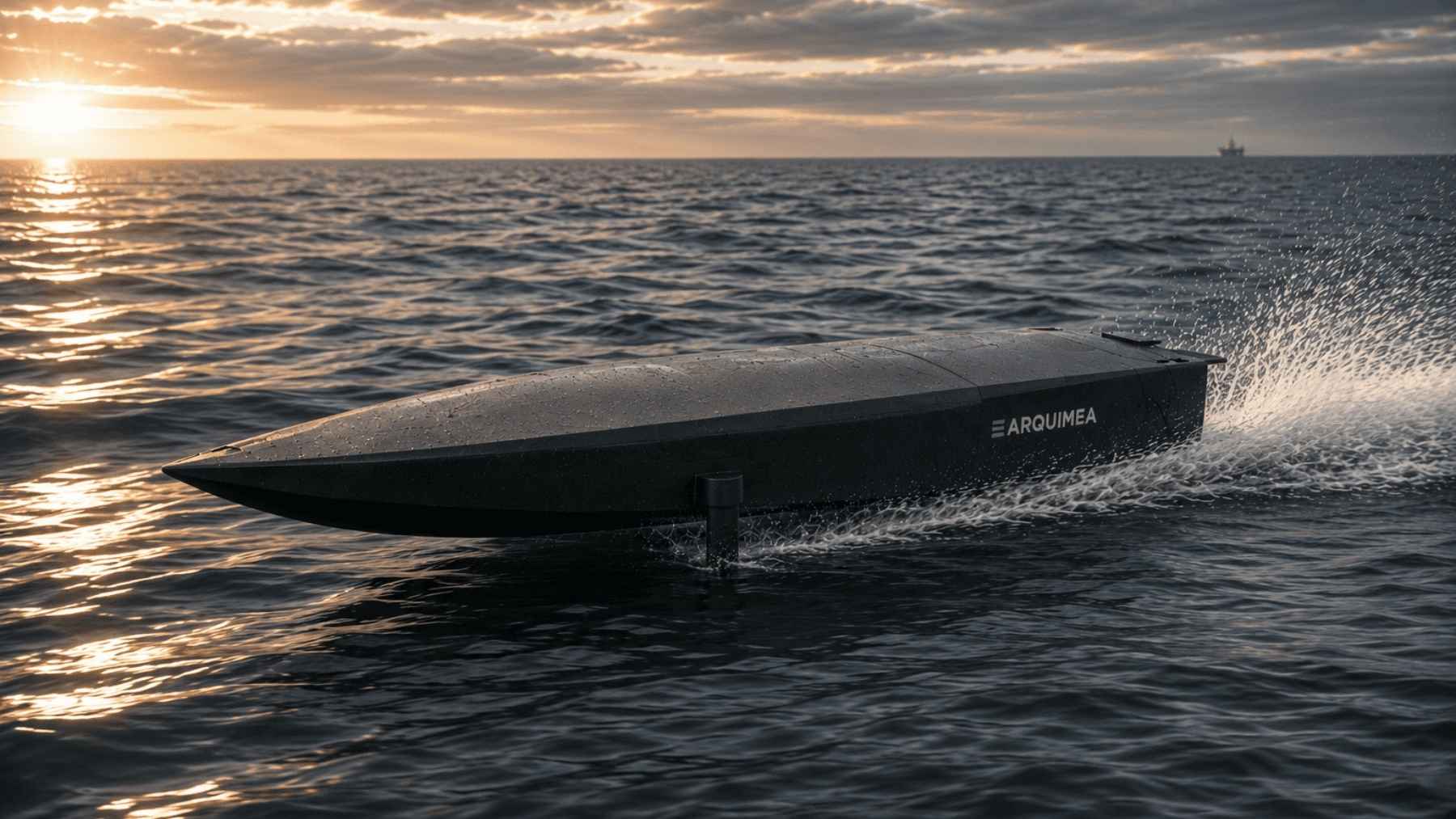
The boat is called Kronos Mini, and it comes from Arquimea, a Spanish defense and technology firm that has spent the last few years building a reputation in loitering munitions, the category most people know as kamikaze drones. Per the company’s reveal, reported by trade outlet EDR Magazine, Kronos Mini is a two-meter, electrically powered surface craft small enough to be fired from a standard 533 mm torpedo tube. On the surface it planes along on a hydrofoil at up to 20 knots. When the moment comes, it tips under the waves and finishes the job from below, always striking beneath the waterline.
A two-meter boat that fits down a torpedo tube
Strip away the framing and Kronos Mini is a small, odd-looking machine with a very specific job. Arquimea puts its top surface speed at 20 knots, its endurance at 65 nautical miles, and its payload at 30 kilograms, all packed into a hull two meters long, figures the Spanish defense outlet Infodefensa laid out alongside the company. The hydrofoil is the trick that makes the rest work. It lifts the body clear of the water to cut drag at speed on the surface, and it doubles as the control surface that lets the craft drop below the waves for a short underwater run when it needs to close the last stretch unseen.
It is not built to be one thing. The company lists maritime surveillance and reconnaissance, protection of critical infrastructure like ports and pipelines, communications relay, and intelligence work alongside the attack role, and says the boat can run several of those jobs at once, either alone or as part of a coordinated swarm. The electric drive keeps it quiet, which matters far more for a craft that wants to get close before anyone notices it than it does for almost anything with wheels.
It also is not, yet, a finished weapon in anyone’s fleet. Every number above is Arquimea’s own, presented at a trade show, and the company frames the short underwater dash as a capability that is unusual among surface drones rather than something a navy has run through its paces in the open. Kronos Mini is the newest entry in a family the company calls Kronos, which climbs from this Mini up through Light and Heavy versions, the heaviest of which is meant to haul other munitions rather than be one.
Below the waterline is the whole point
The dive is the part worth slowing down on, because it is the difference between hurting a ship and sinking one. A hit above the waterline tears up whatever is on deck, the radars, the launchers, the people, and that can take a vessel out of a fight. But water does not pour in through a hole that sits above the water. Put the same charge below the waterline and the sea does the rest, flooding compartments until the ship cannot stay up. It is the reason torpedoes have aimed low for more than a century, and it is why a surface drone that can only reach the waterline is doing the lesser version of the job.
That is the gap Kronos Mini is built to close. A surface boat that rams at the waterline does damage; one that can duck under and strike beneath it is aiming at the part of the hull that puts a ship on the seabed. The catch, and it is a real one, is what happens to the drone. In the attack role this is a loitering munition, which is the polite term for a machine that is spent on the target. It can loiter, scout, and relay on the way in, but the strike itself is one-way. Set up as a sensor, it comes home. Set up as the warhead, it does not.
The underwater half came from a company Arquimea bought last year
Parked next to Kronos Mini on the Spanish stand was a second machine that explains a lot about how Arquimea got here. S-WISE is a hybrid that works as both an uncrewed underwater vehicle and a surface one inside the same mission, built for anti-ship work and for hunting mines when it is fitted with the right sonar. Arquimea’s figures give it up to 24 hours of endurance, a top speed above 9 knots, a reach of up to 85 nautical miles, and onboard automatic target recognition. The detail that ties the two together is the brain. S-WISE runs the same onboard computer as Kronos Mini, the one doing the AI work and picking out targets, so the surface boat and the submarine think with the same hardware.
Arquimea did not build that underwater half from scratch. It bought Perseo Techworks, a Spanish developer of autonomous underwater vehicles, in September 2025, and S-WISE was Perseo’s flagship. “The acquisition of Perseo Techworks represents a key milestone in Arquimea’s growth strategy to become the European leader in multi-domain loitering munitions for land, sea, air and space,” said Manuel Martín Flórez, who runs Arquimea’s defense business. Perseo’s own contribution to the design is clever in a way that is easy to miss: the vehicle is 3D-printed from acoustically transparent plastic, which makes it quieter to sonar and means a damaged one can be reprinted and patched up far from a shipyard.
Spain has quietly been stacking up underwater hardware
None of this appeared out of nowhere. The program S-WISE grew out of, originally called Wise, started around 2021 as a three-way effort: Perseo designed the vehicle, the Cartagena firm SAES supplied the underwater acoustics and sensors, and the state shipbuilder Navantia acted as integrator and coordinator. The control system is built to plug into NAIAD, the command-and-control setup Navantia uses for uncrewed vehicles, and that is the same Navantia that builds Spain’s S-80 submarine, the crewed boat that brews its own hydrogen from bioethanol while submerged. Spain has been doing a surprising amount of work under the water lately, and a lot of it runs through the same few companies.
It is also not the only country pointing drones downward. Turkey just unveiled a 19.8-ton drone submarine designed to surface, loose a swarm of FPV drones, and slip back under, all of it shipping inside a standard container. The U.S. Navy is working on underwater drones meant to swim point for the mini-subs that carry SEALs. The pull across all of it is the same one driving Kronos Mini: the surface is crowded and easy to watch, and the water underneath it still hides things.
What is sitting on the Villepinte stand today is a two-meter boat with a spec sheet and a swarm pitch, not a weapon any navy has admitted to buying. The numbers are the company’s, the underwater sibling is a year-old acquisition still proving itself, and a loitering munition only earns its keep the one time it gets used. But the idea behind it is hard to put down. The cheap surface drone that rewrote the Black Sea did its damage at the waterline because that was as deep as it could reach. Build one that can drop under and hit where torpedoes hit, and you have taken the most disruptive naval weapon of the decade and aimed it at the part of the ship that actually goes down.
 @georgekafantari ROOKIE4 months ago