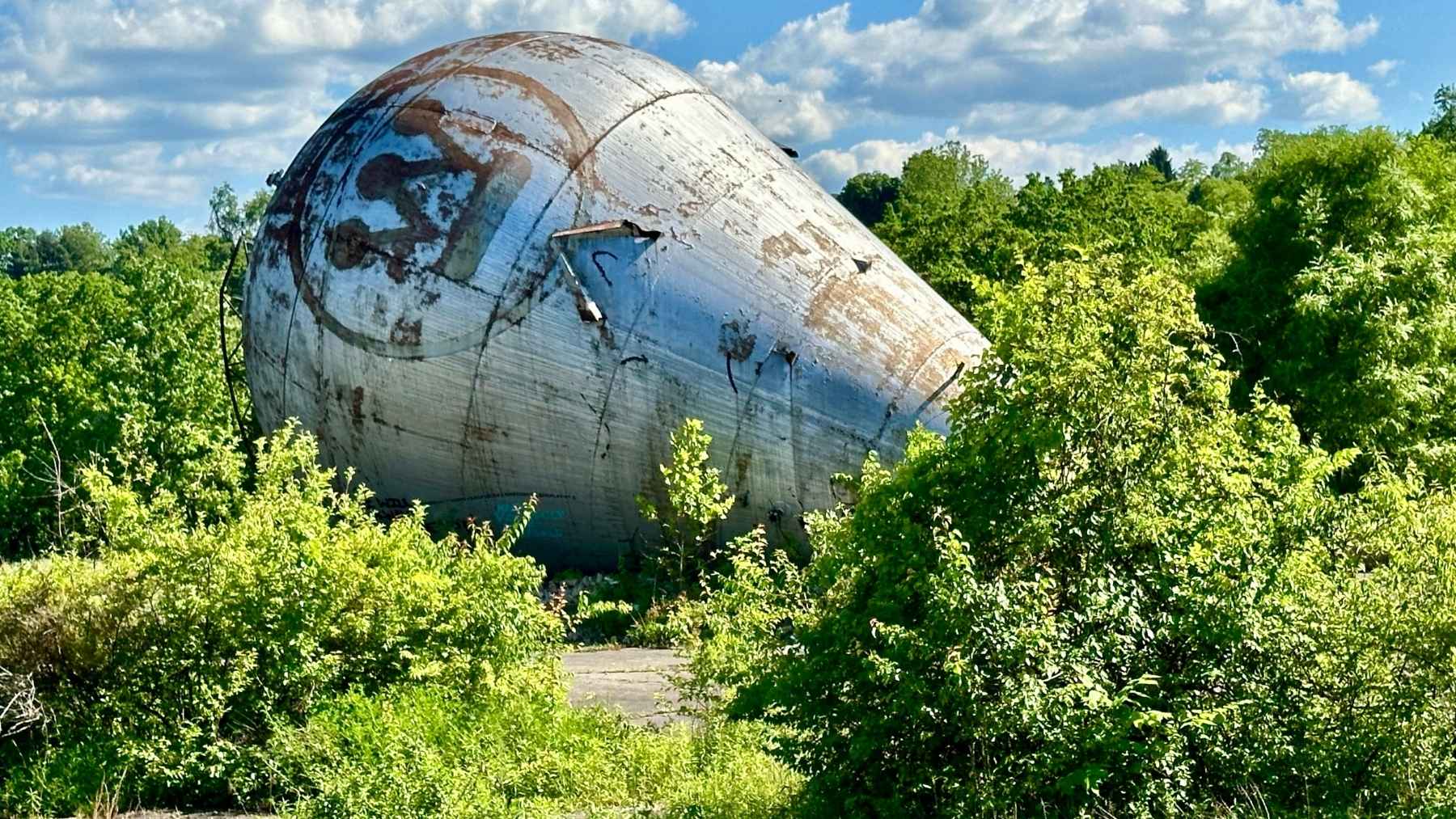

Most companies mark their history with a bronze plaque in the lobby, or maybe the founder’s desk behind a rope. Westinghouse is going a fair bit bigger. The company is taking apart a 65-foot steel pear that’s spent more than a decade lying on its side in a weedy lot outside Pittsburgh, so the pieces can be hauled across the metro area and stood back up at its headquarters.
That pear is the Westinghouse Atom Smasher, and even if you’ve never heard of it, you’ve felt its consequences. It’s the world’s first industrial Van de Graaff generator, the machine that helped turn nuclear physics from a university curiosity into a business, and it’s been rusting behind a chain-link fence in Forest Hills, Pennsylvania, since a demolition crew tipped it off its brick base in January 2015. CBS Pittsburgh reported in late July that Westinghouse plans to disassemble it, restore it and rebuild it at the company’s nuclear headquarters in Cranberry Township.
So how does a machine that important spend 11 years on its side in a vacant lot?
That’s most of this story, really. But first, the machine.
So what exactly is an atom smasher?
“Atom smasher” is what people in the 1930s called a particle accelerator, and frankly it’s the better name. This one is a Van de Graaff generator, the same basic device your high school physics teacher used to make some volunteer’s hair stand up, scaled to the height of a five-story building. Belts running at high speed carried electric charge up to an electrode near the top, where it piled up to 5 million volts. That charge then flung particles down a tube and into targets, hard enough to crack their atomic nuclei open. And the famous pear-shaped shell isn’t the machine itself, by the way. It’s a pressure vessel that kept everything inside from arcing over.
Westinghouse put it up at its Forest Hills research laboratory in 1937, and here’s the detail I keep coming back to: the company committed the money in 1936, three years before anyone had discovered nuclear fission. No one knew there was going to be a nuclear industry. Westinghouse bet there would be, and in 1940 researchers working on this machine discovered the photofission of uranium, a result IEEE later recognized with an Electrical Engineering Milestone. In short, they showed you can split a uranium nucleus by hitting it with a gamma ray, which is basically light carrying an enormous amount of energy, instead of hitting it with another particle.
The bet paid off about as well as any corporate bet ever has. Westinghouse went on to build the reactor for the Nautilus, the first nuclear-powered submarine, and Shippingport, the first full-scale commercial nuclear power plant in the US. The atom smasher itself ran until 1958, when newer machines made it obsolete, and then stood over the neighborhood for decades as a landmark.
Then someone knocked it over
The research lab closed, and in 2013 the property, roughly 11 acres, was sold to Gary Silversmith, a Washington, D.C. developer with apartment plans. In January 2015, Forest Hills residents found the atom smasher off the brick base it had stood on for nearly 80 years, lying on its side in the dirt. Silversmith said at the time that the building underneath was too far gone to save, and that he’d put the bulb on a new concrete base and repaint it.
That didn’t happen. What happened instead was 11 years of graffiti, rubble and weeds, with one of the most important artifacts of the early Atomic Age sitting there like a beached submarine. The borough drew up plans to move it down the street next to the borough building, but the cost came in around $250,000 and the idea died. Forest Hills Mayor Patricia DeMarco told KDKA she tried to get Westinghouse to fund a move back then, and the company wasn’t interested. She also said she understands the property is now up for sale.
America is pretty good at leaving its early nuclear hardware in strange places, to be fair. There’s a 240-megawatt reactor that’s been sitting under a watered grass mound in Nebraska since 1969, and Germany turned a finished breeder reactor that never loaded fuel into an amusement park. The atom smasher was in that club right up until this summer.
Cranberry Township found out from the news
The work started in late July, when crews from MBM Construction began putting scaffolding up around the structure, according to TribLive. The plan, per the construction team, is to reinforce the bulb from the inside, take it apart from the top down, then lift and rotate what’s left so it can come off in sections. Silversmith put it plainly: “Westinghouse is carefully disassembling it and rebuilding it at their corporate HQ.”
Here’s my favorite wrinkle. On August 3, Cranberry Township manager Dan Santoro told the Butler Eagle that Westinghouse “has not reached out to Cranberry Township to talk with us” about the atom smasher, and that the company would need some type of approval to put the structure on its campus. So in early August, the destination of a 65-foot piece of nuclear history was learning about its new tenant from the newspaper. A Westinghouse spokesman wouldn’t say when or how the move would happen, only that plans would be shared later.
There’s plenty I can’t tell you yet. KDKA asked Westinghouse whether the rebuilt atom smasher will be open to public view at the Cranberry campus and got no answer, and I can’t find any on-the-record reporting past early August on how far along the teardown actually is.
KDKA Radio did put a date on it: the station reported on July 30 that the whole project is expected to be finished by mid-to-late October, with the pear standing upright again at Westinghouse’s Cranberry Township headquarters. So if you want to see it lying where it fell in 2015, I wouldn’t wait around.