
Every few months somebody on the internet rediscovers the story of a cheap diesel submarine that “sank” a US aircraft carrier during an exercise. There are a handful of those stories floating around, and the Dutch one is arguably the best of the bunch, because the guy who pulled it off decided to sail underneath the carrier afterward, more or less for fun.
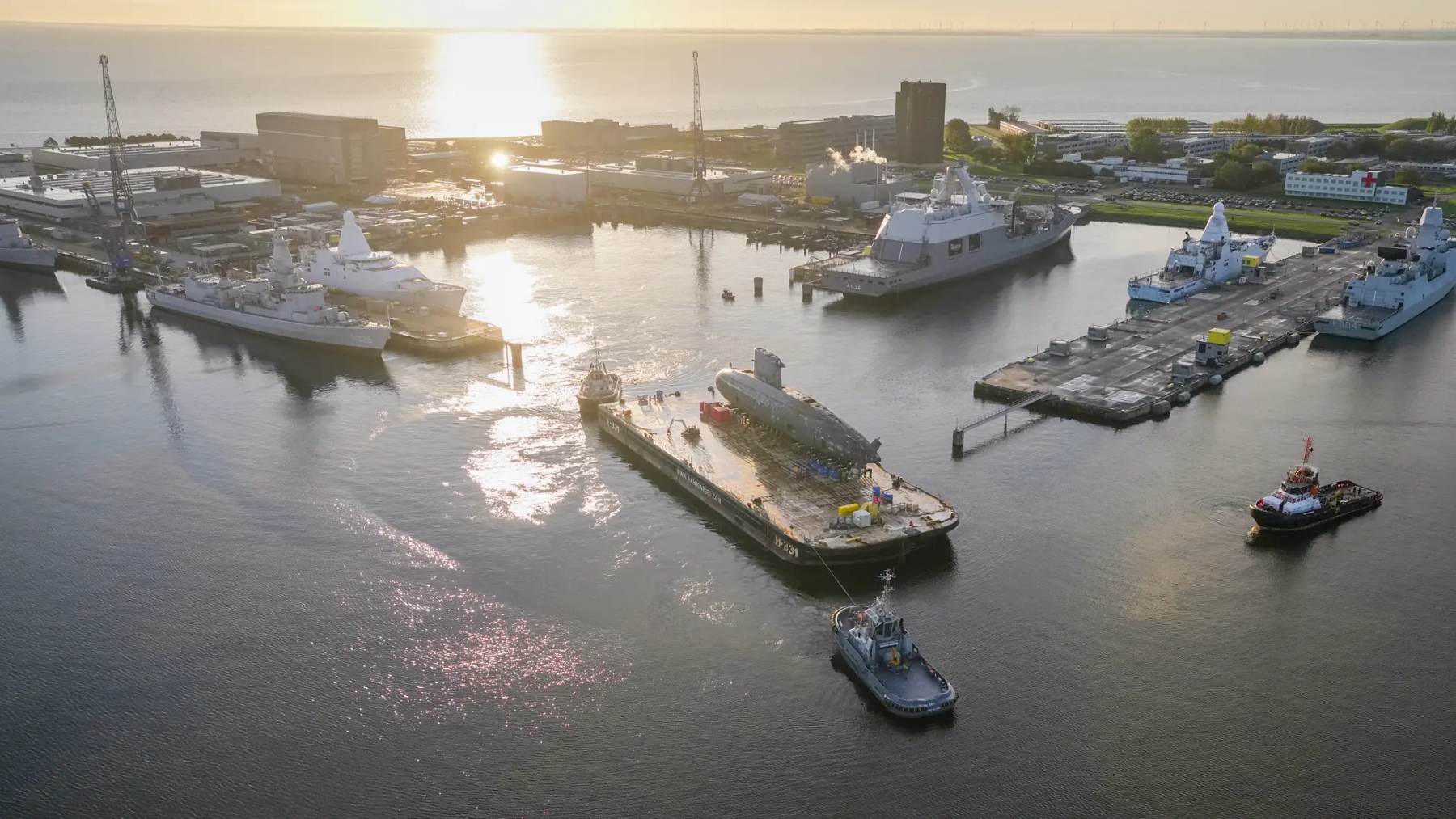
That boat is the Walrus. And on October 12 she left her home port of Den Helder for the last time, sitting on a floating pontoon behind tugboats, headed for a scrapyard in Amsterdam.
She didn’t go under her own power, because she can’t anymore. The Dutch navy has spent the last few years pulling anything useful out of her to keep her three sister boats running, and the Ministry of Defence’s own announcement describes her as fully used up. So what’s getting cut apart in Amsterdam is basically a 223-foot steel tube with the good stuff already gone.
So what is the Walrus, exactly?
She’s a diesel-electric attack submarine, the first of four the Dutch built in Rotterdam through the 1980s. The Ministry’s spec sheet puts her at 68 meters long, which is 223 feet, with a 28-foot beam and a draft of just under 25 feet. She displaces 2,450 tons on the surface and 2,800 tons submerged, carries a crew of around 50, can dive past 980 feet and runs about 20 knots underwater on batteries. Four torpedo tubes up front fire Mk 48 heavyweight torpedoes, which is also what American submarines shoot.
If you’re wondering why a boat laid down in 1979 and launched in 1985 didn’t enter service until 1992, the answer is a fire. An electrical fire broke out on board in August 1986, about ten months after launch, and it did enough damage that her sister Zeeleeuw got finished first and commissioned in 1990. The Walrus didn’t get her flag until March 25, 1992.
From there she worked. By the Ministry’s own count at her decommissioning ceremony, she spent 3,000 days at sea over 31 years and was sent on 14 formal deployments, including an intelligence-gathering run in the Persian Gulf in 2002 and a drug-interdiction stint in the Caribbean in 2007. The Dutch navy doesn’t say much about what its submarines actually do out there, which is kind of the whole point of owning a submarine.
The day she “sank” the Theodore Roosevelt
Now for the reason this boat gets written up in American outlets. In February 1999 the Walrus was sent to a big US exercise called JTFEX 99-1, which ran from Norfolk, Virginia down to Puerto Rico with something like 24,000 people taking part. The Walrus was cast as the bad guy. Her job was to go after the carrier battle group built around USS Theodore Roosevelt.
Most of what we know about what happened next comes from Jaime Karremann, who runs the Dutch naval site Marineschepen.nl. He interviewed the boat’s commander, Jan Hubert Hulsker, and checked the story against the Walrus’s own logbook. Hulsker was a 35-year-old lieutenant commander at the time. He says the man who handed him the exercise paperwork told him flat out that he was going to lose, because the carrier always wins.
It didn’t go that way. Over the first two days the Walrus put simulated torpedoes into four Arleigh Burke-class destroyers. Then her electronic warfare mast, which is basically an antenna that listens for other people’s radar, picked up a cluster of signals from one direction. Hulsker went deep, ran an intercept course, and when he came back up to periscope depth the carrier was sitting dead ahead at 4,000 yards, steaming toward him, with F-14s taking off. He fired a simulated salvo and then let off a green smoke grenade, which is the agreed signal during an exercise that a submarine has just scored a hit.
Nothing happened, because apparently nobody saw it.
So he crept closer and fired a second grenade at about 1,500 yards. That one got noticed. “All hell broke loose,” Hulsker told Karremann, with every sonar in the group pinging and helicopters launching. And rather than run, he took the boat straight under the carrier. The standard depth for passing beneath a Nimitz-class hull is 30 meters, roughly 100 feet, and Hulsker went a bit deeper than that because, as he put it, the thing is really big. The Walrus shook hard enough that off-watch sailors climbed out of their bunks to see what was going on.
On the way out, anything that switched on its sonar got a torpedo. The logbook lists eight ships: the carrier, four destroyers, a Canadian frigate, a German frigate and an Oliver Hazard Perry-class frigate, so seven escorts plus the Roosevelt. You’ll see other outlets say eight escorts and 1,500 meters. Karremann built his version on the logbook and the interview, and his distances are in yards, so I’m going with his numbers.
Did she get away clean? Hulsker, to his credit, says he can’t tell. The escorts reported simulated attacks on the Walrus afterward, and nobody can say whether those would’ve landed. What he does have is a letter from Vice Admiral William Fallon, then in charge of the US Second Fleet, thanking the boat for its impressive attack on the battle group, dated March 1, 1999. The crew painted a walrus with a carrier in its mouth on the sail. The Canadian navigation officer who was told to photograph the Roosevelt through the periscope turned out to have no film in his camera, and from the sound of it the whole boat held that against him for years.
Why strip her for parts instead of selling her?
Here’s where the pontoon comes in. In April 2022 the Netherlands decided it couldn’t afford to modernize all four boats, so two would retire early and donate their organs to keep the other two sailing until replacements arrive. The Walrus was already sitting on dry land by then. She was formally decommissioned on October 12, 2023, three years to the day before the tugs took her away, and she lost the right to the “Zr.Ms.” prefix, the Dutch equivalent of “USS,” at the same time.
Since then every usable installation and component has come out of her and gone into Zeeleeuw, Dolfijn and Bruinvis. That’s pretty much how you keep a 1980s submarine class running when the companies that built the parts moved on decades ago. Britain is doing something similar on a much bigger scale with the nuclear boat it’s taking fully apart in a Scottish dry dock, and recovering steel from it for new submarines.
What’s left of the Walrus is going to a specialized transport-and-scrapping company in Amsterdam, working under the supervision of the Dutch military’s materiel command. The Defensiekrant, the Ministry’s own paper, says the job will take two to three months and go in sections, with part of the hull melted down. The boat was never offered to the highest bidder, and the Ministry says that’s a security call. Same reason nothing from her is headed to a museum yet: the navy won’t release any pieces until the whole class is out of service, so if you were hoping to see her sail or her periscope on display, you’ll be waiting a while. She’s the first Dutch submarine of her generation to go to the breakers.
The move itself is frankly the kind of thing I’d pay to watch. The boat was rolled onto the pontoon on a train of small self-propelled transporters, the remote-controlled wheeled platforms you see shuffling bridge spans around, and the whole trip from Den Helder to Amsterdam took less than a day. Army Recognition says she went in through the North Sea Canal behind three tugboats, one of them the Eems Warrior. The Ministry’s photos show two tugs on the line and its statement just says “tugboats,” so take the count as approximate. Britain’s only ice patrol ship came home the same way a week earlier, and that one still has a navy hoping to fix her.
What replaces her?
Zeeleeuw is next for the scrapyard, and the Ministry hasn’t put a date on that. Army Recognition expects it later this year. After that the Dutch are down to two submarines, Dolfijn and Bruinvis, commissioned in 1993 and 1994, until the first of four Orka-class boats from France’s Naval Group shows up in Den Helder. The Ministry’s current date for that is 2033, with the fourth boat in 2037, and it plans to keep the old class sailing until 2035. If you do the math, Dolfijn will be 40 years old when her replacement arrives, which is nine years older than the Walrus was when the Dutch decided she was done.
Captain Wiebe van Beek, who runs the Dutch submarine service, compared the Walrus to a 35-year-old car in the Ministry’s video program. “It’s not as modern as you’d want anymore,” he said. I’d say that’s about right, with the small caveat that most 35-year-old cars never drove under an aircraft carrier.
The Ministry of Defence posted the tow announcement at 11:08 on the morning of October 12, 2026, and its Defensiekrant confirmed four days later that the Walrus had reached the Amsterdam yard in under a day, with two to three months of cutting ahead of her.
Image Credit: defensie.nl