
Solar efficiency records turn up every few months, and almost none of them change anything you can buy. The cell that set the newest one is usually smaller than a postage stamp, measured under a lamp, and a long way from anything a utility would bolt to a steel torque tube. LONGi certified 35.5% in July on a device it never described in any detail.
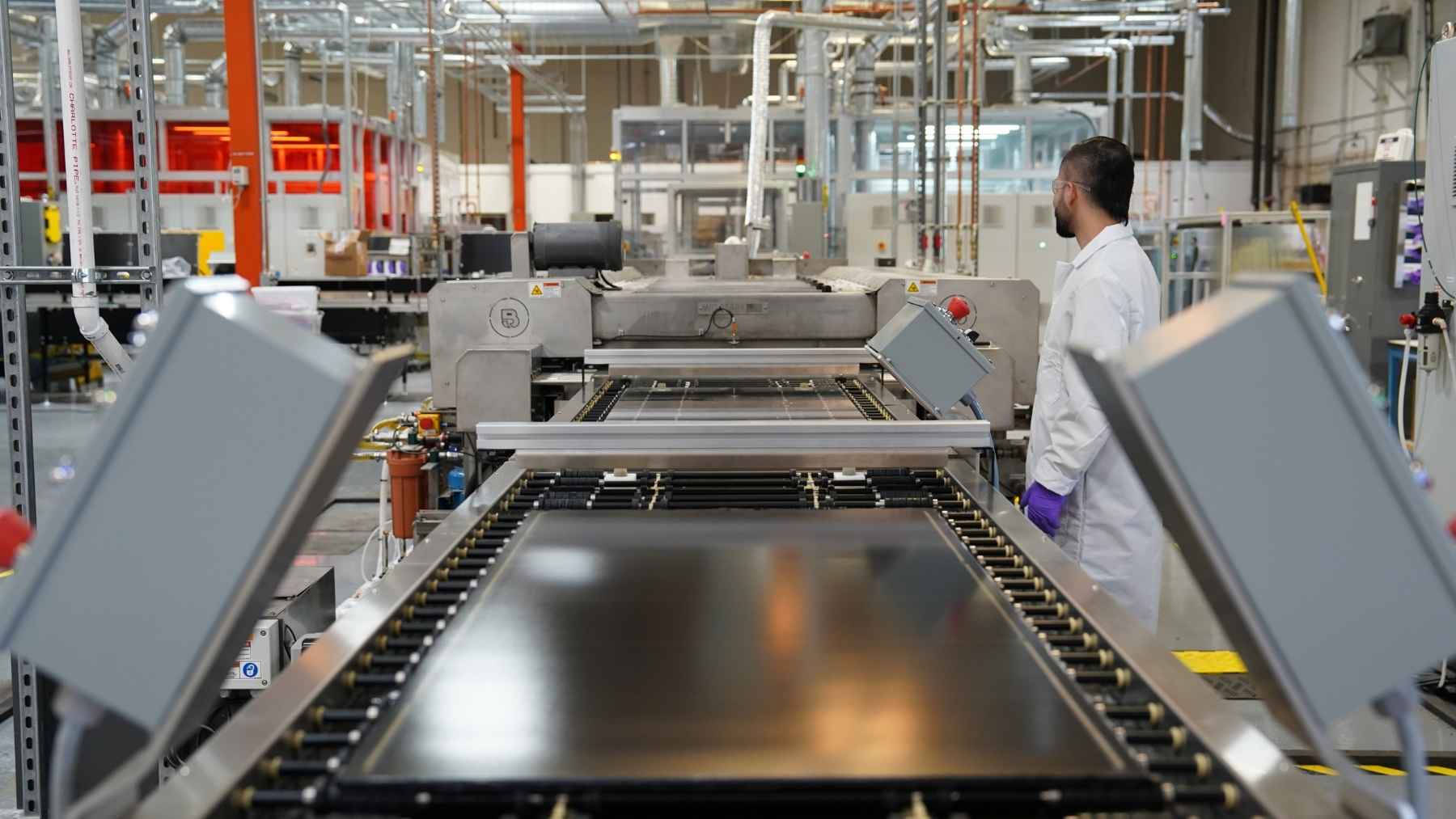
Then there is a 65,000-square-foot building in Fremont, California, where a company called Tandem PV runs a line that turns out perovskite-silicon panels roughly 60 times the size of the coupons its own researchers used to make. The line is rated at about 40 megawatts a year. It opened on April 20.
Three things have happened since. Tandem PV shipped what its CEO calls its first production-quality panel in late July. On August 3 it bought the Oregon company that makes one of the coatings inside that panel. And it says it has signed letters of intent worth close to a billion dollars for a panel that has not passed certification yet.
The panel coming off the line is 60 times the lab coupon
Fremont is what the industry calls a commercial demonstration factory, which means it exists to prove a process rather than to fill orders. According to Tandem PV’s own announcement, the line holds roughly 40 megawatts of annual nameplate capacity, and the panels coming off it are about 60 times larger than the company’s research-scale devices.
You can check that arithmetic. The demonstration module the company showed in June measured about four inches on a side, 100 square centimeters. Multiply by 60 and you land near six and a half square feet, which matches what pv magazine USA reports the company is building now, about the size of a First Solar Series 4 module. The high-volume product planned for 2028 moves to standard industry sizes.
Sixty times is a bigger jump than it sounds. Everything that goes wrong with a thin coating goes wrong worse when the coating gets wider, because pinholes, edge seals and uneven layers all scale with area. Wharton told pv magazine USA the remaining engineering work is exactly that translation from lab process to full-size panel.
Five grams of liquid on an 80-pound panel
The design decision underneath all of this is where the perovskite goes. Tandem PV does not deposit it onto the silicon cell. It puts the layer on the top sheet of glass and stacks that glass over a finished silicon module, wired as a four-terminal device.
Which means the silicon underneath can be anybody’s. The 30.4% module used an interdigitated back contact cell from Maxeon, and the company says the same glass has been tested over PERC, TOPCon and heterojunction cells. A buyer picks the silicon, sources it domestically if it wants the tax credits, and Tandem PV treats that cell as a pass-through cost.
The quantities involved are small enough to be funny. Wharton told pv magazine USA that the perovskite added to a panel weighing around 80 pounds amounts to about five grams of liquid, roughly a blueberry’s worth, and that the extra power is worth more than the extra material costs.
There is a catch in the arithmetic, though. That Maxeon cell runs at about 25% on its own, and under the tandem glass it contributes 8.7%, because the perovskite takes the wavelengths first. The layer on top does 21.7%. Add them and you get 30.4%, which is a real gain over the silicon alone, but it is not 25 plus anything.
Coating quality is what decides whether that stack holds up, which explains the August 3 purchase of nexTC, a Corvallis, Oregon outfit spun out of an NSF-funded center at Oregon State in 2018. It makes solution-based transparent oxide coatings, the ultrathin layers that move charge around while still letting light through to the silicon. Founder Cory Perkins came with the deal. Terms were not disclosed.
Nobody outside the company has certified the headline number
Tandem PV has published two efficiency figures this year and both are its own. April’s factory announcement carried 29.7% from internal testing. June’s mini-module came in at 30.4%, also internal, and the company said at the time it was going into third-party certification. No certified result has appeared since.
That distinction is the whole ballgame in this industry. LONGi’s 35.5% was signed off by the European Solar Test Installation. A Chinese Academy of Sciences group had a 1 cm² tandem cell certified at 32.89% in May. Those are laboratory devices, and Tandem PV’s number sits on something it can actually build, but an internal number is still a number nobody has audited.
The gap between a lab reading and a working panel is not small either. A semi-transparent perovskite cell whose 22% figure went round the world had set that number on a smaller device under a lamp. Wharton’s own estimate for a full-size module built on the 30.4% design is 28%.
Even 28% would be a meaningful jump. Most commercial panels on the market run between 22% and 24%, and the best silicon modules you can buy from Aiko or LONGi land around 25%. California is helping pay to find out: the state’s Energy Commission handed Tandem PV a $4 million grant in July 2025 specifically to fund independent testing and validation.
One more detail from that April launch. The endorsement quote in the announcement came from former energy secretary Jennifer Granholm, who joined Tandem PV’s board of directors six weeks later.
Perovskite’s whole problem has always been that it dies young
Perovskite degrades. That has been the objection since the material first showed up in efficiency charts, and no amount of laboratory efficiency has ever answered it.
Tandem PV’s answer so far is accelerated testing. The company reports less than 1% average annual power loss on its latest panels, about ten times better than its own results a year earlier, and around 1% a year under UV-accelerated conditions at 149°F. It plans to sell a 30-year warranty at 1% degradation or less, and Wharton says the newest glass-glass modules have shown no measurable loss after a year outdoors.
Silicon’s field average, for comparison, is about 0.59% a year. So the target is close to the incumbent, not ahead of it, on the one metric where the incumbent has four decades of receipts.
Accelerated testing is also not the qualification gauntlet. Getting a panel certified means weeks inside a damp heat chamber and hundreds of round trips down to minus 40, which is what a Qcells perovskite-silicon panel went through before anyone would talk about durability.
The real answer comes from dirt. Tandem PV plans paid pilot deployments with independent power producers later this year, and Wharton reckons bankability needs roughly six to 12 months of field data after that. Which puts the first outdoor verdict somewhere in late 2027.
Forty megawatts in a country rated for 69.9 gigawatts
American module factories now hold 69.9 gigawatts of nameplate capacity, according to SEIA’s supply chain dashboard, against about 3 gigawatts of domestic cell capacity. The United States installed 43.1 gigawatts of solar in 2025. Run the division and Fremont’s entire annual nameplate is roughly eight hours of last year’s installation pace.
That is not a criticism of the plant, it is what a demonstration line is for. But it does put the billion dollars of letters of intent in perspective. At the $0.40 per watt the company describes as its market-driven price, that paperwork works out to around 2.5 gigawatts of panels, or about 62 years of Fremont output.
Letters of intent are also not orders. They are non-binding statements that somebody would like to buy something, subject to the product existing, passing certification and proving itself in a field.
The economics behind the interest are straightforward enough. Tandem PV estimates roughly $100 million of capital per gigawatt of perovskite glass capacity, and because the silicon is a pass-through, buyers can stack wafer, cell and module 45X credits worth $0.14 a watt. Wharton’s pitch to independent power producers is that a manufacturer still shipping 23% panels against a 30% competitor is, in his words, “kind of in trouble”.
None of that gets settled inside a factory. It gets settled when an independent power producer drops a pallet of these in a field and reads the meter a year later.
Until then Fremont is a 65,000-square-foot building making panels 60 times the size of the ones that made the promise, which is further than anyone else in American perovskite has managed. It is not remotely a Louisiana plant taking in a raw sheet of glass and handing back a finished panel four and a half hours later, twelve a minute, all day. That is the distance the next two years have to cover.
 @betweenhedges ROOKIE2 months ago