
The USS The Sullivans isn’t leaving Buffalo this fall after all.
The plan was to tow the World War II destroyer out of the Buffalo River and across Lake Erie to a shipyard in Erie, Pennsylvania, where she’d finally get the new steel she’s needed since she partly sank at her pier four and a half years ago. Instead, she’s spending one more winter tied up beside the cruiser Little Rock and the submarine Croaker. Brian Luallen, the president and CEO of the Buffalo and Erie County Naval & Military Park, told WBEN the move will likely happen next spring.
If you’re keeping score, that’s the third target date. The park first hoped to have her in dry dock last October, then pushed it to this October, and now it’s next spring. Which means The Sullivans has spent more time waiting for a dry dock than she spent fighting World War II.
She’s a Fletcher-class destroyer, 376 feet long and 2,050 tons, according to the Navy’s official history of the ship, and she’s named for the five Sullivan brothers from Waterloo, Iowa, who all died when the cruiser Juneau went down off Guadalcanal. So she’s a pretty big deal to a lot of people, and not just in Buffalo.
So what’s holding her up?
Mud, mostly. And the paperwork for the mud.
The Buffalo River carries sediment downstream, and it settles around anything that sits still long enough, three warships included. Luallen told WIVB nobody’s dredged the water around the ships in roughly 21 years, and that the silt has built up into a “mud cradle” around them. Basically, the river has slowly tucked them in, and somebody has to dig them out before a tugboat can pull them free.
That digging needs a permit from the Army Corps of Engineers, which regulates dredging in navigable waters. Luallen said the park wants to dredge between The Sullivans and the Croaker and next to the Little Rock. He told WGRZ that spring depends on exactly when that permit comes through, and that he’s heard it’s imminent. So until the Corps signs off, spring is a goal, not a date.
Then there’s the asbestos. Pretty much every warship of her era was built with it, and Luallen told WGRZ the park will take it out of the historic areas where it was used before she heads to dry dock. It isn’t exactly news aboard The Sullivans, either. When the National Park Service wrote up her nomination as a National Historic Landmark, her interior was closed to visitors because of asbestos fibers.
That leaves one more Buffalo winter, and anyone who’s spent a January there knows that’s not nothing. Luallen told WIVB the park is always worried about winter, and that divers were going back in the water before it got too cold to do the stopgap work that keeps the ships afloat at the pier. Frankly, I’d rather see a museum wait one more season than rush a hull this tired across a lake with a reputation for getting nasty in a hurry.
The Little Rock has to move first
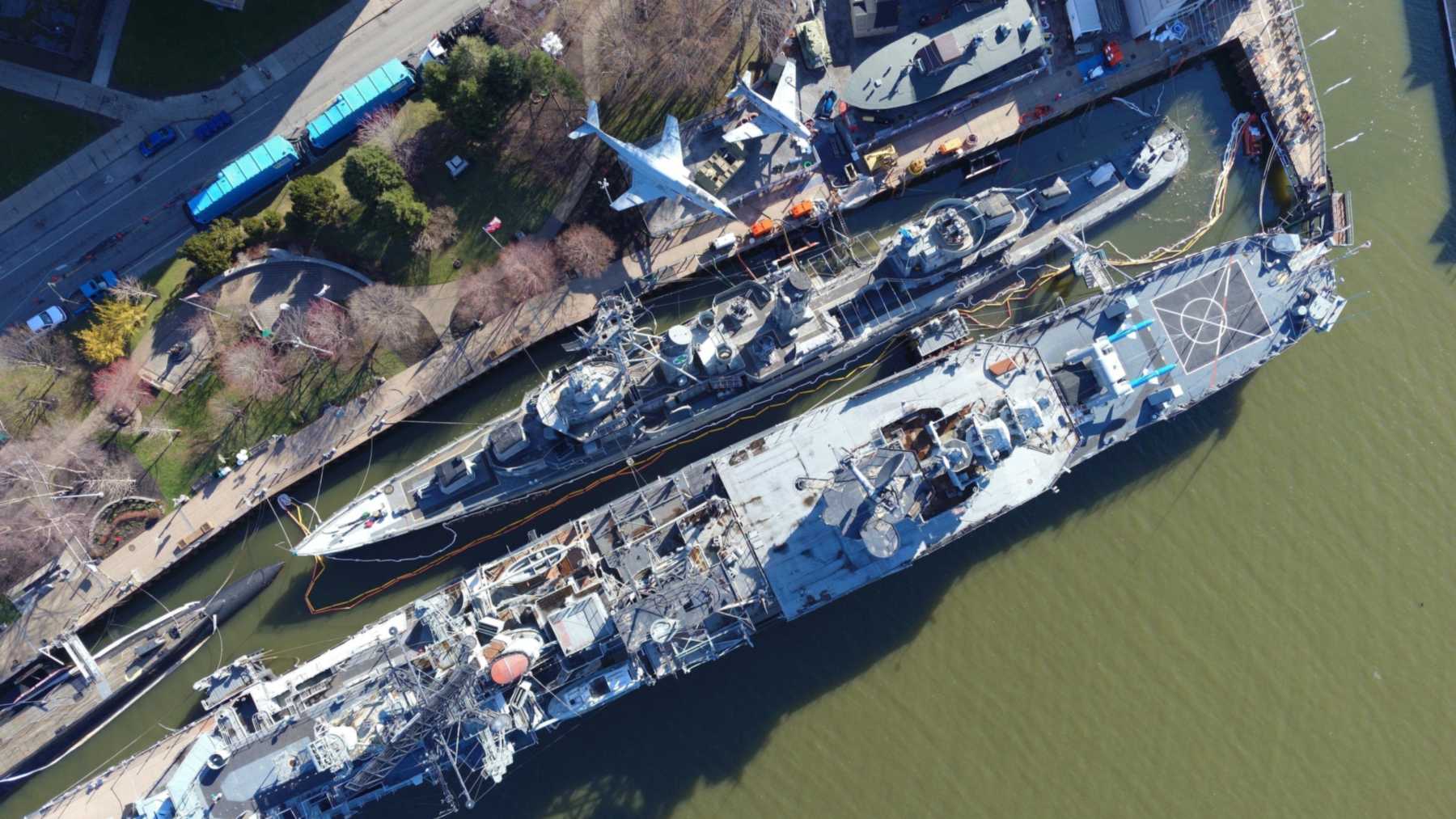
Getting the two smaller ships out is going to take some choreography. The Sullivans and the Croaker sit closer to shore, with the 610-foot Little Rock outside them, so the cruiser has to be pushed out of the way first. Then tugs can tow the destroyer and the sub out, and the Little Rock gets pushed back into her spot so the park can keep running its programs while the other two are gone.
WGRZ has been calling the whole routine the “dance of the ships,” which is a pretty generous description of three hulls that haven’t run their own engines in half a century or more.
The Little Rock needs some prep of her own. When New York’s Department of Environmental Conservation, or DEC, wrapped up the first cleanup phase in April, it said the next phase would start right away on getting the oil out of the cruiser. I couldn’t find an update on whether that work is finished.
Figures: Naval History and Heritage Command, Buffalo and Erie County Naval & Military Park.
Once they’re out, it’s a long, slow pull. Spectrum News reported last year that the park expected the trip to Erie to cover about 90 miles and take roughly 22 hours as a dead-stick tow. That just means the ships get pulled like trailers, with no engines or steering of their own.
It’s also how The Sullivans got to Buffalo in the first place. She and the Little Rock were towed up from the Philadelphia Navy Yard 49 years ago, and the park’s curator, Shane Stephenson, wrote in January that this will be the first long tow for the park’s ships since that trip.
Her hull is the whole problem
When she sank, river water got in through her worn-out hull plating, and she listed hard at her pier with part of her stern deck underwater. The park got her pumped out and almost fully upright in about a month, and she’s been patched and watched ever since.
Patches only go so far, though. Luallen told WBEN the long-term repair “has to involve new steel hulls,” and the park’s January drydocking update spells out what that means for the destroyer. The goal is to cut out the badly deteriorated steel from roughly a foot above the waterline all the way down to her keel and replace it.
That’s a big job, and nobody knows yet exactly how big. According to the same update, the condition of her internal framing and the long structural members running the length of the hull could change the scope and the cost once she’s fully exposed in dry dock. The Croaker is even more of a mystery. The park says she’ll need an inspection with her keel out of the water before anyone can pin down her repair list, and her interior tanks have flammable coatings that’ll make the work trickier.
A dry dock, in case you haven’t seen one up close, is a basin you float a ship into before pumping the water out, so she ends up resting on blocks with her whole hull exposed. It’s the only practical way to replace plating below the waterline, since you can’t really cut away the bottom of a ship you’re also trying to keep afloat.
So why not just do it in Buffalo?
Because the park doesn’t have a dry dock, and building one would cost a fortune. Paul Marzello, who ran the park at the time, told WBEN last year that a dry dock in Buffalo would probably cost somewhere between $60 million and $80 million. That’s roughly three times what the park has raised for the entire project, so a tow to Donjon’s shipyard in Erie is pretty clearly the cheaper way to go.
Luallen’s current estimate for the tow and the dry dock work combined is four to seven months, and it hinges on what the yard finds once the hulls are out of the water. He told WGRZ the park may need to raise more on top of the more than $20 million in local, state and federal money already in place, in case new problems turn up. Given the warning in that January update about her framing, I’d say that’s a pretty safe bet.
The pumping already happened
The progress you could actually see came back in the spring. In March, inspectors found a pinhole in a fuel tank on the Croaker letting petroleum out into the river now and then, plus water getting into The Sullivans. The Coast Guard, the DEC, the city and the park set up a joint command and spent more than a month pumping. By the time the DEC announced the first phase was done on April 24, workers had pulled 124,665 gallons of diesel and oily water out of the Croaker and 100,418 gallons out of The Sullivans.
You may be wondering why a job like that needs a naval architect standing over the pumps. The park’s January update has a pretty neat explanation.
Diesel weighs about 7 pounds a gallon. So if a ballast tank on one side of the Croaker held, say, 14,000 gallons of it, emptying that tank would shift roughly 98,000 pounds off one side of the sub. If the tank were full of water instead, at about 8.34 pounds a gallon, it’d be more than 116,000 pounds. The 14,000 is the park’s own hypothetical, not a measured tank, but the point stands. Empty the wrong tank on an 80-year-old submarine without balancing it out, and she could get unstable.
She’s got company
The Sullivans isn’t the only old warship stuck in this kind of limbo. Her Fletcher-class sister, the USS Kidd, finished her overhaul at a Louisiana shipyard and was still waiting on the Mississippi to rise high enough to float back into her cradle in Baton Rouge when we checked in October. Over on Lake Michigan, the submarine Silversides spent the summer on blocks in a Wisconsin dry dock, her first time out of the water in 72 years.
The Sullivans and the Kidd are two of the four Fletcher-class destroyers still around out of 175 the Navy built. So it’s arguably a good thing that somebody’s willing to fight the mud, the permits and the weather for this one.
For now, she stays put. Luallen told WBEN on October 19 that the park has raised $22 million for the effort, and that the trip to Erie will likely happen next spring.