
Most warships the Navy retires end up in one of three places. A handful become museums, most get scrapped, and a surprising number get parked at the Navy’s inactive ship facility in Philadelphia, which is basically a long-term lot on the Delaware River where old hulls sit tied up for years while somebody figures out what to do with them.
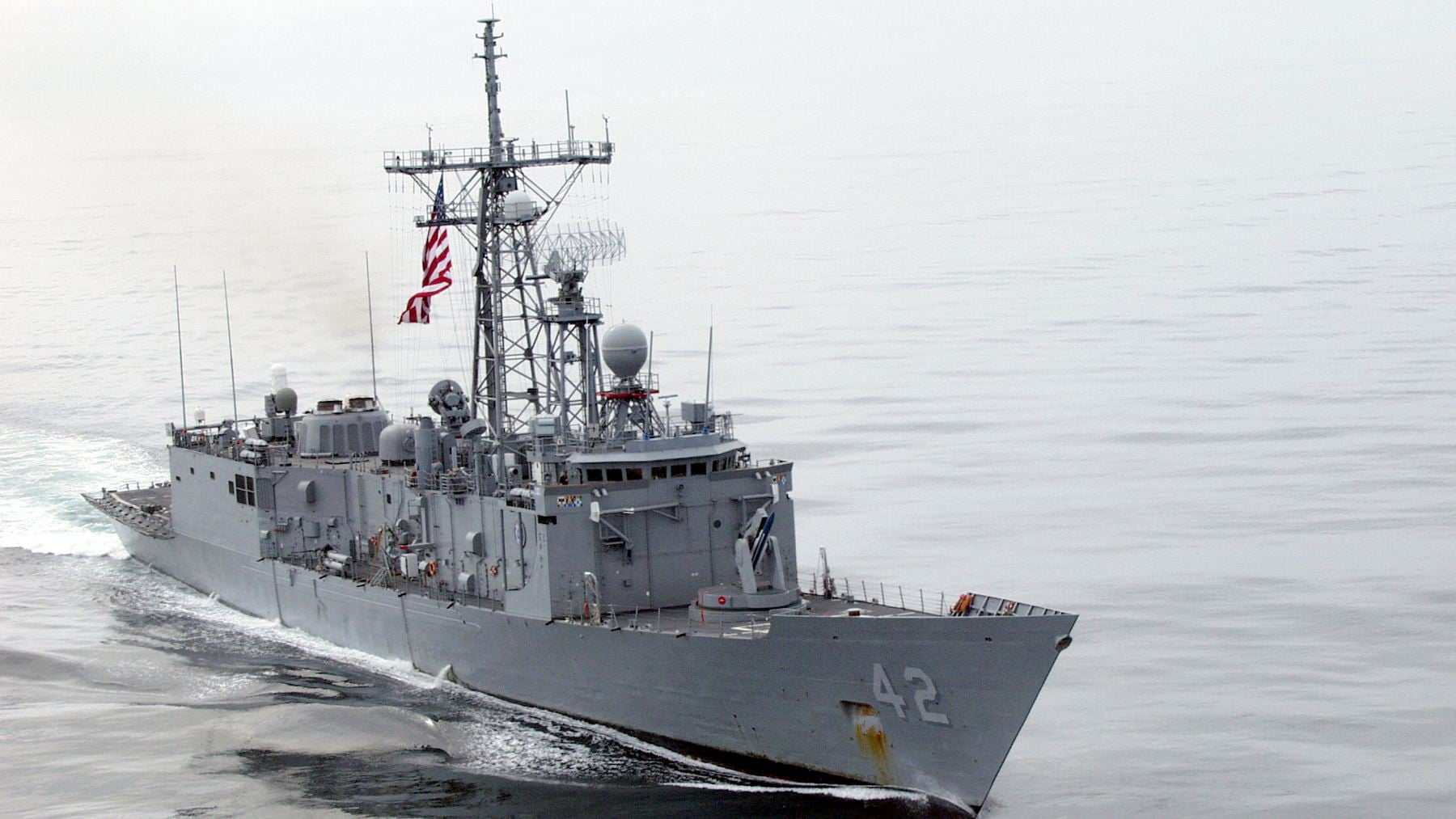
The frigate USS Klakring sat in that lot for 13 years. The Navy decommissioned it on March 22, 2013, and from the looks of things nobody had a firm plan for the ship until this year. Then in August a tug pulled it down the Delaware and across the Atlantic to Scotland, and on September 21 the US and British navies shot it full of holes about 150 nautical miles off the Hebrides until a torpedo finally put it on the bottom. US European Command’s own write-up called it “a very bad day” for the frigate. I’m not going to argue with that.
So why drag a 43-year-old ship across an ocean just to sink it? Because the Navy wanted to see exactly what its weapons do to a real hull, and there’s only one way to find that out.
So what’s a SINKEX?
SINKEX is Navy shorthand for a sinking exercise. You take a decommissioned ship, strip out the fuel, oil and anything else the EPA doesn’t want on the seabed, tow it out past the continental shelf and let ships, aircraft and submarines fire live weapons at it until it goes down. The Klakring is the fourth decommissioned Navy ship sunk this way in 2026, according to USNI News, after the amphibious transport dock Juneau on June 27, the cruiser Mobile Bay on July 11 and the amphibious assault ship Peleliu on July 17, all three in the Pacific.
This one was different in a couple of ways. It was the live-fire finale of Atlantic Thunder 2026, a two-week exercise that ran from September 14 to 25, led by the Navy’s 6th Fleet with the Royal Navy, the Royal Air Force and the US Air Force all taking part. And before the ship ever left Philadelphia, engineers from Naval Surface Warfare Center Carderock and Naval Information Warfare Center Pacific wired it with sensors so every hit got recorded. The Navy says it’ll use that data to figure out how fast its own ships might fail under the same kind of punishment, and what it would take to repair them.
That’s arguably the whole point. The missiles are the show, but the sensors are why the show took four years to plan, according to the UK Defence Journal, which sat in on the post-exercise briefing.
Longest range first
Capt. Kelechi Ndukwe, who commands Task Force 65 and ran the exercise, told the UK Defence Journal that the shooting was sequenced from the farthest weapon inward, so the sensors could record each impact on its own. “We started with the longest range ordnance,” he said, and worked in from there.
That first shot came from the destroyer USS Paul Ignatius, which fired an anti-surface version of the SM-6 at what the Navy calls its maximum range. If you’re wondering how far that is, so am I. Ndukwe said the number’s classified, and the open-source estimates USNI News cites run from 186 to 248 miles. The SM-6 is primarily an air-defense missile, the thing a destroyer uses to knock down aircraft and incoming missiles, and the newer versions add GPS guidance so it can dive on a ship instead.
Then the British took their turn, twice. The frigate HMS Portland fired a Naval Strike Missile, the first time the Royal Navy’s put one of those into an actual warship rather than a floating target, and the Royal Navy says it can hit targets more than 100 miles away while skimming the sea. Lt. Cmdr. Louise Kirkaldy, Portland’s principal warfare officer, called the shot “a significant milestone for the Royal Navy.” After that, a Wildcat helicopter flying off Portland’s own deck fired a Sea Venom, a smaller anti-ship missile built for corvette-sized targets. Ndukwe confirmed it was the first live firing of a Sea Venom since the missile was declared operational last year, and that it hit. A Wildcat carries four of them, and that’s the same count a German startup claims for its new drone boat, so you’ll probably hear more about this missile.
US Air Force F-15E Strike Eagles out of RAF Lakenheath dropped bombs on the frigate as well, according to Navy Lookout, which puts the total at five weapon types. The 6th Fleet’s own release lists the F-15Es among the participants but names only the SM-6 and the torpedo as weapons, so that part’s coming from Navy Lookout’s reporting rather than an official count.
And after all of that, the Klakring was still floating, which I didn’t expect.
The final hit came from underwater. USS Massachusetts, a Virginia-class attack submarine, fired a Mk 48 ADCAP torpedo, the Navy’s heavyweight torpedo and pretty much the standard way a submarine sinks a ship. Down went the frigate, into what Ndukwe described as a deep valley off the Hebrides that the EPA signed off on in advance. Baird Maritime puts the depth at about 6,000 feet.
Before you read any of that as a tribute to Bath Iron Works, which built the ship in Maine in the early 1980s, keep in mind that a target hulk’s a pretty strange thing to shoot at. There’s nothing aboard to burn or explode, and there’s also nobody aboard trying to save it, so it’s tougher than a real warship in some ways and weaker in others. As far as I can tell, the Navy hasn’t said how much damage each weapon actually did. That’s what the sensors were for, and Navy Lookout reports it’ll be several months before that data’s processed.
Why an American ship on a British range?
You may be wondering why the Navy hauled a hull across the Atlantic when the Royal Navy has a steady line of its own retired frigates heading off to be scrapped. The answer’s money, as it usually is. Ndukwe described a deal between the two governments in which the US paid to prepare and tow the Klakring over, and the UK paid for the range. Navy Lookout points out that preparing a British hulk would have put that bill on the British side instead, which explains a lot.
The range in question is the Hebrides Range, a Ministry of Defence facility off the Outer Hebrides that’s run by the contractor QinetiQ. It’s an instrumented range, which basically means there’s radar and tracking gear on the islands around it, so the people running a test get far more out of it than they’d get from just watching the splash. The same range hosted the last Atlantic Thunder in 2022, when the ex-USS Boone went down under fire from HMS Diamond, USS Arleigh Burke, RAF Typhoons and P-8 patrol planes.
One thing that surprised me a little: Ndukwe said no uncrewed systems took part at any stage. Given how much of the Navy’s drone-boat and drone-submarine work turns up in exercises these days, that’s an odd thing to leave out of a kill-chain test. European Command said before the exercise that an underwater survey of the wreck was planned, per Baird Maritime, so a drone may still get a look at the Klakring, just not while the shooting was going on.
The submarine is the newest thing in this story
The Klakring dates from 1983. USS Massachusetts was commissioned on March 28 of this year in Boston Harbor, and on August 17 the Navy did something it almost never does and skipped the boat’s post-shakedown yard period, the dry-dock stay every new warship normally gets so the builders can fix whatever rattled loose in its first months at sea. The Navy’s own director of submarine programs called that a calculated risk. Nine months after delivery, the submarine was in the North Atlantic putting a torpedo into a frigate, and that’s about as fast a start as a new boat gets.
Was skipping the yard period a smart move? We’ll find out over the next few years, and frankly a successful torpedo shot on a stripped hulk doesn’t settle it either way. It does mean the newest attack submarine in the fleet has now fired a live Mk 48 at something, and that’s more than most of them can say in their first year.
Planning for the next Atlantic Thunder has already started, Ndukwe said, with the goal of running it in 2028, half the gap between the last two. The Navy’s shipbuilding plan from May lists six more decommissioned ships lined up for sinking exercises in the coming years, according to USNI News: the cruisers Antietam, Vella Gulf and Port Royal, the destroyer Paul F. Foster, the dock landing ship Germantown and the frigate De Wert, a sister ship of the Klakring.
Image Credit: U.S. Navy via Wikimedia Commons