
The first time somebody hands you a tiller, you pick up two rules about sharing the water. One of them is written down: a boat under sail usually has right of way over a boat under power, with a stack of exceptions people argue about in yacht club bars. The other one isn’t written down anywhere, because nobody figured it needed writing down. There’s a person on the other boat, and they’re looking at you.
In Portsmouth Harbour, on the south coast of England, the second half of that isn’t holding up so well anymore.
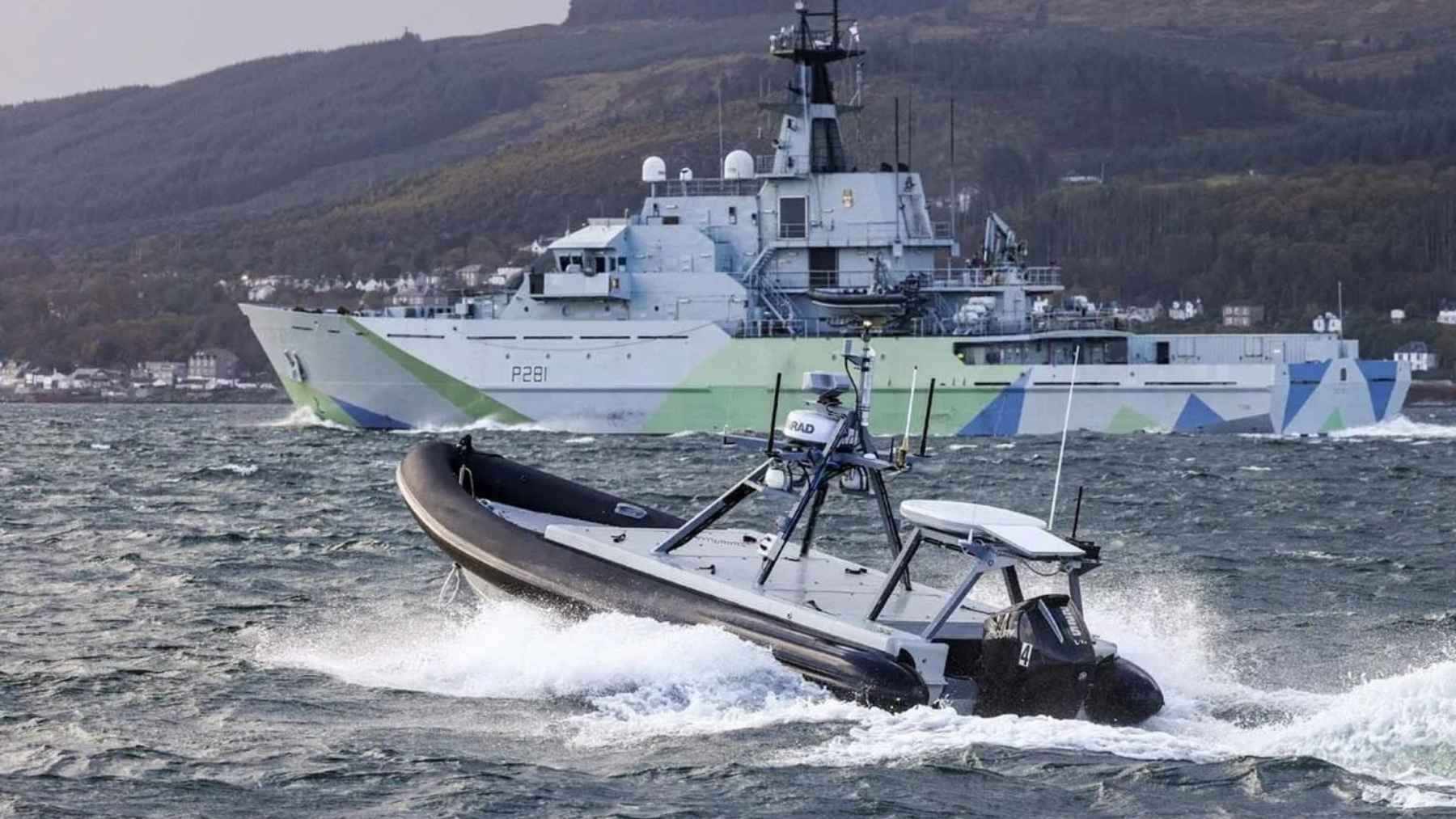
The Royal Navy has seven uncrewed boats called Rattlers running trials and training in that harbor, and in June one of them hit a 55-foot racing yacht.
The yacht is Lutine, an X-55 built by the Danish yard X-Yachts in 2010 and owned since 2014 by Lloyd’s Yacht Club, the sailing club of the Lloyd’s of London insurance market. She’s 55 feet long, she weighs about 35,000 pounds, she’s got a carbon fiber rig, and she normally lives in Haslar Marina right at the mouth of the harbor. After the collision she went into dry dock at Hamble Point Marina to fix a gouge in her starboard stern. No injuries were reported.
The Navy called it a “controlled training exercise” in a statement to Marine Industry News, said both vessels took minor damage and have since gone back to sea, and confirmed it’s investigating. Guy Williams, commodore of Lloyd’s Yacht Club, confirmed the collision happened and declined to say more. An anonymous source told The Sun the drone “went rogue” before it hit, and that Lutine was under sail with right of way at the time. That’s one unnamed source, the Navy hasn’t confirmed either detail, and you’d do well to hold both of them loosely.
So who was driving?
A Rattler is a rigid inflatable boat, 7.2 meters long, which works out to a hair under 24 feet. That’s no bigger than the center console you’d see on a trailer at any boat ramp in the country. SYOS Aerospace builds them in Fareham, a few miles up the coast, and the Navy says the seven of them went from idea to delivery in a matter of weeks. GB News reported that the one involved was Rattler 4.
The harbor master’s notice says these boats are driven remotely from what it calls a Remote Operating Centre, which is a control room on shore, and that a safety vessel tags along the entire time. The Navy says it’s a two-person job, one sailor driving and the other working the sensors and the live data feeds, off a portable laptop rig. When the Portsmouth News got a tour of XV Patrick Blackett, the experimental ship the operators work from, the sailors were flying the boats with PlayStation controllers.
So on paper, there’s always a human at the controls. The Navy hasn’t said whether that particular boat was under remote control or running itself when it hit, and it hasn’t said whether the safety boat tried to intervene. Both questions sit inside an open investigation, which is a fair reason not to answer them yet, and as far as I can tell there hasn’t been anything published on it since June.
If that distinction sounds academic, it really isn’t. The IMO sorts crewless ships into four degrees of autonomy, and the harbor master’s standing notice spells them out: degree three is a ship driven from somewhere else with nobody aboard, degree four is a ship whose own software decides what to do. That’s where the Rattlers are meant to end up. The Royal Navy has said they’ll work without direct human control in time, and that time isn’t now.
The rule is 650 feet, where possible
Everything afloat in that harbor has to follow COLREGs, the international rules of the road that sort out who gives way to whom. One of them says every vessel keeps a proper lookout by sight and by hearing at all times. So how does a boat with nobody on board hear anything? That’s the operator’s problem to solve, and it isn’t a small one. The King’s Harbour Master’s notices make them write the answer down. Anyone who wants to run an uncrewed boat in Portsmouth applies in writing at least 14 days out and has to explain how the thing will keep that lookout.
Then there’s the separation rule. The notice covering the Rattlers says they’ll hold a minimum of 200 meters, about 650 feet, from other craft “where possible”, and that trials get modified or aborted if a close-quarters situation develops. Two words are carrying an awful lot of weight in that sentence. They’re “where possible”. Out in Sandown Bay on a quiet Tuesday, 650 feet is nothing. In the harbor entrance with a Gosport ferry coming through, it’s a hope.
The Sun also reported that a Gosport ferry and a tug had already been forced to take evasive action around the drones. Same caveat as before on where that one comes from.
Seven boats, and they’re still out there
The notice running the program right now is numbered 46/26. It launches the boats from HMS Warrior Slipway or 2 Basin inside the naval base and works them in Portsmouth Harbour, Sandown Bay and Ryde Middle, by day and by night, from March 1 to December 31. A safety boat goes out with them every time, either a PAC-24 RHIB, a Vahana workboat or a P2000 patrol vessel, and if something starts going wrong, that crew is supposed to step in.
A second notice went out on July 28, a month after the collision, putting uncrewed boats off Hill Head and Stokes Bay under those same Rattler callsigns. That one runs 24 hours a day until December 31 as well, in remote or autonomous mode, and it tells the safety boat to hold within 100 meters, about 330 feet.
The Rattlers don’t have that water to themselves, either. Go through this year’s notices from that office and you’ll also find a boat called MARS towed out of the Old Camber in Portsmouth, same name and same home water as the SubSea Craft drone boat that swaps its weapons in and out as cassettes, which we wrote about on September 9.
Then there are two called K3 Scout and K5 Scout working Hill Head and Roway Wreck, and a 24.6-foot RIB called PD007 in Hayling Bay. The Navy bought 20 K3 Scouts in March, and that’s the hull that got parachuted into the North Sea four times in six days in July.
So that’s four separate uncrewed boat programs sharing the eastern Solent with car ferries, aircraft carriers and people out for a sail on a Saturday. They’re all legal, approved and posted in advance, which is more than you can say for most of what surprises you on the water.
I don’t think the June collision is an argument against any of this. If you’re going to fight alongside these boats, you’ve got to learn to run them somewhere, and a working harbor full of traffic is arguably the most honest test available. It also means the cost of getting it wrong lands on somebody who never signed up for the trial, which this time meant a yacht club and its insurer. The Portsmouth News put Lutine’s value at £400,000, about $540,000 at today’s exchange rate.
The notice keeping seven Rattlers in those waters was signed by King’s Harbour Master G W Bishop on March 16 and expires on December 31. The one before it expired on March 31, and his office had the replacement out two weeks early.