
If you’ve ever squinted out from the Ayrshire coast toward that lump of granite in the Firth of Clyde, you know Ailsa Craig mostly as a bird sanctuary and the source of every curling stone that’s ever slid across Olympic ice. It’s not a place you associate with seabed espionage.
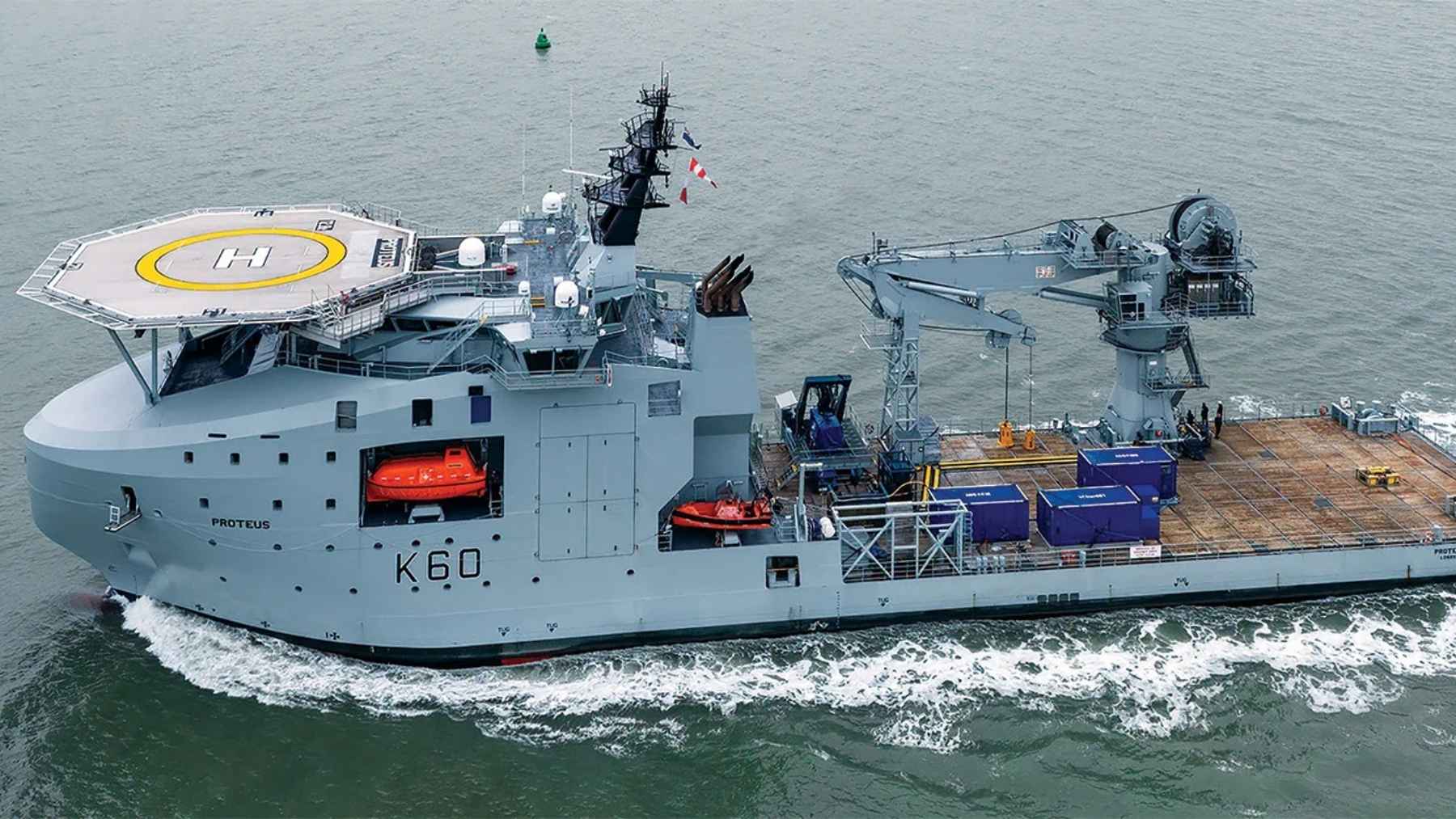
But on Wednesday, July 1, locals got a good look at a ship that absolutely is. RFA Proteus, the UK’s first multi-role ocean surveillance vessel, cruised past the island on its way to Fairlie Quay, per local reports from the Ardrossan Herald.
Proteus isn’t just another gray hull ambling around Scottish waters. It’s the Royal Navy’s dedicated answer to a very modern nightmare: somebody parking a trawler or a submersible over one of the fiber-optic cables that run the global internet, and quietly cutting it.
And the ship is stuffed with the kind of underwater tech that, if you saw it in a movie, you’d assume was CGI.
An oil-rig ship painted gray and handed a new job
The short version: Proteus started life as an offshore support vessel called MV Topaz Tangaroa, built in Norway in 2019 to service oil rigs. The UK Ministry of Defence bought it for £70 million (about $94 million) in February 2023.
The ship arrived at the Cammell Laird yard in Birkenhead that January for a light-touch military conversion, got painted naval gray, and entered service in October 2023 as the first Multi-Role Ocean Surveillance Ship, or MROSS.
Here’s a detail that tells you how fast priorities shifted: the program was accelerated using money freed up by cancelling the National Flagship, the successor to the royal yacht. Britain traded a floating reception hall for a seabed-warfare ship. After the Nord Stream pipelines were sabotaged in 2022, nobody argued.
The Clyde stop is now routine. Proteus has been spotted in Scottish waters repeatedly, including a pass by Great Cumbrae in 2024, as it trials the autonomous underwater systems it’s built to launch. The firth is deep, sheltered, close to the North Atlantic exits Russian submarines like to use, and packed with existing naval infrastructure. If you want to test seabed-guarding kit near real strategic plumbing, this is where you go.
A hole in the bottom of the ship, on purpose
The signature feature, and the reason every headline reaches for “James Bond,” is the moon pool. It’s an opening cut straight through the hull. That sounds terrible for a vessel, but it’s genius.
Instead of hoisting a submersible over the side and hoping the North Atlantic doesn’t smash it against the hull, the crew launches and recovers underwater vehicles through the ship’s own belly, in shelter. Navy Lookout puts the moon pool at 7.2 by 7.2 meters (about 24 by 24 feet), big enough to work heavy kit through in weather that would otherwise shut operations down entirely.
Then there’s the crane: a 120-metric-ton unit with a 3,000-meter wire, per the Ardrossan Herald. That means the crew can lower serious equipment nearly two miles straight down. Most cables and pipelines the UK cares about sit well within that reach.
Add a forward flight deck for helicopters, a hangar full of remotely operated vehicles, and workshops to keep it all running, and you have something that looks less like a warship and more like a floating seabed-ops base.
The unglamorous specs matter too. Proteus measures 98.1 meters (321 feet 10 inches), offers around 1,000 square meters of cargo deck, and runs diesel-electric propulsion with twin bow thrusters that hold it dead still over a target. When you’re inspecting a suspicious object next to a fiber cable, standing still in current and weather beats top speed every time.
The internet rides on garden hoses nobody watches
Here’s the number that reframes everything. A UK parliamentary joint committee report found that around 570 undersea cables, with another 80 planned, carry between 95 and 99% of the world’s intercontinental telecommunications data. Satellites could absorb only about 5% of that volume if things go wrong.
The US Congressional Research Service puts the figure at roughly 99% of transoceanic digital traffic, running over a network of more than 500 mostly privately owned cables. Your bank transfer, your group chat, and every trans-Atlantic API call ride bundles of fiber about as thick as a garden hose, sitting on a seabed nobody’s really watching.
Which was fine in peacetime. Less fine after the Nord Stream sabotage of 2022, when everyone in NATO simultaneously realized how easy it would be to do the same to a data cable.
The committee’s conclusion on the obvious suspect is blunt: “Russia has the concepts, capabilities and preparatory intent for conducting sabotage if necessary.” It also noted substantial damage could be done without ever crossing the threshold of armed conflict. A cable gets cut, nobody claims it, attribution takes months, and the news cycle moves on.
Fairness requires the other half of the same report. The cable industry told the committee that sabotage remains rare, and that 70 to 80% of faults come from fishing gear and dragged anchors. Undersea cables suffer 150 to 200 disruptions a year from accidents alone, per CSIS analysis. Skeptics say fix the trawler problem first. The committee’s answer, in effect: accidents are also excellent cover for someone cutting one on purpose.
Proteus doesn’t look for cables. Its robots do
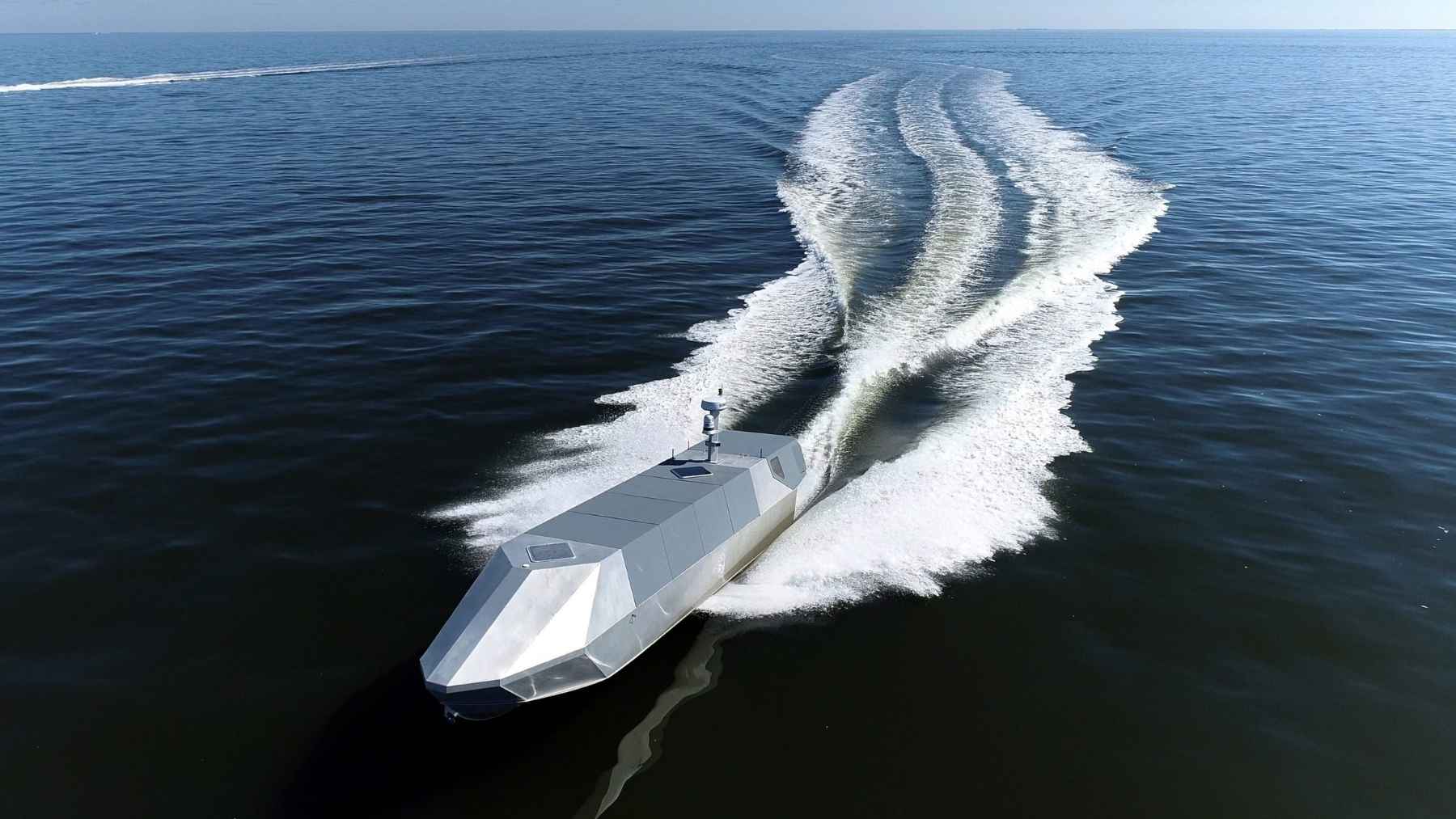
The whole reason for the moon pool, the monster crane, and 1,000 square meters of deck is that Proteus is a mothership for uncrewed underwater vehicles. The ship doesn’t do the peering. The drones it carries do.
This matches where naval thinking has landed across the board. Nobody serious believes a single crewed ship can patrol thousands of miles of cable. The play is a big mothership, a fleet of cheaper autonomous underwater vehicles, and sensor fusion to flag anomalies, the same logic behind Boeing’s giant Orca drone submarine on the American side.
Crewing reflects it. Proteus sails with about two dozen Royal Fleet Auxiliary sailors plus up to 60 Royal Navy specialists running the underwater surveillance and warfare systems. Less a warship’s crew, more a laboratory afloat.
And it has already done the day job. In November 2024, the Ministry of Defence released a photo of Proteus shadowing Yantar, the Russian survey ship that Western navies politely call a spy vessel. When Yantar loitered around the English Channel in January 2025, Defence Secretary John Healey told the House of Commons that Russia was “the most pressing and immediate threat.”
The threat board keeps filling up
The parliamentary report flags a monitoring gap that explains why the UK needed this ship. Coastal radar covers only 22% of the UK’s Exclusive Economic Zone. AIS trackers on commercial vessels can simply be switched off near sensitive sites. And only about 10% of the UK’s global marine area has been mapped to modern standards, per the 2022 National Strategy for Maritime Security cited in the report. You cannot defend infrastructure you cannot see.
Meanwhile, incidents pile up. At least 11 undersea cables were damaged in the Baltic Sea over a recent 15-month stretch, several by ships dragging anchors, with no formal attribution and plenty of skepticism. NATO now runs robot patrols over Baltic seabed cables for exactly this reason.
Britain’s answer at the strategic level is Atlantic Bastion, the program to wire the North Atlantic with sensors, crewed ships, and autonomous systems, an approach Germany is mirroring with AI-piloted sub-hunting drones. Proteus is one of the first physical pieces of that puzzle actually in the water.
One ship, no guns, and a very long coastline
Proteus has limits, and they’re not small. It’s a mothership, not a warship. Navy Lookout notes no self-protection armament had been fitted at commissioning, though it may be added later. The theory is that presence plus sensors plus drones deters and detects, with the shooting, if it ever comes, done by other Royal Navy assets.
There’s also only one of it. A second MROSS remains in its concept phase, per a government letter from January 2025, potentially as a purpose-built vessel entering service in the early 2030s. One hull cannot cover the approaches to the British Isles, never mind allied cable landing points across the North Sea and Atlantic.
So treat Proteus as a proof of concept as much as an operational asset: a testbed for the autonomous systems, sensors, and doctrine that a bigger seabed-warfare force will eventually run on.
If you spotted a gray ship gliding past Ailsa Craig on Wednesday and thought it looked oddly purposeful for a fishery patrol boat, that’s because it is. Proteus is the sharp end of the UK’s answer to a question nobody was seriously asking in 2015: what happens when the plumbing of the global internet becomes a military target. The Firth of Clyde is where they’re working out the answer.