
- 4 MONTHS AGO · INDUSTRYA 1,200-ton German machine named Mary just started grinding under the Potomac in Washington, boring a 5.5-mile tunnel to stop the 650 million gallons of stormwater and raw sewage that hit the river every time the capital’s Victorian sewers overflow
- 4 MONTHS AGO · INDUSTRYItaly just started boring the ramp to the world’s longest rail tunnel with one 2,000-ton machine that has to be taken apart and hauled backward through its own hole to dig the second tube
- 3 MONTHS AGO · INDUSTRYA 44-foot German machine named Panama spent 17 months boring the first tunnel ever to pass under the Panama Canal, kept every ship moving above her the whole time, and is now down to her final few hundred meters before the station where she gets taken apart
- 2 MONTHS AGO · INDUSTRYA 1,764-ton tunnel borer spent 19 months grinding about 98 feet under two runways and Terminal 2 at Paris’s main airport while planes kept landing on schedule above her, and a crane has now lifted her 33-foot cutting wheel out of the exit pit
- TODAY · THIS ARTICLEA 2,200-ton boring machine named Roberta dug 3.6 miles of subway under Paris as Houda, was taken apart and shipped 1,370 miles to Italy and back for a rebuild, and now starts 4.3 miles of new tunnel with the 187-ton cutting wheel that came home by truck, ship and barge
Ask a mechanic about remanufactured engines, and you’ll probably get a pretty enthusiastic answer. A reman engine is an old block that’s been stripped down, cleaned up, machined, and rebuilt with new wear parts. It usually costs less than a brand-new crate engine and shows up a lot sooner, and once it’s bolted in, most drivers never know the difference.
It turns out the people digging Paris’s new subway feel pretty much the same way about tunnel boring machines.
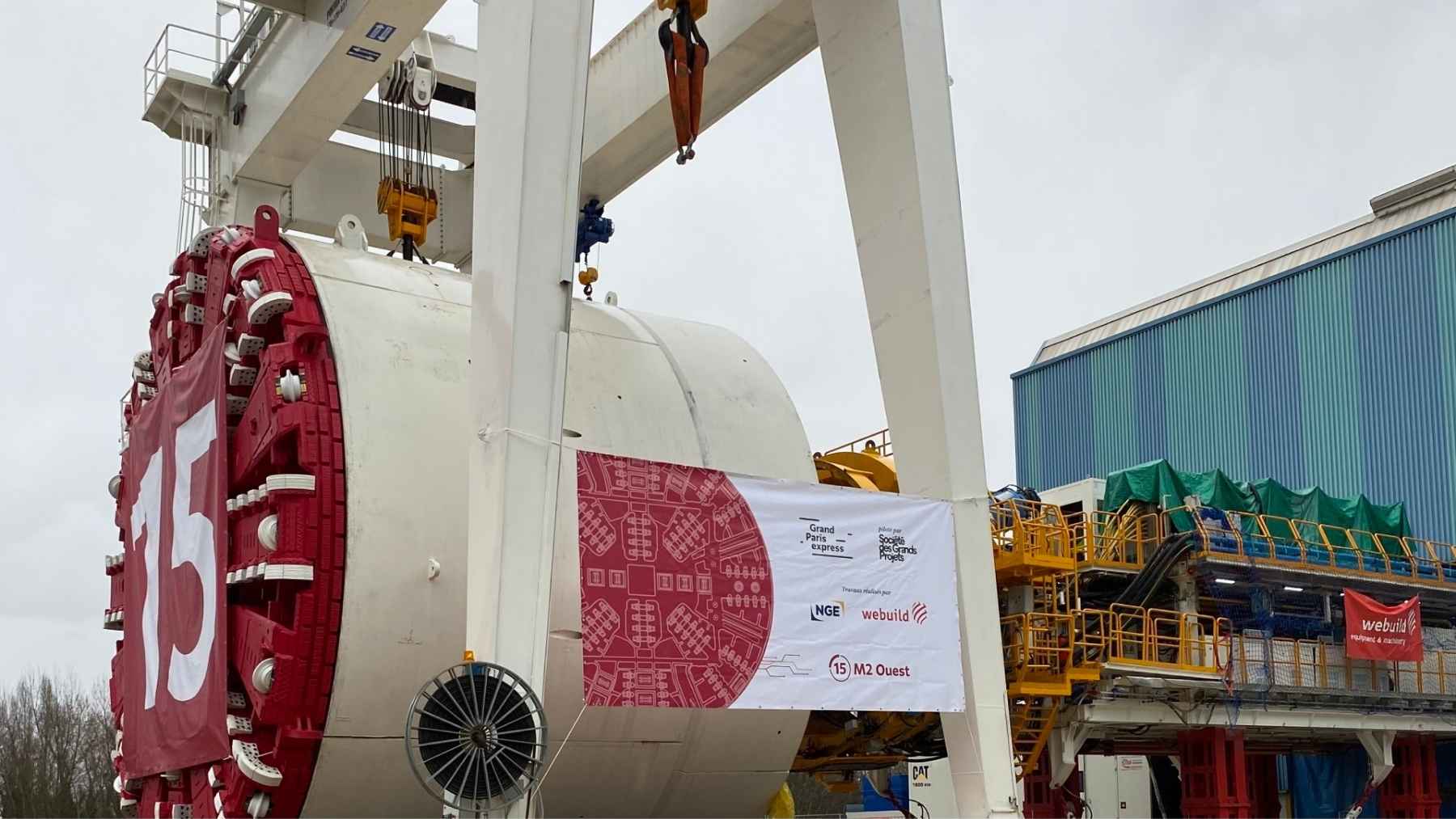
On October 7, the Société des grands projets, the French state agency building the Grand Paris Express (formerly called the Société du Grand Paris), held a naming ceremony in Gennevilliers, just northwest of Paris, for a machine called Roberta. She weighs about 2,200 tons, her cutting wheel is just over 32 feet across, and she’s lined up for roughly 4.3 miles of new metro tunnel.
She’s also not new, not by a long shot.
Roberta used to be called Houda
If you haven’t heard of Roberta, that’s because she went by Houda until this week. Under her previous name, she spent more than three years grinding out about 3.6 miles of Line 16, another Grand Paris Express route, under the suburbs northeast of the city. She was the last of that line’s seven machines to finish, breaking into her exit shaft at a site called Mare au Chanvre a little over two and a half years ago.
That’s usually where a tunnel borer’s story ends. When we covered Virginie, the Line 17 machine that tunneled under Charles de Gaulle airport, nobody had said yet whether she’d be scrapped or rebuilt. But Houda got the rebuild.
Crews took her apart and shipped her to Terni, in central Italy, where Webuild, one of the contractors on her new job, runs a facility that specializes in overhauling big tunneling machines. According to Tunnel Business Magazine, she got a complete overhaul, some updated technology, and modifications to suit the ground on her new route.
So how do you get a 187-ton cutting wheel from central Italy to the edge of Paris?
Slowly, and arguably, that trip is the most impressive part of this whole story. The contractors say the logistics chain ran about 1,370 miles. Her heaviest components, that wheel included, shipped out of Civitavecchia, a port up the coast from Rome, and made the rest of the trip by truck, ship, and barge. She got to Gennevilliers in late August.
Nobody’s said which ports or rivers she used along the way. Frankly, I’d have paid good money to watch a 187-ton wheel float past on a barge.
As for the new name, it honors Roberta Arrigoni, a Webuild architect who has spent 37 years on major, complex infrastructure projects and has been part of the Grand Paris Express from the start. French tunnel crews traditionally give their machines women’s names, a nod to Saint Barbara, the patron saint of miners. This one’s now had two.
So why not just build a new one?
Mostly because it takes forever. Tunnel boring machines aren’t really something you pick up on a lot. Each one’s basically set up for the specific ground it’s going to chew through, and that tends to take a while before a single foot of tunnel gets dug.
The contractors say rebuilding Houda saved about 12 months compared with building a new machine from scratch and also reduced costs and carbon emissions. They haven’t put a number on the money, though.
A year matters here. Line 15 will be a ring all the way around Paris, the longest metro line in the country, and the western stretch Roberta’s working on is scheduled to open by the end of 2031. Once it does, the contractors say, riders will get from Saint-Denis Pleyel to La Défense, the big business district on the city’s west side, in 19 minutes.
Reusing a borer isn’t a new idea, by the way. We’ve written about one that sat on the surface for 11 years before heading back underground in Arizona. But shipping a 2,200-ton machine to another country for a rebuild and then shipping it back is a pretty serious commitment, and I’d say it beats leaving one to rust in a yard.
So what is an earth pressure balance machine?
Roberta’s an earth pressure balance machine, or EPB, and she was originally built by China Railway Engineering Equipment Group, according to Tunneling Journal. It’s simpler than it sounds. As the wheel spins, the dirt it cuts loose gets packed into a sealed chamber right behind it, and that packed dirt pushes back on the ground in front so the face can’t cave in or let groundwater flood the tunnel. A large screw conveyor then discharges the spoil from that chamber at a controlled rate, so the crew can maintain the pressure where they want it.
Everything behind the wheel stretches back more than 328 feet, and it lines the tunnel as it goes. Roberta will set about 23,000 precast concrete segments on this job, and nearly four in five of them will be made from fiber-reinforced concrete. That’s concrete with short fibers mixed right in, which lets each segment get by with a lot less rebar. The segments come from a plant in the Paris region that’s partly owned by NGE, the French builder leading the job, and the contractors say the method uses half as much steel as conventional segments.
Most of the dirt is leaving by boat
The job comes in two parts. From a shaft called Les Cabœufs in Gennevilliers, Roberta will first dig about three-quarters of a mile to Saint-Ouen, then set off from Gennevilliers again in the opposite direction for 3.6 miles toward Courbevoie. That second drive is about as long as her stretch of Line 16, which I’m fairly sure is a coincidence.
What I can’t tell you is how she gets from the end of the first drive back to Gennevilliers to start the second, because the announcement doesn’t say. I couldn’t find a start date for the first drive, either.
The package also includes four new stations: Bécon-les-Bruyères, Bois-Colombes, Les Agnettes and Les Grésillons. Then there’s the dirt, which is a whole operation of its own.
The tunneling should produce about 654,000 cubic yards of spoil. Most of it’s supposed to be reused rather than dumped, and the contractors say 80% will leave on barges along the Paris region’s waterways. That spares local roads roughly 64,000 truck trips.
If you’ve ever been stuck behind a dump truck on a two-lane road, you’ll appreciate that number more than most.
The whole package is a €1.38 billion contract, held by a group led by NGE with Webuild and Equans France.
If the schedule holds, trains should be running through her new tunnel by the end of 2031.
 A 990-foot ocean liner that crossed the Atlantic faster than any liner before or since has just started her last trip out of Mobile behind tugboats, headed for a spot 22 nautical miles off the Florida Panhandle where she’ll be sent down into 180 feet of water on WednesdayIndustry · 13 hours ago
 A nearly 23-foot tunnel boring machine just broke through into its first station under downtown Toronto after cutting about 4,265 feet and lining the tunnel with roughly 780 concrete rings, and its twin is due to punch through right beside it in DecemberIndustry · 3 days ago
 A 13,632-ton freighter lies broken in two 530 feet down in Lake Superior, 51 years after she sank in a November storm with all 29 men aboard, and federal scientists estimate up to 1,191 barrels of heavy fuel oil could still be inside a wreck with no reported leakIndustry · 4 days ago

 @jerryroane ROOKIE1 month ago