
- 4 MONTHS AGO · INDUSTRYA 1,775-ton machine named by schoolchildren has been grinding under a British national park since 2019 and holds the world record for the longest tunnel ever driven by a single borer, 18.6 miles and counting, extended while her owner’s budget read zero — and that owner just hired a second engineering firm to figure out how to finish the mine
- 4 MONTHS AGO · INDUSTRYA 4,000-ton machine named Partenope has been turning a 44-foot cutting wheel through the hills east of Salerno for 17 months, 18 electric motors pouring 10 megawatts into that one wheel, and nobody outside the site will say how much of the tunnel is left
- 3 MONTHS AGO · INDUSTRYA 44-foot German machine named Panama spent 17 months boring the first tunnel ever to pass under the Panama Canal, kept every ship moving above her the whole time, and is now down to her final few hundred meters before the station where she gets taken apart
- 2 MONTHS AGO · INDUSTRYA 5-foot tunnel bored 1,017 feet through bedrock under the canal that lets freighters skip Niagara Falls broke through in 33 days, with ships passing 65 feet above the crew, and the same machine is now cutting a second one
- TODAY · THIS ARTICLEA 1,764-ton tunnel borer spent 19 months grinding about 98 feet under two runways and Terminal 2 at Paris’s main airport while planes kept landing on schedule above her, and a crane has now lifted her 33-foot cutting wheel out of the exit pit
If you’ve flown through Paris at any point in the last year and a half, you’ve probably done the standard Charles de Gaulle routine: the long walk through Terminal 2, the wait at the gate, the planes stacking up outside the window. What you almost certainly didn’t know is that a machine weighing 1,764 short tons (1,600 metric tons) was grinding along about 98 feet below all of it the entire time.
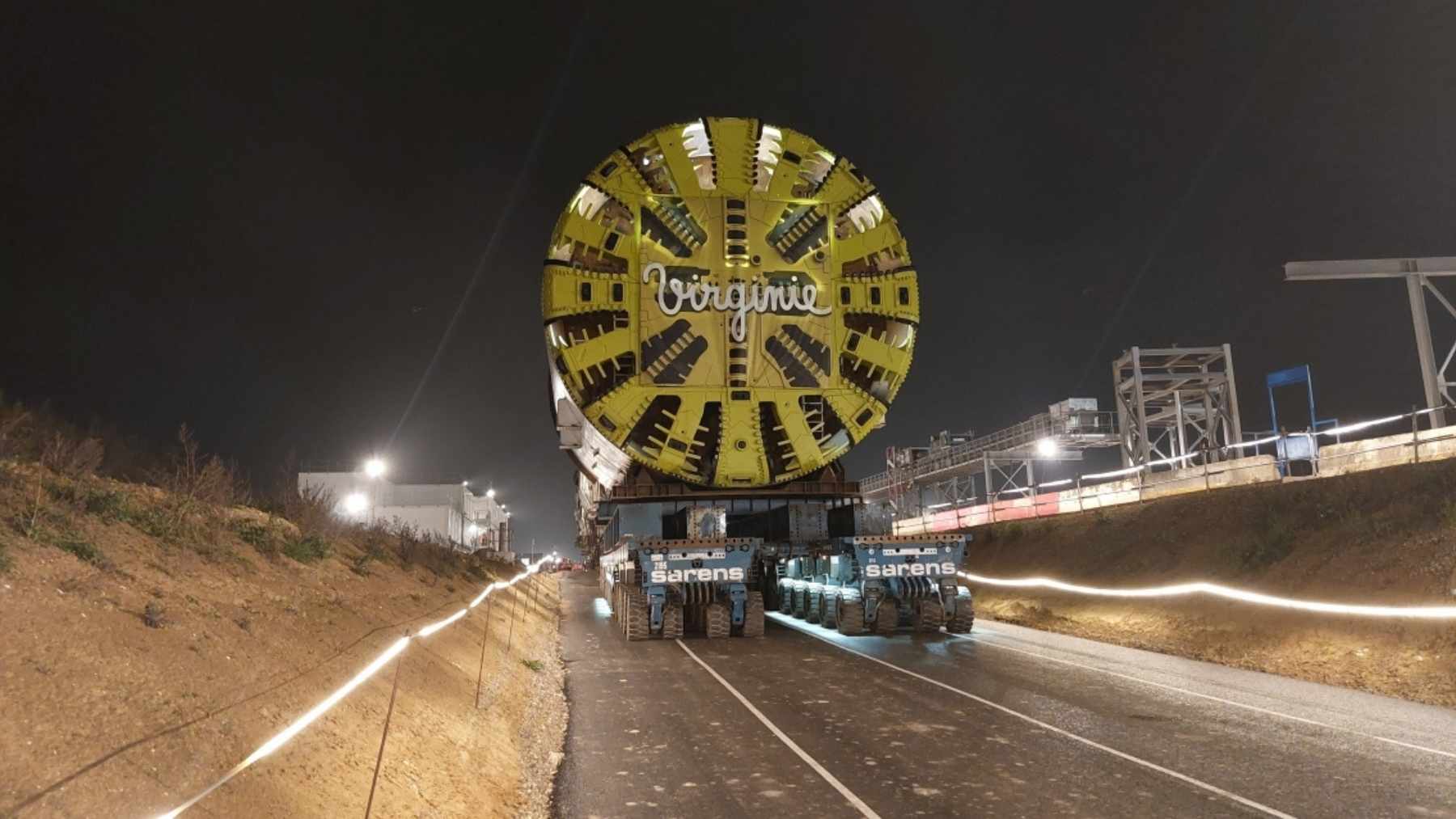
Her name is Virginie, and she’s done. The tunnel borer set off from Le Mesnil-Amelot in December 2024 and broke through at Tremblay-en-France, on the far side of the airport, on August 6, ending a 19-month drive of nearly four miles. Then, on September 16, a crane lifted her 33-foot cutting wheel out of the exit shaft, the first big step in taking the whole machine apart. The Société des grands projets (SGP), the French public body building the Grand Paris Express metro network, published its wrap-up of the drive on September 17. Everything below comes from that account and from the contractors doing the work.
We covered Virginie back in July, when the story was how crews moved the fully assembled borer to her launch shaft in one piece. This is the other end of that trip.
So what was she digging under?
Virginie’s route ran under a high-speed rail line, then under two of the airport’s runways, then past Terminal 2, where the line’s airport station is going in. And yes, it’s the same Terminal 2 you’ve probably been stuck in. She did the whole thing at roughly 98 feet down, with trains running and planes taking off and landing on schedule the whole time.
Traffic above never stopped. SGP says the dig had zero impact on airport operations, start to finish. That’s the operator grading its own homework, admittedly, but I can’t find any independent report of a flight or a train disrupted by the tunnel work either, so the claim holds up from where I’m sitting.
The pace explains a lot. SGP says a borer like this covers 33 to 46 feet on a good day, somewhere around 820 feet in a month, depending on what kind of ground it’s chewing through. That sounds slow until you remember what’s parked on top. The thing you worry about when you tunnel under a runway is the surface above settling, even by a hair, which is why everything overhead got monitored obsessively. Razel-Bec, the lead contractor, flagged the passes under runway 2 and runway 4 as the touchiest crossings of the whole drive.
How do you get a 328-foot machine out of the ground?
Not in one piece, that’s for sure.
A tunnel borer is less a drill and more a rolling factory. The wheel up front chews through the ground. Everything it chews out gets hauled away out the back. And the machine bolts curved concrete segments into rings behind itself as it moves. So the tunnel is permanently finished right behind the machine that’s digging it, which means there’s exactly one way out for Virginie: forward, into a pit at Tremblay-en-France, where crews cut her into pieces a crane can handle.
The 33-foot wheel came off first, on September 16, with the build teams gathered around to watch. Dismantling is arguably the least glamorous phase of a tunneling project, and it’s also the only phase you can actually see happen, since everything else went on where you couldn’t watch it, 98 feet under an airport.
What happens to the parts is a fair question. SGP hasn’t said whether Virginie gets scrapped or rebuilt for another job, and Grand Paris machines have gone both ways before. Florence, one of the four borers that dug Line 17 ahead of her, was taken apart mid-project and reassembled a few miles away for a second drive. Other machines have had stranger afterlives: we’ve written about a borer that came back from the ocean floor.
The name, by the way, wasn’t an accident. Every Grand Paris borer gets a godmother, a tradition tied to Sainte-Barbe, the patron saint of miners, and schoolkids in Le Mesnil-Amelot picked Virginie Guyot, the first woman to join and later command the Patrouille de France, the French air force’s aerobatic display team. So the machine that spent her entire working life underneath an airport is named after a fighter pilot, and SGP itself calls the pairing a nod to her distinctly aviation-heavy career. Somebody over there apparently has a sense of humor.
So when do trains actually run under the airport?
The digging part of Line 17 is over. Five machines, Sarah, Bantan, Dorine, Florence and Virginie, have bored about 12.4 miles of tunnel since 2020, and Virginie’s 3.7-mile leg is the last of it; there’s nothing left to dig. The finished line will run 16.5 miles from Saint-Denis-Pleyel, on the northern edge of Paris, out past the airport to Le Mesnil-Amelot.
What’s left is mostly above ground, because part of the route doesn’t run through a tunnel at all; it rides a viaduct. SGP says crews will assemble the final viaduct sections at Tremblay-en-France before the end of 2026, completing the line’s path end to end, and the section serving Charles de Gaulle is currently slated to open in 2030.
 A 990-foot ocean liner that crossed the Atlantic faster than any liner before or since has just started her last trip out of Mobile behind tugboats, headed for a spot 22 nautical miles off the Florida Panhandle where she’ll be sent down into 180 feet of water on WednesdayIndustry · 1 week ago
 A nearly 23-foot tunnel boring machine just broke through into its first station under downtown Toronto after cutting about 4,265 feet and lining the tunnel with roughly 780 concrete rings, and its twin is due to punch through right beside it in DecemberIndustry · 1 week ago
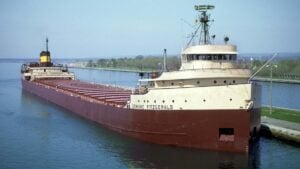 A 13,632-ton freighter lies broken in two 530 feet down in Lake Superior, 51 years after she sank in a November storm with all 29 men aboard, and federal scientists estimate up to 1,191 barrels of heavy fuel oil could still be inside a wreck with no reported leakIndustry · 2 weeks ago