
You’ve got a rough idea of what your car’s maintenance schedule looks like. Oil every few thousand miles, brakes when they start complaining, and somewhere down the road there’s a big job like a timing chain that makes you wince at the estimate. The Tennessee Valley Authority keeps a schedule like that for the power plant it buried inside a mountain just west of Chattanooga, and the big-ticket item there comes around once a decade, weighs almost 200 tons, and doesn’t get touched without switching the whole plant off for two months.
TVA wrote the job up in June 2025, so this isn’t breaking news. It’s better than that. Starting March 1, the agency put a crew of 300 inside Raccoon Mountain Pumped Storage Plant, pulled the spherical valves off generating units 2 and 4, rebuilt both, and had water spinning turbines again on day 60 of a 60-day plan. If you’ve ever had a contractor in your house, you know exactly how rare that last part is.
So what’s inside this mountain, exactly?
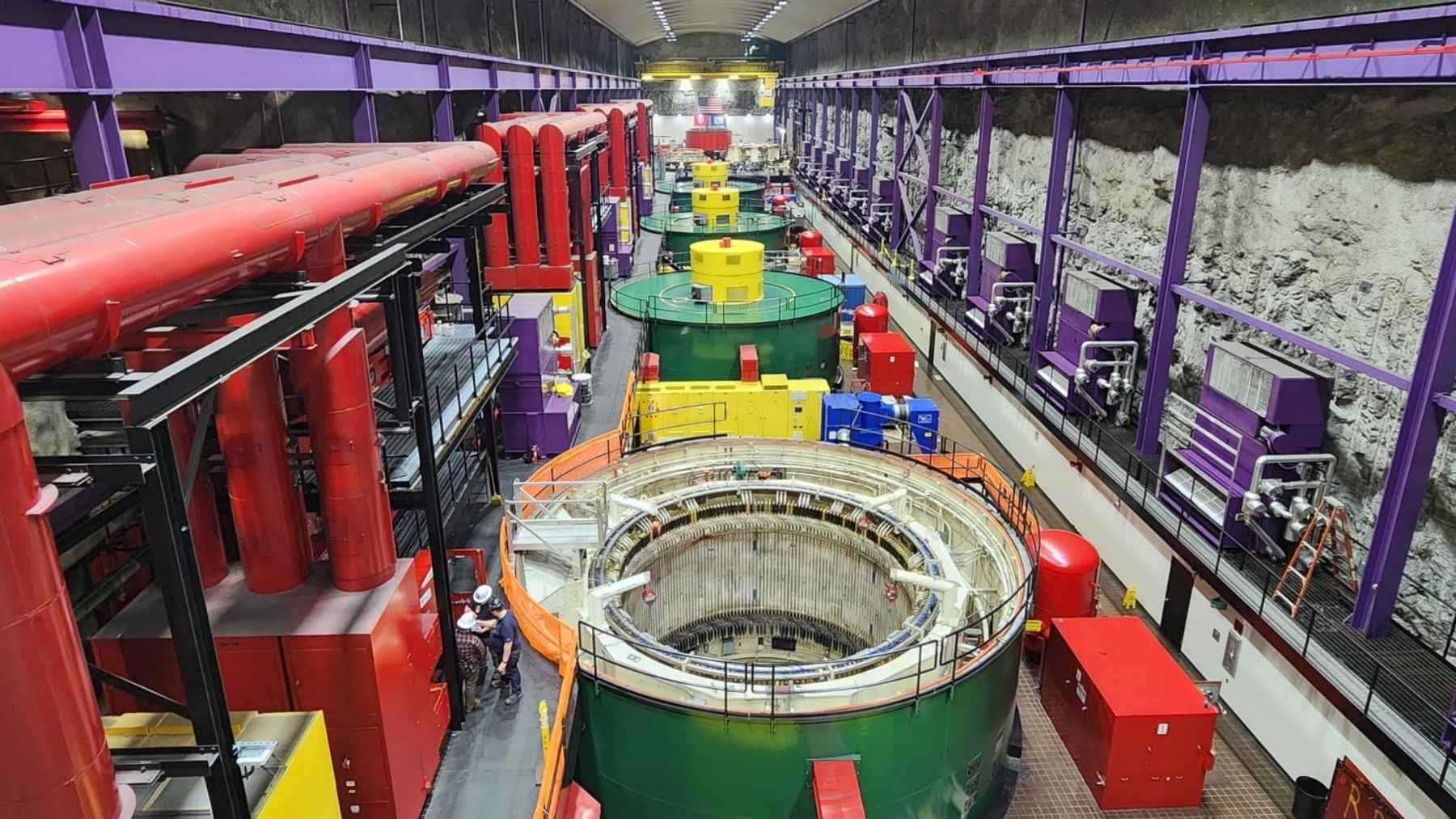
Raccoon Mountain is a pumped storage plant, and that’s really just a battery made of water and elevation. When demand is low, four pump-turbines push water from Nickajack Reservoir at the base of the mountain up to a 528-acre lake TVA dug into the summit. When demand spikes, that water falls back through a tunnel in the mountain’s core and spins the same machines the other way, in a powerhouse sitting 1,000 feet below the surface of the upper lake. TVA says the plant delivers more than 1,700 megawatts during peak hours, enough for about 935,000 homes, and John Clapacs, its outage planning and execution manager, says soaking up surplus power this way spares TVA from cycling other plants on and off, which he counts as a cost saver for the whole fleet. Scotland has been running the same trick on Loch Ness since the 1970s.
The construction was arguably a bigger circus than any maintenance since. When the Kennedy administration floated a pumped storage study in 1961, Congress didn’t exactly line up behind it, and Walter Rogers, who chaired the House Irrigation and Reclamation Subcommittee and sponsored the study himself, called the idea “a Rube Goldberg invention.” TVA built it anyway. Crews broke ground in July 1970, dug 12,000 feet of tunnels, hollowed a football-field-sized cavern out of the limestone for the powerhouse, and wrapped the summit lake in a rockfill dam 230 feet high and 8,500 feet long, the biggest TVA has ever built. The first unit went commercial on December 31, 1978, the bill came to just over $300 million, and the agency’s history page says the four Allis-Chalmers pump-turbines were the largest running anywhere at the time. Australia is pouring concrete for its own version right now, half a mile inside a mountain, so the idea’s aged pretty well.
In pumping mode the plant pushes seven million gallons a minute uphill, and refilling the lake takes 28 hours, per TVA’s fact sheet.
How much water sits up there is apparently a harder question than it should be. TVA’s outage story says the lake holds 107 billion gallons, while the fact sheet says roughly 12 billion. I ran the numbers on the 60 million cubic yards of water the history page describes, I get about 12 billion gallons, and I can’t make 107 billion fit on a 528-acre lake, so the fact sheet wins.
Why does swapping two valves take 60 days?
Each generating unit gets its water through a penstock, the pipe that feeds the turbine, and each penstock has a spherical valve in it. Picture a steel sphere with a passage bored through the middle: rotate it a quarter turn and the path for the water opens or shuts. It’s the last thing standing between the machinery and the lake overhead. At Raccoon Mountain each one is 10 feet in diameter, runs on hydraulics, and weighs almost 200 tons, roughly what an empty Boeing 747 weighs.
TVA says lifting a single valve took a day and a half, with master riggers easing it through some seriously tight clearances. That sounds slow until you remember what’s on the hook, and frankly a day and a half starts to look brisk. Unlike the 110-ton valve Hydro Tasmania hauled through a tunnel in September, these don’t have to leave the mountain at all. Crews moved each valve to an erection bay inside the plant, spent two weeks taking it apart, put four weeks into repairs and refurbishment, and used the final two weeks of the outage to reassemble and test everything. They worked around the clock, handing tasks across shift changes, and the 60-day estimate ended on day 60.
So why switch off all four units to service two valves?
TVA hasn’t spelled out every step of the engineering logic, but here’s the shape of it. Holli Hess, the agency’s senior manager of hydro generation, mentioned unwatering the lake as part of the work, and the planning team spent two years, starting in 2023, hunting for one 60-day window where a four-unit outage would hurt the grid the least. This was the 10-year service on a calendar that also has three-year and five-year visits, so nobody wanted to come back twice. When the generators rumbled back on day 60, TVA asked its outage manager, Aaron Case, what came next. “I’m going to Disney World,” he said.
TVA wants another mountain
TVA says the finished plant was the world’s largest of its type at the time, and the agency apparently likes the trick enough to consider running it again. Its 2025 draft environmental review weighed three build options: a new 1,200-to-1,600-megawatt plant at Rorex Creek in Jackson County, Alabama, flagged as TVA’s preferred choice, a similar plant at Widows Creek in the same county, and an 800-megawatt expansion of Raccoon Mountain itself. In February 2026, Scottie Barrentine, TVA’s project manager for the Alabama site, told TV station WHNT that the geology at Rorex Creek looks a lot like Raccoon Mountain’s and that the agency was still finalizing the financial analysis.
The original, meanwhile, has been back at full output since the valves went home. TVA even cracked the doors for a day: it scheduled rare public tours of the underground powerhouse for July 8, 2026, as part of the country’s 250th-anniversary events, according to the Chattanooga Times Free Press, which notes the public doesn’t normally get inside anymore outside special tours. And on the maintenance calendar TVA keeps for this place, the next appointment this size is roughly a decade away.