
If you’ve ever caught a wind turbine fire on the local news, and in Iowa or Texas that’s a fairly regular feature, you know the format. The trucks show up, the top of the tower smokes, and a bunch of firefighters stand in a field waiting for it to burn out. They’re not being lazy. The fire is sitting a couple hundred feet above the tallest ladder they own. Last month Germany got its own version, on a sea dike in the far north of the country, and the numbers on this one are about as clean as this sort of story gets.
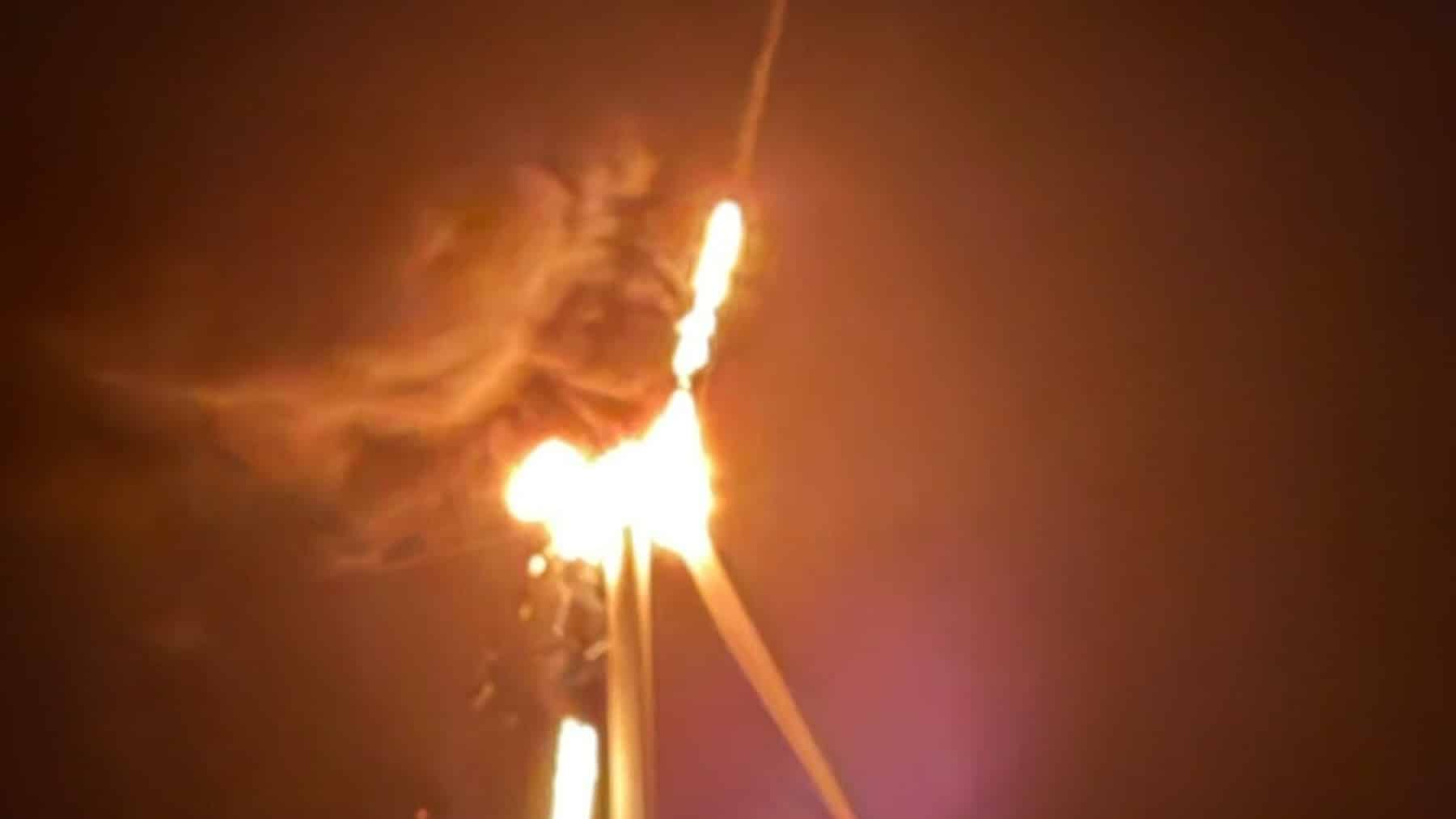
The turbine stands on a dike on the North Sea coast at Simonsberg, a village of about 800 people in Nordfriesland, the county tucked into Germany’s northwestern corner next to the Danish border. At around 10:30 p.m. on Monday, September 21, the nacelle caught fire. That’s the box at the top of the tower that holds the gearbox, the generator and most of the electronics, and on this machine it sits 84 meters up, which is 276 feet. The whole turbine, from the ground to the tip of a raised blade, is 140 meters, or 459 feet. Roughly 60 firefighters and other responders drove out to it, according to a police spokeswoman quoted by the Hamburger Morgenpost. Then they cordoned off the ground and let it burn.
So why didn’t anybody put it out?
Because nothing they own goes that high
The standard German ladder truck, the kind every decent-sized town keeps in the firehouse, is rated to reach roughly 75 feet. The big ones get a little past 100. In the States you’d call that a 100-foot ladder truck, same idea. This fire was at 276 feet. You could stand two of the biggest ladders in the country end to end and still come up about 65 feet short, and that’s before you ask who’s going to climb toward a steel box full of burning gearbox oil.
So the police spokeswoman’s explanation, that the height made it impossible to fight the fire, isn’t a cop-out. It’s the official playbook. The German fire service association, the DFV, put out a guidance note on wind turbine fires when the country had fewer than 20,000 of them, and the advice hasn’t really changed since. If the fire is at the base of the tower or in the little transformer shed next to it, go ahead and fight it. If it’s up in the nacelle, don’t. Clear a radius of at least 500 meters, which is 1,640 feet or roughly a third of a mile, push that cordon further out downwind if it’s blowing, and let the machine burn out under supervision.
That’s basically what 60 people did at Simonsberg.
What’s actually up there burning?
Quite a lot, as it turns out. The nacelle on a turbine this size is give or take the volume of a school bus, and it holds a gearbox full of oil, a generator, the hydraulics that pitch the blades, and cabinets of cable and switchgear. The outer shell is fiberglass, same as the blades. Once the oil and the plastic get going, the whole top of the tower burns like a bonfire with a very good view, and pieces of it come down. Burning fiberglass, chunks of the housing, and in the worst cases a whole blade. The 500-meter rule exists because of what falls, not because of the flames.
That’s also why the regional dispatch center sent a public warning for Simonsberg at 10:47 p.m., 17 minutes after the first alarm, telling people to stay out of the area and expect heavy smoke. It canceled the warning at 11:51 p.m., 64 minutes later. Police said the next morning that the cause wasn’t known, and as far as I can find, nobody has named the operator, the turbine model, or how long it burned. Simonsberg has several turbines with different owners on file, so I can’t even tell you whose machine it was.
A quick note on the height, since the German reports don’t agree. One outlet put the fire at about 60 meters, roughly 200 feet. The police spokeswoman quoted by the Morgenpost and the Flensburger Tageblatt, the local daily, both say 84. I’m going with the police.
How often does this happen?
Less than you’d think, and more than the industry would like. Germany had 29,226 wind turbines running on land at the end of last year, per the annual count the BWE trade group commissions, with 958 new ones switched on during the year and 456 retired. Nobody keeps an official national tally of turbine fires. The BWE keeps a list it admits isn’t complete, and that list had a little over 70 fires on it going back about two decades when the Bavarian public broadcaster asked last year. The group’s own estimate is five to ten fires a year nationwide. Call it one turbine in 3,000 to one in 6,000 in any given year.
That’s a pretty good record, frankly. It’s also cold comfort if you run the volunteer fire department in a county like Nordfriesland, which has the second-highest density of wind turbines of any county in Germany, 1,222 kilowatts for every square kilometer of land by the BWE’s figures, behind only the next county down the coast. If one turbine in 3,000 burns in a year and your county is wall to wall with them, you’re going to get the call eventually. And when you do, you’re going to stand in a field.
The Simonsberg machine is a little unusual in one way, by the way. At 459 feet it’s slightly shorter than the average turbine standing in Germany, which the same BWE report puts at 147 meters, or 482 feet. The turbines the country switched on last year averaged 222 meters, or 728 feet, with their hubs around 479 feet off the ground. So the fire at Simonsberg was high for a ladder and low for a turbine. On a new machine the same fire would be burning at nearly twice the height, and the firefighters would be doing the same thing from the same distance.
Can you build a turbine that puts itself out? Sort of. Some newer nacelles carry automatic suppression systems that flood the compartment with gas or water mist when a sensor trips. Whether the Simonsberg turbine had one, and whether it fired, hasn’t been reported. Given the result, I’d guess not, but that’s a guess.
If you want the version of this story where a German turbine comes down on purpose, a village in Saxony had an 820-foot machine taken apart with cranes this summer because it hummed. And off the Irish coast, a jack-up barge just pulled the blades off seven 406-foot turbines that stand a bit shorter than the one at Simonsberg. Turbines get taken down all the time. They just don’t usually take themselves down at 10:30 on a Monday night.
The Flensburg police said on the morning of September 22 that the cause of the fire was still open. The Kooperative Regionalleitstelle Nord, the dispatch center that covers Nordfriesland, had sent its public warning for Simonsberg at 10:47 p.m. the night before and lifted it at 11:51 p.m.
Image Credit: mopo.de