
How do you sink more than 10 years and close to $1.5 billion into a helicopter that flies itself, buy 38 of them, and then decide you don’t want any of them a little over two years after the first one went to sea? Ask the Navy.
The Navy managed it with the MQ-8C Fire Scout, and I’ll admit I’d pretty much written the program off as one of those expensive Pentagon footnotes. Then the Army showed up and asked for four.
Four of the Navy’s retired Fire Scouts are now flying out of Dugway Proving Ground in Utah and Redstone Arsenal in Alabama as test aircraft for Army sensors, flown by a team that, in its own words, started with zero experience on them. The Navy says the whole arrangement kept a bit over $70 million off the Army’s procurement bill, and it put the story out through the Department of War’s feature desk on October 23.
So a program that was being wound down and trucked to the desert has a second act, sort of. How did that happen, and why did the Navy walk away in the first place?
So what is an MQ-8C, exactly?
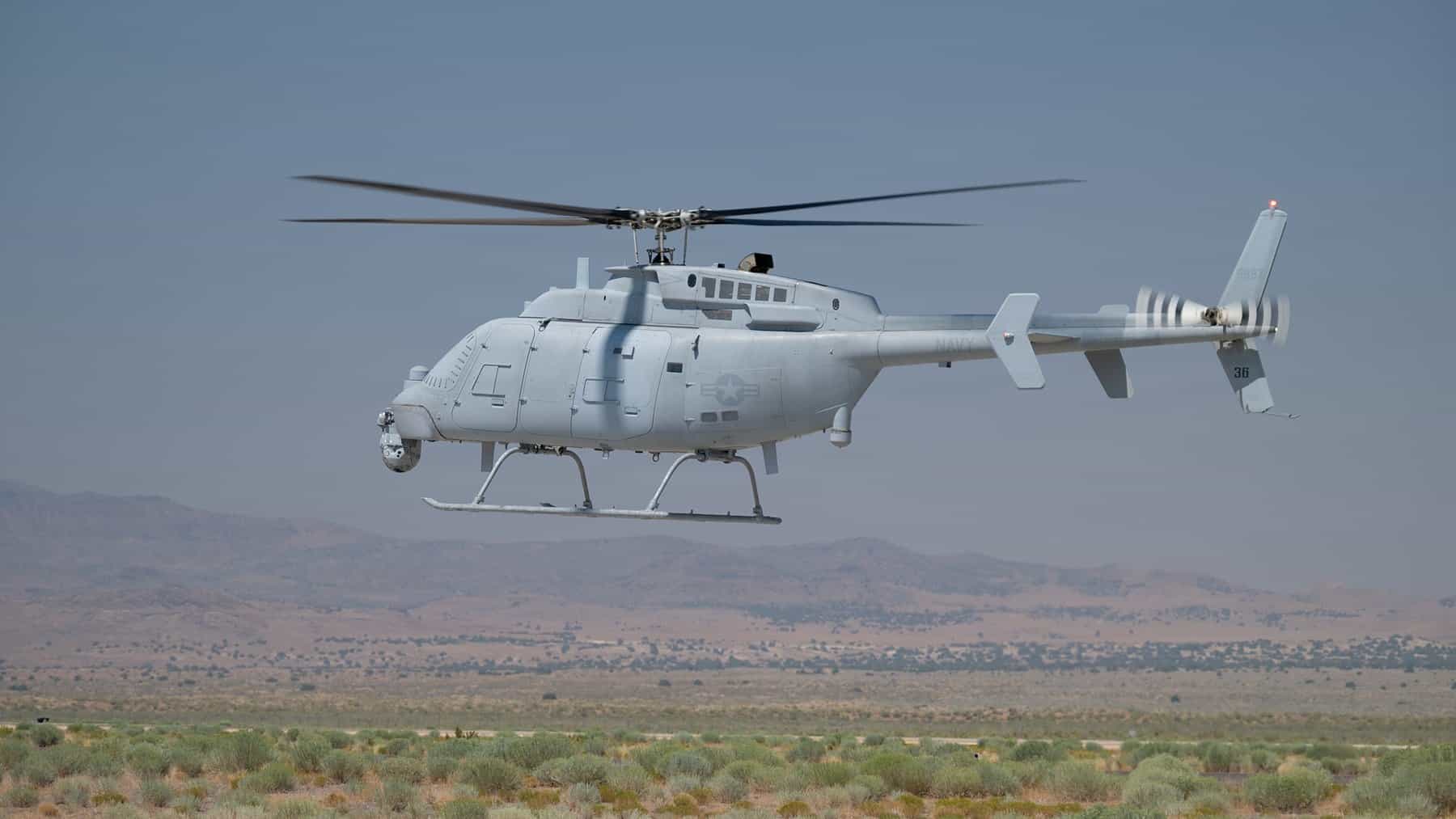
If you’ve ever been on a tour helicopter over the Grand Canyon or watched a traffic chopper on the morning news, you probably saw a Bell 407. Northrop Grumman took that airframe, pulled out the pilot’s seat and everything a pilot needs, and filled the space with fuel, autonomy hardware, and sensors. Northrop’s own page puts the 407 at north of 1,600 airframes and 4.4 million-plus flight hours, and that’s the point: you don’t develop a new helicopter; you teach a proven one to fly alone.
By the Navy’s fact file, the result weighs 6,000 pounds with fuel and payload on board, runs 34.7 feet long, tops out at about 155 mph, and can stay up for 12 hours while working roughly 170 miles from the ship. It carries more than 700 pounds of payload.
The job was to take off from the deck of a Littoral Combat Ship, go look at things with cameras and radar, and come back. As an added twist, there’s nobody on board for any of it. That’s a lot of capability for a helicopter nobody wanted to keep.
Why the Navy let it go
The first MQ-8C deployment was on the USS Milwaukee in December 2021. By early 2024, the Navy’s budget request already had the type on the way out, and FlightGlobal went through the budget documents that spring.
Operational flying was set to end in the last quarter of fiscal 2024, with the full sundown due by the close of fiscal 2026, which is September 30 of this year. The Navy once planned to buy 177 of these for $3.47 billion. It bought 38, pulled two from the inventory, and had 17 of the remaining 36 actually operational when the retirement was announced.
Cmdr. Ian Adams, the resource officer for the type in the Navy’s Air Warfare Division, gave FlightGlobal the reason in one line: “It’s sitting around $28 million per copy,” and a drone costing $100,000 to $250,000 could handle the same job. Basically, the small Group 3 drones got good enough while the Fire Scout was still working its way through testing, and a helicopter-sized price tag stopped making sense for a job a much cheaper aircraft could do.
Manned MH-60s would cover the gap. The Constellation-class frigate had been designed to carry the MQ-8C, and that question’s still open.
You can argue that either way. A 12-hour helicopter with a proper radar does things a $250,000 drone can’t, and I’d frankly rather have both. But the Navy’s math was the Navy’s math, and the divestment started in February 2024.
Halfway to the boneyard
When the Navy retires an aircraft, it usually goes to the 309th Aerospace Maintenance and Regeneration Group at Davis-Monthan Air Force Base in Tucson, which everyone just calls the boneyard. It holds close to 4,000 aircraft and 6,650 engines, and a Defense Department photographer shot a row of Fire Scouts sitting there in the Arizona sun in February 2025.
The program office was about 60 percent of the way through shipping aircraft, control systems and support gear to Tucson when the Army sent over a request for information in November 2024. The Redstone Test Center in Alabama, under Army Test and Evaluation Command, wanted to know whether a Fire Scout could serve as what the Army calls a captive carry testbed.
Captive carry just means you bolt a new sensor or payload to an aircraft and fly it around without ever dropping or launching anything. The sensor stays attached, the engineers collect flight data, and nobody’s buying a brand-new aircraft for the job. For a test center it’s a pretty ordinary need, and a helicopter that’ll fly itself for 12 hours with 700 pounds of payload is a pretty reasonable thing to hang sensors on.
I’ll be upfront about one thing the Navy’s write-up doesn’t settle: where the four airframes physically came from. The evaluation visit happened at Point Mugu in California, not Tucson, and the story doesn’t say these particular aircraft came back out of storage.
So “the Army saved four Fire Scouts from the boneyard” is a better headline than it is a fact. The documented version is that the fleet was being shipped there, and four of them went to Alabama instead.
Four aircraft, two control trucks, and a year waiting on radios
The timeline moved fast by Pentagon standards. This is something I don’t get to write too often when reporting on military stuff. Teams went to Point Mugu in December 2024 to look at the aircraft and the mobile mission control systems.
In January 2025, the test center put the ask in writing to the Navy’s Air Warfare Division: four MQ-8Cs, two of those mobile control systems, spare engines, and the support equipment to stand up a site at Redstone. The Navy approved it in May 2025, and by July that year the four aircraft, the two control systems and the support gear were all sitting in Alabama.
Then came the step that actually took a year. Earlier in the divestment, radios, transponders, and modems had already been pulled from the aircraft and returned to common stock, the Navy’s shared parts pool.
Getting those back out took what the program office describes as a year of negotiations with Naval Supply Systems Command, and the last of that gear arrived at Redstone this July. That means the Army couldn’t fly four helicopters for about a year while waiting on radios.
Ground testing wrapped up in August and flight tests started at Dugway and at Redstone. The Army’s own photo shows one of the aircraft hovering over Michael Army Airfield at Dugway on August 4.
Chief Warrant Officer 4 Taylor Kiel, the test director and experimental test pilot on the project, said: “Considering where we started, having zero experience with these systems, it’s quite remarkable what has been accomplished.”
Marine Corps Col. Leigh Irwin, who runs the Navy’s Multi-Mission Tactical UAS program office, called it a win for both services’ acquisition shops and said the whole transition, through to first flight tests, came in within 14 months.
So is $70 million the real number?
That $70 million is definitely an eye-catching part of the story. It’s the program office’s estimate of what the Army would have spent buying equivalent aircraft, not an audited figure, and it covers the whole package: four aircraft, two control systems, engines, and support equipment.
So you can’t divide it by four and call it the price of a Fire Scout, and you shouldn’t set it against the Navy’s 2024 “$28 million per copy” either, because the two numbers weren’t calculated the same way. The Navy also says it’s seeing savings in testing, flight hours, data, contracts, and manpower, but it didn’t put a dollar figure on any of that.
As far as I can tell from the Navy’s account, the Army got a flying sensor test rig with 12-hour endurance and a control system that’d already been built and worked. The Army didn’t get a weapon.
These are test aircraft for Army sensor packages, and the announcement doesn’t put them anywhere near a combat role or a deployment. The Navy hasn’t said which sensors are going on them either, and that’s apparently the kind of detail you leave out of a press release about a sensor testbed.
We’ve been watching a lot of this hand-me-down logic lately. A British cargo drone that spent months hauling supplies between warships was hung with laser-guided rockets at a Florida air base and sent after kamikaze drones, and a 4,100-ton frigate that sat tied up in Philadelphia for 13 years was towed across the Atlantic to be sunk as target practice. Against that, four helicopters that get to keep flying because someone in Alabama sent an email is arguably the happiest ending retired military hardware gets.
Is this the Fire Scout coming back? No. The Navy’s schedule still had the last of its MQ-8Cs off the books by the end of September, and nothing I’ve found confirms whether that date held or slipped. The Navy’s own account confirms something smaller and more specific: the Army asked in November 2024, the Navy said yes in May 2025, the radios showed up in July 2026, and an MQ-8C was hovering over Dugway Proving Ground for the Army on August 4, 2026.