
The last time you thought about a breakwater was probably never, and that’s sort of the point of a breakwater. You pile rock in a long line outside a harbor, the waves break on the rock instead of on the ships, and everyone tied up behind it forgets the thing exists. It’s been the deal for a couple thousand years.
Genoa’s deal has a snag. The existing breakwater sits too close to the docks to give the biggest container ships room to come in and turn, so the port’s building a new one farther out, with maneuvering room Webuild says will take ships around 1,300 feet long. Farther out, on that stretch of the Mediterranean, means a lot deeper.
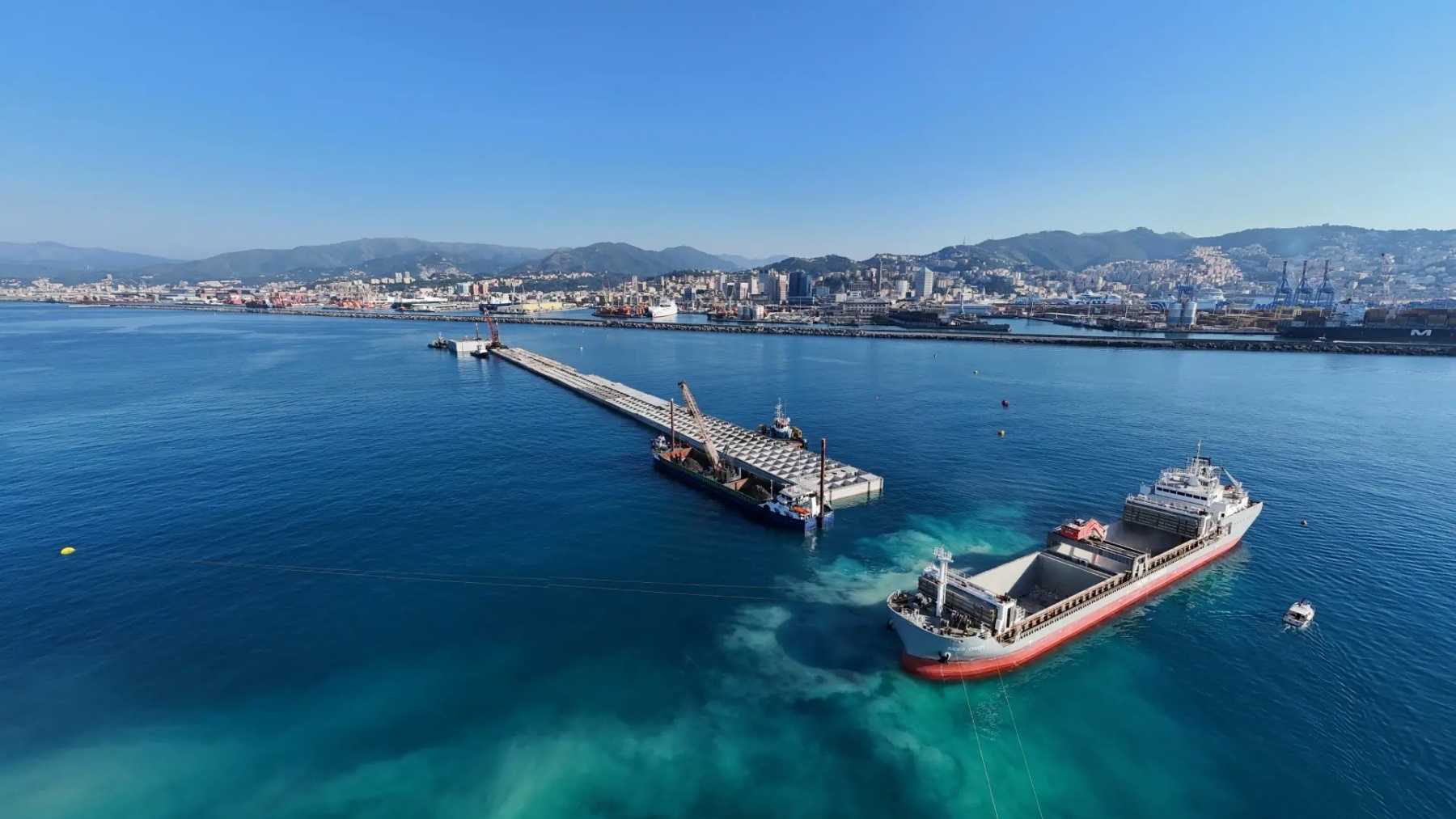
On September 8, Webuild, the Italian contractor leading the consortium building it, announced that work had started on the crest wall, the concrete barrier that will run along the top of the whole structure and stand about 23 feet above the water. The same release mentioned, almost in passing, that the 32nd caisson had recently been set on the seabed.
So what’s a caisson, and why am I counting them?
So what exactly are they sinking out there?
A caisson is a hollow concrete box. Picture a shoebox with the lid off and a grid of partitions inside, then make it out of reinforced concrete and scale it up to the size of an apartment building. Crews build each one floating in Vado Ligure’s harbor, down the coast from Genoa, pouring the walls in stages and jacking the steel formwork up a few yards at a time until the box is tall enough. Then tugboats tow it to the site, the crew floods the cells with seawater, and it settles onto a prepared base. Once it’s down, the cells get filled with rock, and the box isn’t going anywhere.
They come in two sizes. The standard ones run about 131 feet long and 82 feet wide, the first of them stood 71 feet tall, and the port authority has put them at roughly 11,000 tons apiece. The mega caissons, built for the deepest stretch, measure 220 feet long, 98 feet wide and 108 feet tall, which Webuild compares to an 11-story building, and the company puts them at about 16,500 tons. There’ll be 35 of the big ones.
You don’t build a 16,500-ton box on a regular barge. The big ones take shape on a semi-submersible platform called Tronds Barge 33, which sinks itself about 66 feet so a finished caisson floats off its deck instead of being lifted. Webuild says the barge goes under and comes back up “like a steel whale,” which is a pretty good line for a press release, and frankly beats trying to find a crane for the job. The consortium even mixes some of its concrete on a floating plant out at sea.
Most of the work is underwater, and most of it is gravel
You can’t just drop an 11,000-ton box on the seabed and hope for the best. Before any caisson goes down, the consortium drives gravel columns into the bottom. A vibrating steel probe the engineers call a vibroflot hangs from a crane on a floating pontoon, works its way into the seabed with water and air jets, and gravel pours in around it as it comes back out, leaving a compacted column behind. Each one runs 23 to 39 feet long, the plan calls for 70,000 of them, and the last count the consortium made public put about 49,000 in the ground. On top of the columns goes a bed of rock, close to 10 million tons of it by the end, shipped in from quarries in Liguria, Tuscany and Spain. The caissons sit on that.
So why go that deep at all? Because the farther from the docks you put the wall, the deeper the water under it, and along the new line the seabed drops from 82 feet to 164. A conventional rock-pile breakwater gets wider at its base the deeper the water gets, so at 164 feet you’d be dumping a small mountain into the sea. Standing hollow concrete boxes on a gravel bed is, roughly speaking, how you build a vertical wall in deep water instead.
Webuild says no offshore breakwater in Europe has ever been founded that deep. That’s the company’s claim, not mine, though I’m not aware of one that goes deeper.
The crest wall is what you’ll actually see
The caissons don’t finish the job on their own. Their tops poke several feet above the surface once they’re sunk and filled, and the consortium then pours a concrete slab across them, the superstructure, and builds the wave wall on top of that. The release puts the finished height at about 23 feet above sea level, which is the same height as the breakwater Genoa has now, according to the port authority. The wall’s designed to take the combined hit of surface waves and the ones moving underwater, the company says, and to keep the access channel and the basins behind it calm enough to keep ships moving in bad weather.
The company frames the start of the wall as the moment the project stops growing mostly underwater and starts showing itself above it. That’s a bit of corporate poetry, but it’s also basically true. After more than three years of work, most of what’s been built is something you’d need a dive computer to visit.
So how far along is it?
I’ve gone through Webuild’s release list for this, because the company announces caissons the way some automakers announce sales figures, one at a time and with great enthusiasm. The 27th went down on July 21 and brought the breakwater to about 4,070 feet. By the end of July the count stood at 29, three caissons in ten days, which the company made a point of noting, and I don’t blame them. That’s a brisk pace for anything built on the seabed. The 31st, a mega caisson, landed on August 10 and pushed the structure to roughly 4,900 feet, a shade under a mile. Then came the 32nd, and the September 8 release about the wall.
Webuild hasn’t said which day the 32nd actually went in, or whether it’s one of the big ones, and it doesn’t publish a running tally of how many of the 32 are the mega size. Going by the releases, at least six are.
Thirty-two is a long way from done. Webuild’s project page calls for more than 70 caissons in the first phase, which covers just under 3 miles of a breakwater that’ll eventually run about 3.8 miles, and the Italian trade site Shipping Italy counts 103 in all once the second phase adds 30 more on the outer arm. The schedule the consortium works to allows about 20 days per caisson, and the July run of three in ten days tells you they can stack placements a lot closer than that when the weather cooperates. I’d read the summer as the consortium showing what it can do, not what it can do every month.
The deadline’s moved, too. This project was sold as a flagship of Italy’s post-pandemic recovery plan with a finish date of next month. The revised plan pushed the end of the first phase to December 2027, according to Shipping Italy, with about €300 million in extra cost attached, and the project page itself now simply says 2027. I wouldn’t put money on December 2027 either, frankly, but that’s a hunch, and the summer pace is the best argument the consortium has against me.
If sinking giant concrete boxes sounds familiar, it’s because we watched a Danish crew lower an 81,000-ton box onto the Baltic seabed late last month. Different trick, though. The Danish boxes are sealed tunnel sections lowered into a trench, while Genoa’s are open on top and sunk by flooding them, which is closer in spirit to the two barges Hungarian crews sank in the Danube this summer to prop up a river, except these were designed to sink from day one.
One more detail I liked. For the last couple of years, the consortium’s been handing the sea life it scrapes off the bottom to the Genoa Aquarium, which keeps it until construction ends and then puts it back. Someone at that aquarium has a very specific job.
Webuild announced the start of the crest wall on September 8, 2026, with the 32nd caisson in place and the breakwater running just under a mile of the roughly 3 miles planned for the first phase, and the consortium’s revised schedule has that phase wrapping up in December 2027.