
Roundabouts are one of those things American drivers have opinions about. Traffic engineers keep installing them because the crash math works out, and plenty of drivers keep treating each one as a personal insult.
Norway has just finished carving two of them 820 feet under the sea.
They sit inside Rogfast, the road tunnel Statens vegvesen is blasting under the Boknafjord on the country’s west coast. When it opens in 2033 it will run 16.6 miles between Randaberg, just north of Stavanger, and Bokn, in twin bores with two lanes each, bottoming out around 1,280 feet below sea level.
The depth is not the interesting part. The interesting part is that a tunnel this deep has an exit, the exit needs somewhere to turn around, and the island it serves has 576 people on it.
Nobody had built a junction like this under the sea before
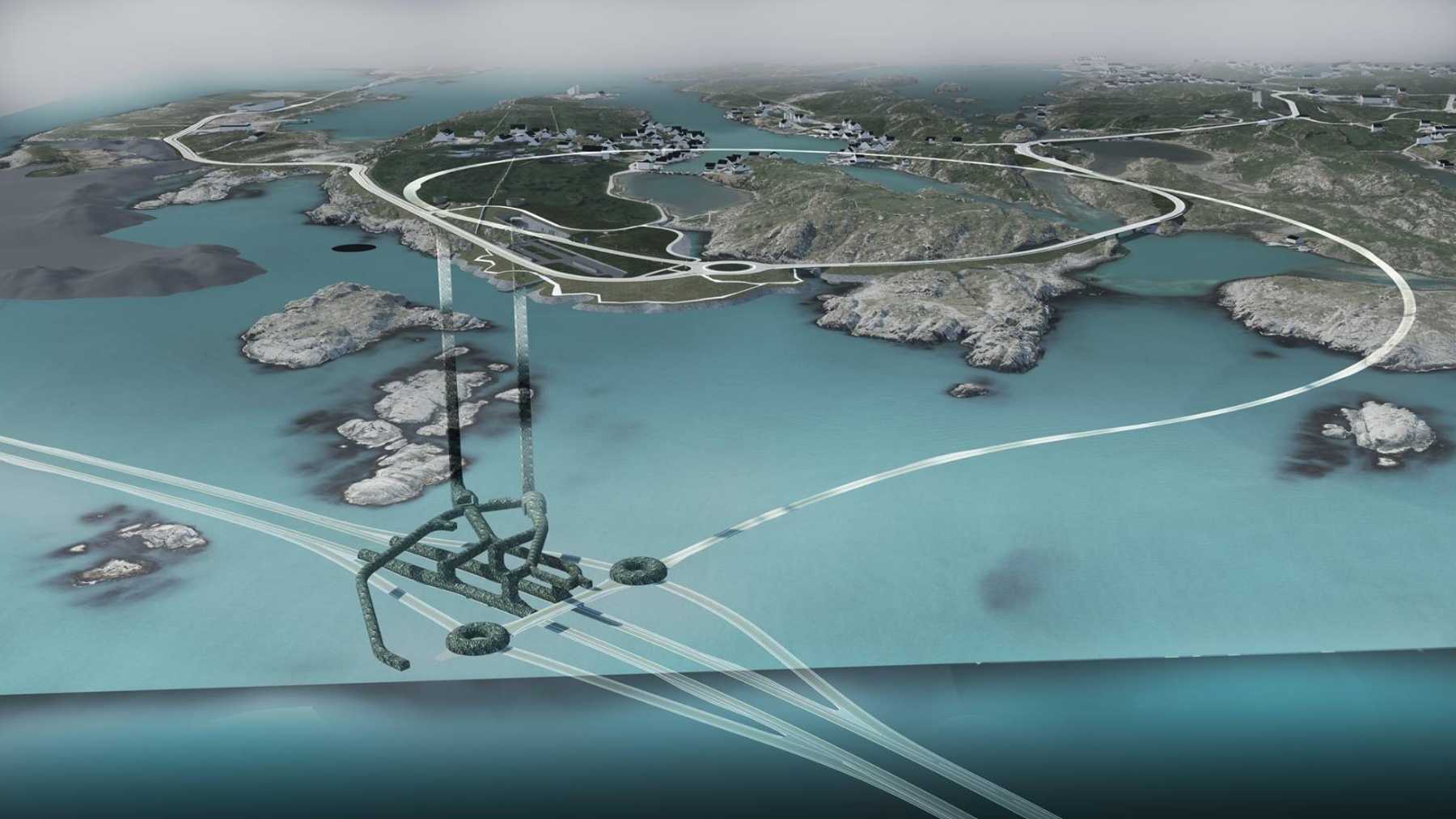
What sits under the island of Kvitsøy, roughly halfway along the route, is a grade-separated interchange blown out of solid rock. Two levels, on-ramps and off-ramps, and two roundabouts feeding a 2.2-mile spur that spirals up to the surface.
Rogfast runs as two separate one-way tubes, which is why one roundabout was never going to do the job. Getting traffic on and off in both directions takes one on each side.
Statens vegvesen announced on February 24, 2026 that the junction had been fully excavated, and described the layout as a design not previously used in an undersea tunnel. That is a fairly restrained way of saying they built something with no precedent 820 feet below the North Sea and then went back to work.
The contract covering it is the largest execution contract the agency has ever awarded: 6.24 billion kroner, about $650 million, held by a joint venture of Implenia and Stangeland Maskin. It covers roughly 5.5 miles of twin-bore tunnel plus the junction and the ventilation works.
The island at the top of the ramp has 576 people on it
Kvitsøy is Norway’s smallest municipality by area, a shade over 2.4 square miles sitting out in the mouth of the Boknafjord. Statistics Norway put the population at 576 in the first quarter of 2026, and the place has actually been growing.
Its highest point is about 92 feet above sea level, on an uninhabited islet, which makes it the lowest high point of any municipality in the country. So the flattest patch of land in Norway is getting the deepest road interchange on the planet drilled underneath it.
Right now the only way on or off is the ferry. When Rogfast opens, Kvitsøy stops being an island in the practical sense, which is the entire reason the spur exists.
Halfway is not the easy half
The same February announcement carried the bigger number. Rogfast is now halfway driven, with crews working from three separate points: Randaberg in the south, Bokn in the north, and outward in both directions from the junction under Kvitsøy.
“That we can now announce that Rogfast is halfway driven is big news, and an important moment for the whole project,” said Sveinung Brude, project manager at Statens vegvesen, in the agency’s statement.
Breakthrough between Bokn and Kvitsøy is scheduled for 2028. Randaberg to Kvitsøy follows in 2029. The teams laser-scan constantly and are aiming to meet within about two inches, which is the sort of tolerance that sounds absurd until you remember they have been walking toward each other underground for years.
The agency has also been open about what comes next, and it is not a victory lap. Surveys indicate the weak rock zones get worse across the second half of the route. Project director Kjell Håvard Belsvik has said the project is well prepared for them, which is a useful thing to be, because Norwegian subsea tunneling is mostly a long argument with seawater.
Crews drill probe holes 80 to 100 feet ahead of the face to see what is leaking. Past a threshold of roughly a liter a minute per hole, they stop and pump cement grout into the rock before blasting again. Progress on the Skanska side, MIT Technology Review reported after a site visit in the spring, swings between 30 meters in a good week and 10 in a bad one.
The tunnel breathes through two shafts drilled 692 feet straight down
Road tunnels have a problem rail tunnels mostly do not, which is that cars produce exhaust and somebody has to get rid of it. Rogfast handles that with two vertical shafts sunk from Kvitsøy down to the tunnel network, one pulling stale air out, one pushing fresh air in.
They are 692 feet deep, one 30.8 feet across and the other 28.2 feet. The first one broke through on February 24, the same day the halfway milestone was announced. Austrian shaft specialist ÖSTU-STETTIN handled the excavation.
Statens vegvesen calls them the lungs of the tunnel, and the description is doing less work as a metaphor than you might think. Without them a 16.6-mile enclosed road with four lanes of traffic in it does not open.
Norwegian drivers started paying for this in 2013
Here is the part that gets overlooked in the record-breaking coverage. Rogfast is a toll road, and collection did not start when construction did. It started before.
Toll operator Ferde has been taking Rogfast money on the Mortavika–Arsvågen ferry since September 5, 2013. Every ferry ticket across that stretch of the Boknafjord bundles a toll for the tunnel alongside the fare for the boat.
Under the rates effective May 21, 2026, the toll portion runs 74 kroner for a car, roughly $7.70. Motorcycles pay 20 kroner. Vehicles over 72 feet long pay 285 kroner, about $30.
Collection then continues at conventional toll plazas for 20 years after the tunnel opens, with the whole thing expected to wrap in 2053. Drivers on that crossing will have been paying for Rogfast for four decades, and for the first 20 of them they were paying while riding the ferry it is designed to put out of business.
The financing is still being assembled. On July 13 the Nordic Investment Bank and Ferde agreed a non-binding facility of up to 4 billion kroner, around $417 million, with loan terms running as long as 27 years.
That crossing is not a quiet one, for what it is worth. It carried just over 1.8 million vehicles in 2024, on a 25-minute sailing that runs every half hour.
What the drive is actually going to be like
About 30 minutes, underground, with no daylight and not much to look at. That is long enough that the designers are treating driver alertness as an engineering problem rather than a nice-to-have.
Norway already ran the experiment. The 8.9-mile Ryfylke Tunnel, currently the world’s longest subsea road tunnel and the one Rogfast is about to demote, opens into a large lit hall partway through, with colored lighting that changes day to day. Artists will be invited to do something comparable inside Rogfast.
Norway has spent decades building this way, and the results keep landing on other people’s desks. The country’s engineers have fielded questions from Japan, Spain and Morocco, and representatives from several US states were scheduled to tour the Rogfast site in May. A two-man British firm has already used Norwegian costs to argue for a Pennine tunnel, and the method Norway used here, explosives rather than a boring machine, is the same one behind its ship tunnel through a coastal mountain.
Compare that with Europe’s other headline subsea job, the Fehmarn Belt link between Denmark and Germany, where 73,500-ton concrete boxes are being lowered onto the Baltic seabed and the schedule has already slipped badly. Rogfast is doing something harder in worse rock and is currently on its stated timeline.
Seven years out from opening, the most complicated single piece of it is finished, and it is a pair of roundabouts almost nobody will ever use.