
Low water on the Mississippi has turned into a pretty regular fall story. You’ve probably seen the photos of towboats and barges stuck on sandbars, waiting for the river to come back up.
Hungary’s government spent August doing the opposite. Its crews wanted barges sitting on the bottom of the Danube, on purpose, and then they started dumping rock across the whole river behind them.
That rock pile is now the reason the country’s only nuclear plant is running. Hungary’s national water directorate says the river is in worse shape than it was in early August, when the plant nearly shut down completely. All four reactors are producing power anyway, because the half-finished underwater dam is holding the Danube about 20 inches higher than it would otherwise sit.
There’s a catch, though. Ships can’t get past it, and the current plan keeps that stretch of Europe’s second-longest river closed to through traffic until the end of November.
So why does a nuclear plant care how deep a river is?
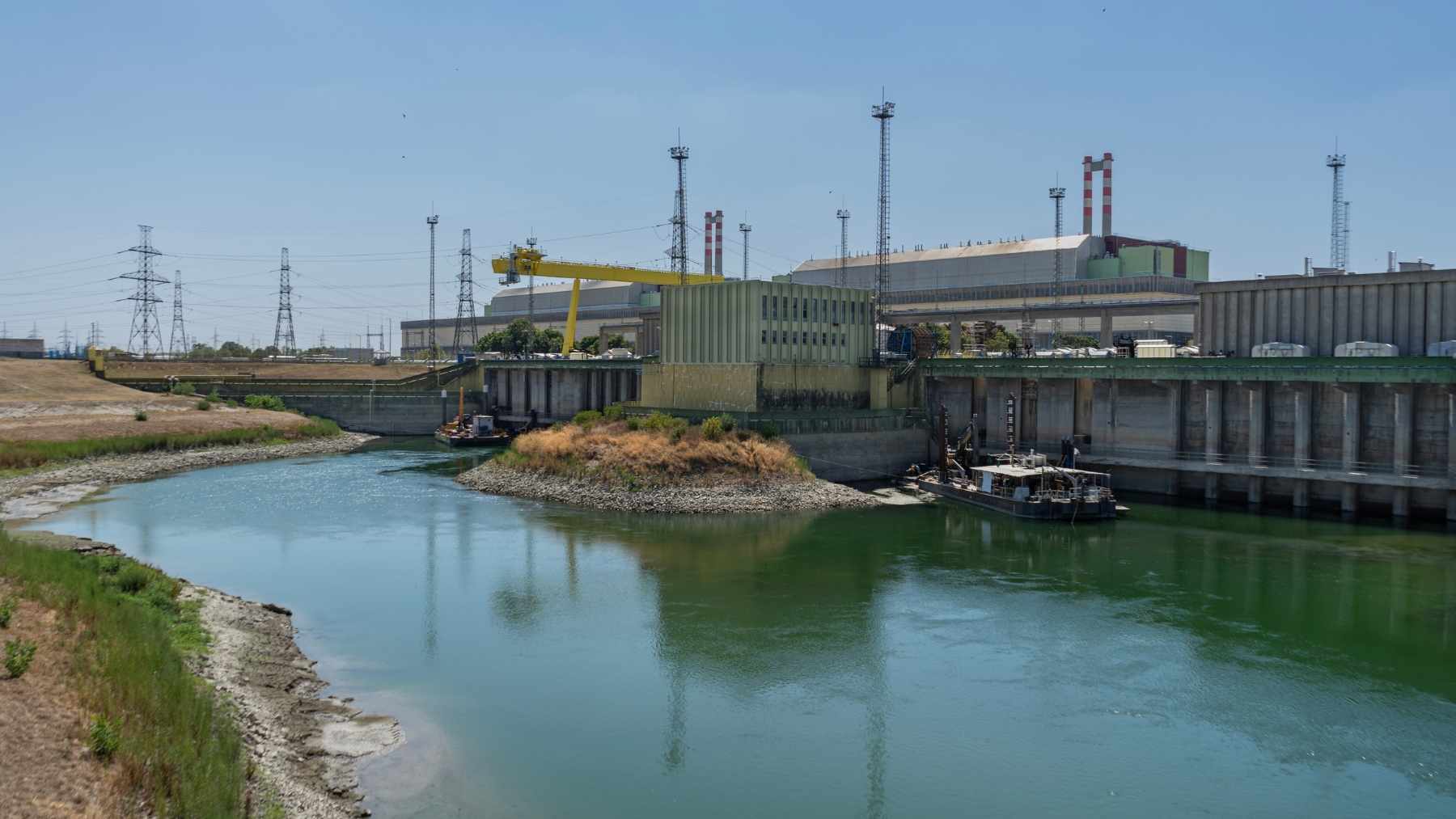
Paks sits about 62 miles south of Budapest and runs four Soviet-designed VVER-440 reactors rated at 479 megawatts apiece. It’s responsible for roughly half of Hungary’s electricity, and like a lot of older plants, it’s cooled with river water.
Here’s the basic setup. The reactors heat water that makes steam, and the steam spins the turbines. Something then has to turn that steam back into water, and at Paks that’s the job of Danube water running through the condensers, which never touches the reactor itself. The running units need about 26,000 gallons of it every second.
You may be thinking the Danube can’t exactly run out of water, and you’d be right. MVM, the state utility that runs Paks, said in a statement carried by World Nuclear News that there was still enough flow to cool the units. The trouble was that the pump intakes sat higher than the surface of the river.
So the water was there, but the pumps couldn’t reach it.
That’s frankly a slightly absurd problem for a 2,000-megawatt power station to have, but it isn’t really a design blunder. By late July the river was 11 inches below its previous record low, according to MVM. And that old record already sat about 3.3 feet under the lowest 100-year level the plant’s designers planned for.
Prime Minister Péter Magyar said output fell from 965 megawatts to 240 in a single night. The government announced a full shutdown, which would’ve been the first in the plant’s history, but it never quite came to that. Unit 2 kept running at very low power through the worst of it, according to NucNet.
Cooling water intakes are a surprisingly common weak spot, by the way. Last month, jellyfish pushed crews at a French plant to shut two reactors down by hand before the swarm could clog the screens.
How do you lift a river?
Basically, you build a speed bump across it. Hungarian engineers call it a bottom sill, and it’s a low wall of rock laid across the riverbed. Water still flows over the top, but it has to back up behind the wall to get there, so the level upstream rises.
The government signed off on August 12, and there wasn’t a plan sitting in a drawer. OVF, the national water directorate, and the engineers it brought in wrote a 411-page one in a matter of days.
The barges were the quick fix. Crews drilled anchor piles 26 feet into the riverbed and tied two 262-foot barges to them with steel cables about an inch and a half thick. Pumps then filled the hulls with water until they settled on the bottom, which is pretty much the opposite of everything a barge is built to do.
Sinking started on August 15. Magyar said the level at the plant’s pumping station rose about 0.4 inches that day. That doesn’t sound like much, but another 4 inches of drop would’ve forced one of the two turbines still running to shut down.
The rock’s always been the real fix, though. Two Airbus H225M military helicopters dropped 4,400-pound concrete blocks into the river, more than 100 trucks hauled stone to both banks, and about 130 people worked the site around the clock.
By August 29, 17 days in, the rock reached all the way across the Danube. That first phase took about 56,000 cubic yards of stone, and Magyar said it finished two weeks early. I’d argue that’s the genuinely impressive bit of this story. The barges make for better TV, but the only rise anyone’s put a number on for them is that first 0.4 inches.
The river is in worse shape now than in August
Units 1 and 3 were back at full power by August 24, after the river rose for a few days and the sill started to bite. Magyar said the whole plant was at full output by the end of the month.
Then the river dropped again. József Gacsályi, OVF’s deputy technical director general, told Hungarian outlet Válasz Online that the water situation is now much worse than it was on August 3, when a full shutdown looked possible. Without the sill, he said, the river at Paks would be well below the all-time low it hit on August 4. Instead, all four units are running.
Gacsályi put the sill’s effect at about 20 inches. On September 9, the plant’s cold-water channel had roughly 6 inches to spare before the first turbine would have to come offline. So it’s working, just with less margin than you’d probably like.
The sill does have a side effect, and it’s a pretty predictable one. When you squeeze a river through a narrower gap, the water speeds up, and fast water digs. Gacsályi said the current scoured out about 490 feet of riverbed below the structure. In places the bottom now sits 43 feet down, where it used to be around 20. OVF says that’s something its designers expected.
Investigative outlet Átlátszó had reported that the sill was collapsing and washing out. OVF denies that and says it’s the riverbed that changed, not the structure. The fix they’ve settled on is more rock to partly fill the hole and firm up the bottom, and a gentler drop spread over 660 to 820 feet.
By September 6, Magyar said, roughly 90,000 cubic yards of rock were in the river, about half of the 190,000 he’d said the whole job would take.
Ships still can’t get past Paks
Here’s where it gets complicated. The plan OVF showed the Danube Commission on August 25 keeps this stretch closed to through traffic until the end of November, with short openings when conditions allow. Pro Danube International, which speaks for shipping and logistics companies, says those windows get announced only a few hours ahead. That isn’t much use if you’re trying to schedule a barge full of cargo.
On September 3, a statement endorsed by the transport ministries of all ten Danube countries asked Hungarian authorities to review the closure and get ships moving through again as quickly as they can. The Danube Commission went further in a letter to Hungarian fact-checking site Lakmusz, published September 17. It says the sill’s already keeping the plant running at today’s low flow, and it wants the government to rethink how it finishes the job.
OVF’s answer is that low water is choking shipping all along the Danube anyway. Gacsályi said the river’s carrying roughly 24,000 cubic feet per second, and he doesn’t expect a real improvement until that tops about 35,000. For what it’s worth, I think both sides have a pretty fair point.
The design does make room for ships eventually. The rock spur sticking out from the Paks bank will be cut down to the level of the lower sill. HVG also reports that a roughly 490-foot section in the shipping lane was built so it can be pulled out, and put back if the river ever drops this low again. What I couldn’t find is the sill’s finished height, which is a big part of what the Danube Commission is arguing about.
Oddly enough, the sill doesn’t have its environmental permit yet, because a government decree let construction start before the usual review. OVF has until September 30 to file for the environmental operating permit and until October 15 to start the water-rights process that decides whether the sill gets to stay. Handover is set for November.