
Every famous tunnel you can name got built more or less the same way: a boring machine the size of an apartment building chewed through rock for years until daylight finally showed up on the other end. The Channel Tunnel did it that way. So did the Gotthard Base Tunnel under the Alps. The longest immersed tunnel ever attempted is skipping the drilling entirely, because Denmark and Germany decided the smarter play was to build their tunnel in a factory, tow it out to sea, and sink it in pieces.
That plan stopped being theoretical last month. Between May 4 and May 7, the first of 89 concrete elements for the Fehmarnbelt tunnel was floated out of a Danish work harbor, lowered to the floor of the Baltic Sea and locked onto the Danish tunnel portal, exactly where the engineers said it would go. The box weighs more than 73,500 metric tons, which is roughly 162 million pounds of concrete asked to land on a gravel bed with millimeter-level accuracy. Once finished, the 11-mile (18 km) tunnel will carry four highway lanes and two electrified rail tracks between the Danish island of Lolland and the German island of Fehmarn, and it will be more than three times as long as the current record holder among immersed tunnels, the 3.6-mile (5.8 km) Transbay Tube under San Francisco Bay.
The first box took three days to park
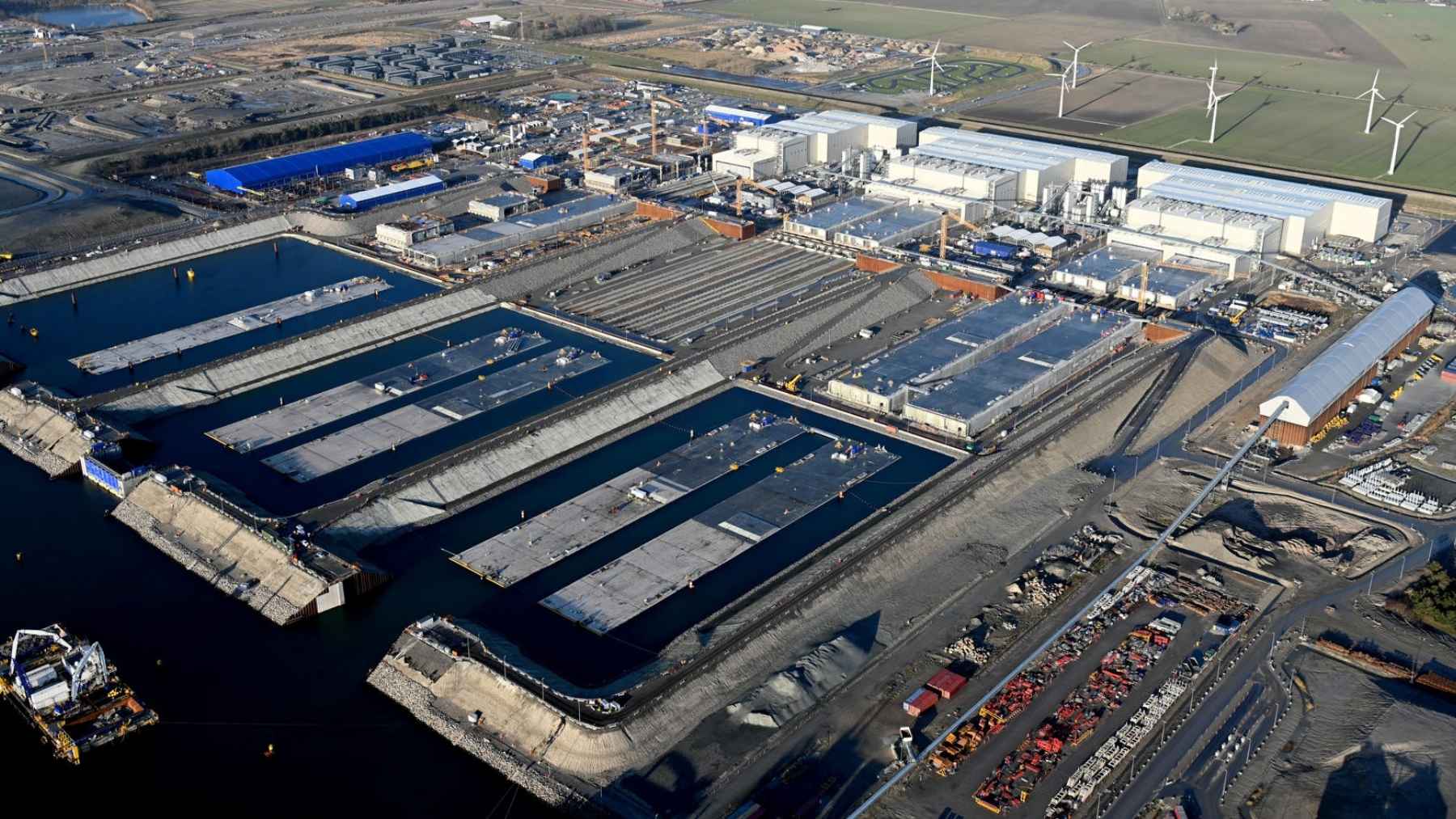
The operation started on a Monday night. At 9 pm on May 4, the element left the work harbor of the tunnel factory at Rødbyhavn on Lolland, where all 89 pieces are being cast. Before departure, crews pumped in 4,500 metric tons of ballast concrete, because the element is sealed at both ends and full of air, and without the extra weight it politely refuses to sink. Five tugboats and a purpose-built immersion vessel called IVY then towed it a little over a mile out to a spot directly off the future Danish portal.
There was a balancing problem to manage on the way down, and Femern, the Danish state company delivering the project, explained it before the dive: the two road tubes are heavier than the two rail tubes, so the structure doesn’t naturally hang level. The fix is a set of temporary water chambers fitted to the outer rail tube, which keep the whole thing horizontal during the descent. The lowering began around midday Wednesday and ran for roughly 14 hours, easing the element into a dredged trench that already had a bed of gravel waiting for it.
Hydraulic arms then pulled it tight against the portal, and surveyors confirmed the final position with laser measurements taken from inside the element itself. The follow-up is almost charmingly low-tech: another special vessel dumps large quantities of gravel along the sides so the box stays put. Sund & Bælt CEO Mikkel Hemmingsen said in Femern’s announcement that the team had “achieved something no one has done before.” Femern also posted footage of the operation, and watching 162 million pounds of concrete get threaded onto a portal is strangely soothing.
Five tubes, 66 winches and 14 miles of steel wire
Each standard element is 712 feet (217 meters) of hollow concrete split into five tubes: two for the highway, two for rail, and a service corridor in the middle for the technical gear. Femern says this is the first time in history that series-produced tunnel elements of this size have been used to build anything, and the production numbers back that up. Per Arup, one of the project’s technical consultants, a single standard element contains about 43,000 cubic yards (33,000 m³) of concrete and displaces 75,000 tons of seawater when it settles in. Ten shorter “special” elements round out the set, each about 128 feet long and 21,000 metric tons, according to New Civil Engineer.
The vessel doing the lowering deserves its own spec sheet. IVY is really two joinable units, Ivy 1 and Ivy 2, that grab either end of an element and pay out cable from 66 winches running some 14 miles (23 km) of steel wire. That winch farm is what lets operators sink an object this heavy to depths of up to 131 feet (40 meters) slowly enough to place it rather than drop it. The Danish Maritime Authority only cleared the vessel this spring after a long wait for final safety checks, which turns out to be a big part of this story.
The margin for error is half a centimeter
Because the milestone arrived two years late. The first element was cast back in May 2024 and the immersion vessels reached the site that October, per New Civil Engineer, and then the whole parade waited while IVY worked through testing and approval. In January, Hemmingsen told reporters the immersion phase was running two years behind schedule, which pushes the tunnel’s opening from the old 2029 target to no earlier than 2031. “It was more difficult than planned,” he said.
Part of the difficulty is that this method has only been tried at scale once before, on the Øresund link between Denmark and Sweden, and the Øresund is about 49 feet (15 meters) deep where that work happened. The Fehmarnbelt runs to 148 feet (45 meters), three times deeper, and Femern’s own people note these elements are longer, wider and heavier than anything Øresund handled. Hemmingsen also put a hard number on the precision required: each element has to be set down within half a centimeter. That’s a fifth of an inch of acceptable slack on a box the length of two soccer fields, lowered through dark Baltic water on steel cables.
New Civil Engineer reported after the immersion that the official timeline is now openly conditional on construction pace and approvals in both countries, and that correspondence between senior project figures earlier this year showed tension between client and contractor as schedule and costs came under pressure. None of that makes the engineering less real. It just means the hard part was never the concrete.
The Baltic seabed is getting crowded
Zoom out and this fits a pattern that keeps showing up in 2026: the most interesting infrastructure on the planet keeps ending up underwater, on purpose. China just lowered a working data center into the sea off Shanghai, cooled by the ocean and fed by offshore wind. Navies are buying submarine drones to babysit the 500-plus seabed cables that carry the world’s internet, a network that runs through this exact body of water. An 11-mile concrete tunnel is the biggest physical object in that club by a comfortable margin.
The no-second-takes flavor of the work has company on land, too. Tasmania’s grid operator is replacing all 287 towers on a live 110,000-volt line without ever switching it off, a different discipline with the same rule: your margin for error is whatever physics says it is, and nothing more. Sinking 89 concrete boxes into a busy shipping strait belongs to the same family. You get one attempt per element, and 88 attempts remain.
So when do you actually get to drive through it?
Later than the old press releases promised, but the payoff hasn’t changed. Driving between Hamburg and Copenhagen today means either rolling your car onto the Puttgarden to Rødby ferry, a crossing of about 45 minutes before you count the boarding line, or taking the long way around, which Vinci, part of the construction consortium, puts at a roughly 100-mile (160 km) detour. The finished tunnel cuts the actual crossing to 10 minutes by car and 7 by train, and Femern says the Copenhagen to Hamburg rail trip drops from about 5 hours to 2.5.
The European Commission has designated the link a priority project and put roughly 1.3 billion euros into construction, on a build that International Railway Journal prices at 7.4 billion euros overall. Denmark is constructing and financing the tunnel and plans to earn the money back through tolls, the same model that paid for the Øresund crossing. The EU’s transport commissioner, Apostolos Tzitzikostas, called the first immersion a historic achievement and said Brussels will back the project the rest of the way.
The first box took three days on the water and two extra years in the waiting room. The remaining 88 get the same recipe: float it out, ballast it down, lower it for 14 hours, land it inside half a centimeter, bury its flanks in gravel, repeat. The score so far is 1 for 1. On a job where a single botched landing stalls everything queued behind it, that’s the only stat worth checking.