
Anyone who’s bought a used car knows the moment it goes up on the lift. The mechanic grabs a flashlight, walks underneath, and you finally find out what you actually paid for.
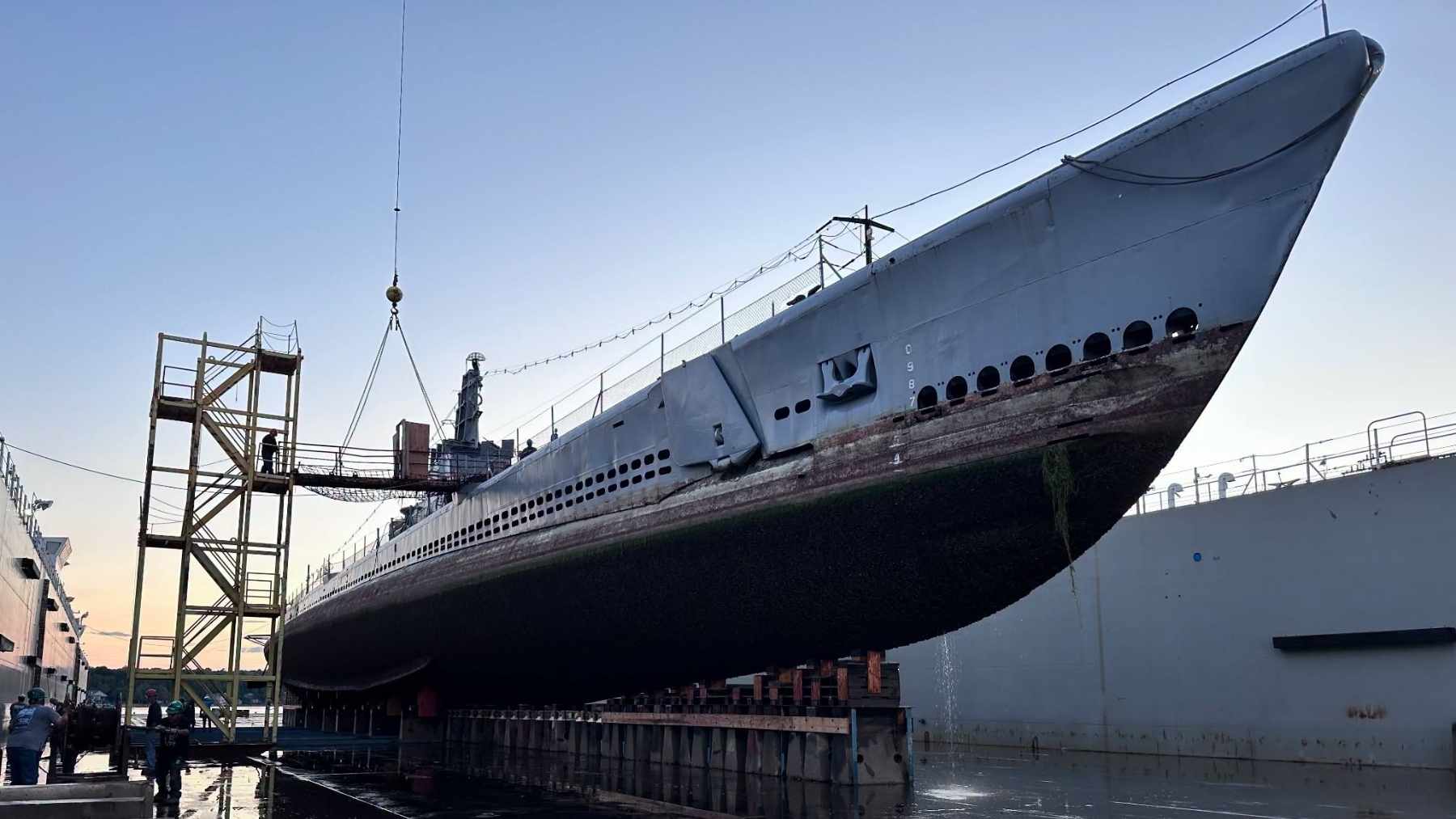
USS Silversides has spent the summer on the submarine version of that lift. The World War II sub, a museum ship in Muskegon, Michigan, got towed across Lake Michigan in July and set down on blocks in a drained dry dock in Sturgeon Bay, Wisconsin. She hadn’t been out of the water since 1954, and the museum says she’s scheduled to come home this month.
So what do you find under a submarine after 72 years?
A hull in better shape than anyone expected, as it turns out, plus a few surprises. One of them wasn’t even hers.
If you’re not a submarine person, Silversides is kind of a big deal. She was commissioned a week after the US declared war on Japan, and a joint Army-Navy committee credited her after the war with 23 enemy vessels sunk, according to the Navy’s history of the boat. Scott Hardin, the museum’s vessel curator, told WXYZ in July that the two subs ranked above her are both gone.
One of the tugboats is older than the submarine
So why tow a submarine whose engines still run? Because her propellers came off a long time ago, according to The Maritime Executive. Her Fairbanks-Morse diesels still run, but that’s about as useful as a healthy engine in a car with no wheels.
Two tugboats ended up hauling the 312-foot sub across the lake. By the Navy’s count, she displaces 1,526 tons on the surface. The tow left Muskegon in the early evening of July 13 and reached Sturgeon Bay the next morning, 16 hours later, according to the museum’s account of the trip.
Six people from the museum, three staffers and three volunteers, rode inside the sub the whole way to watch every compartment and gauge. The museum says her ballast tanks didn’t take on a drop of water, which is pretty reassuring for a boat her age.
The tugs were the Nickelena and the Erika Kobasic, and I’d happily buy the Kobasic a beer. The museum says she joined the Coast Guard in 1939, and back then she was the Arundel, a 110-foot icebreaking tug that spent World War II on the Greenland Patrol, according to the Coast Guard’s historian.
So the boat that’s doing the pulling is a couple of years older than the boat being pulled. Frankly, I can’t think of a better escort.
Museum ships don’t move much, as you’d probably guess. When tugboats pushed the battleship Wisconsin about four feet off her pier in Norfolk in September, it was her first move in 26 years. Silversides went quite a bit farther.
Silversides spent the summer on blocks
Silversides sat tied up at Fincantieri Bay Shipbuilding for about a week before the yard moved her into its flooded dry dock on July 22.
If you’ve never seen one, a dry dock is basically a giant bathtub with a gate at one end. You float the ship in, line her up over a row of blocks on the floor and pump the water out, and she settles onto the blocks so people can walk underneath her with welders and paint sprayers.
Then came the zebra mussels. They’re an invasive shellfish that glues itself to pretty much anything hard sitting still in the Great Lakes, and we’ve seen them pile an average of 25,000 pounds of mussels and debris onto the steel gates at a Missouri River dam. The museum says it found a lot fewer of them on Silversides than it’d expected. That’s about as good as news gets from the bottom of a hull.
The dry dock also turned up a few leftovers from the workers who handled her last docking, in 1954. They’d taken her sonar dome off but left its mounting bolts threaded into place, and one of those bolts turned out to be loose enough to pull out by hand.
Both of the big nuts on the ends of her propeller shafts were still on, too, and the museum says they came off with barely any effort. The museum’s saving them for a future exhibit.
Silversides’ steel is where most of the work’s gone. A sub like this has free-flooding spaces, sections inside her outer skin that were built to fill with water whenever she dove. The ones up front are hidden behind her torpedo doors, and the museum says the steel back there hadn’t been seen since her last docking.
That steel turned out to be healthier than the museum had feared, but it still needed a lot of metal replaced, so steel fitters have been swapping out wasted plate at both ends of the boat. Workers also vacuumed out the silt and grime that had piled up in her ballast tanks over the decades, so each tank could be inspected.
Silversides has had one big thing going for her, though. Veronica Campbell, the museum’s executive director, told WGVU in June that decades in fresh water have kept the boat in better condition than most subs of her class. Salt water eats steel a lot faster than lake water does.
The museum posted a couple more surprises in September. Workers found decades of corrosion and some animal nests tucked behind the steel plating on both of her radar antenna mounts, and the museum didn’t say what kind of animals. So even a submarine can get squatters.
A valve from USS Trigger turned up in a ballast tank
The weirdest find of the summer, and arguably the best, came out of main ballast tank 2D. Ballast tanks are how a submarine sinks on purpose. Let water in, and she gets heavy enough to dive. Blow it back out with compressed air, and she comes back up. The flood valves at the bottom of those tanks are where the water gets in.
That tank’s aft flood valve had USS Trigger stamped on it. Trigger and Silversides were sister boats, built side by side at Mare Island Navy Yard in California, and Trigger hit the water about two months later, according to the museum and the Navy’s official history of Trigger. Nobody seems to know how one of Trigger’s valves ended up on Silversides, including the museum.
Trigger never made it home. The museum says she was sunk with all hands on March 28, 1945, and the Navy’s history has Japanese planes and ships spending two hours attacking a submarine that day. Silversides was one of four American subs close enough to hear it.
Hardin sounded pretty thrilled about the valve, writing that it “could be the only surviving ‘Trigger’ submarine part.” It’s been pulled out and set aside for a display at the museum once the dry dock work wraps up, and I’d argue that exhibit’s worth the drive to Muskegon on its own.
So when does she come home?
The museum says she’s due back in Muskegon in October, and its June announcement pegged that at mid-October. It hasn’t posted a date for the tow back yet, so if you’re hoping to watch her come up the channel, keep an eye on the museum’s dry dock updates.
Silversides’ summer away isn’t cheap, either. The museum’s June announcement put the whole project at an estimated $3.5 million, with $750,000 of that coming from the National Park Service’s Save America’s Treasures grant program.
The FAQ on its dry dock page puts the dry dock work itself at about $2 million, and the museum doesn’t explain the gap. I’d guess the bigger number covers the tows and everything else around the shipyard work.
USS Cobia, the Gato-class museum sub in Manitowoc, Wisconsin, went through the same Sturgeon Bay yard last year. Her visit cost about $1.5 million and ended a 29-year gap since her last dry dock, while Silversides had gone 72.
While Cobia was up on blocks, a volunteer found a seam on one of her main ballast tanks split open for 4 feet, according to the Wisconsin Maritime Museum. As far as I can tell from the Silversides updates, nothing that scary has turned up this time.
Figures: USS Silversides Submarine Museum, Naval History and Heritage Command, Wisconsin Maritime Museum.
The new coating on Silversides’ underwater hull is designed to protect her for the next 15 to 20 years, according to the museum, which says subs like her need a dry dock about that often anyway. So if everything goes to plan, her next trip across the lake should come a lot sooner than 2098.
The museum’s latest update from Sturgeon Bay, posted September 9, had steel repairs still underway around her stern torpedo doors. Its event calendar lists Silversides as away from Muskegon through October 16.