- 2 MONTHS AGO · MILITARYA 23-foot drone boat fired a winged kamikaze drone out of a launcher on its deck at a NATO exercise, the aircraft popped its wings open and streamed live video into the Spanish fleet’s combat software on the way to its target, and nobody was aboard the boat or the aircraft
- 2 MONTHS AGO · MILITARYA force of more than 60 drone boats and aircraft staged a simulated attack on a 3,660-ton frigate at night, while 20–30 uncrewed escorts defended it and nine separate command systems shared a network for coordinating the exercise
- 4 WEEKS AGO · MILITARYA 216-pound six-rotor drone lifted a soldier who had lost both legs off a position he held alone for 491 days and flew him more than 9 miles over a river and mined ground hanging from a winch, after the ground robot sent for him was blown up
- 3 HOURS AGO · MILITARYA 300-kilowatt laser built into a box the size of a shipping container shot down a stand-in for a cruise missile for the first time with no tracking aids bolted to the target, months after the Army had already dropped its plans to put the system into service
- TODAY · THIS ARTICLEA jet drone about twice the size of the Air Force’s first robot wingmen stands on its tail to take off and land with no runway, using a fighter engine whose nozzle swivels to steer it, and the first full-scale prototype has been shipped to Kansas to be tested hanging from a crane
Most of us only think about runways when we’re stuck on one. They’re long, flat and about as exciting as an empty parking lot. Military planners think about them a lot more, though, because a runway can’t move, and a fighter jet sitting at the end of one is a far easier target than the same jet in the air.
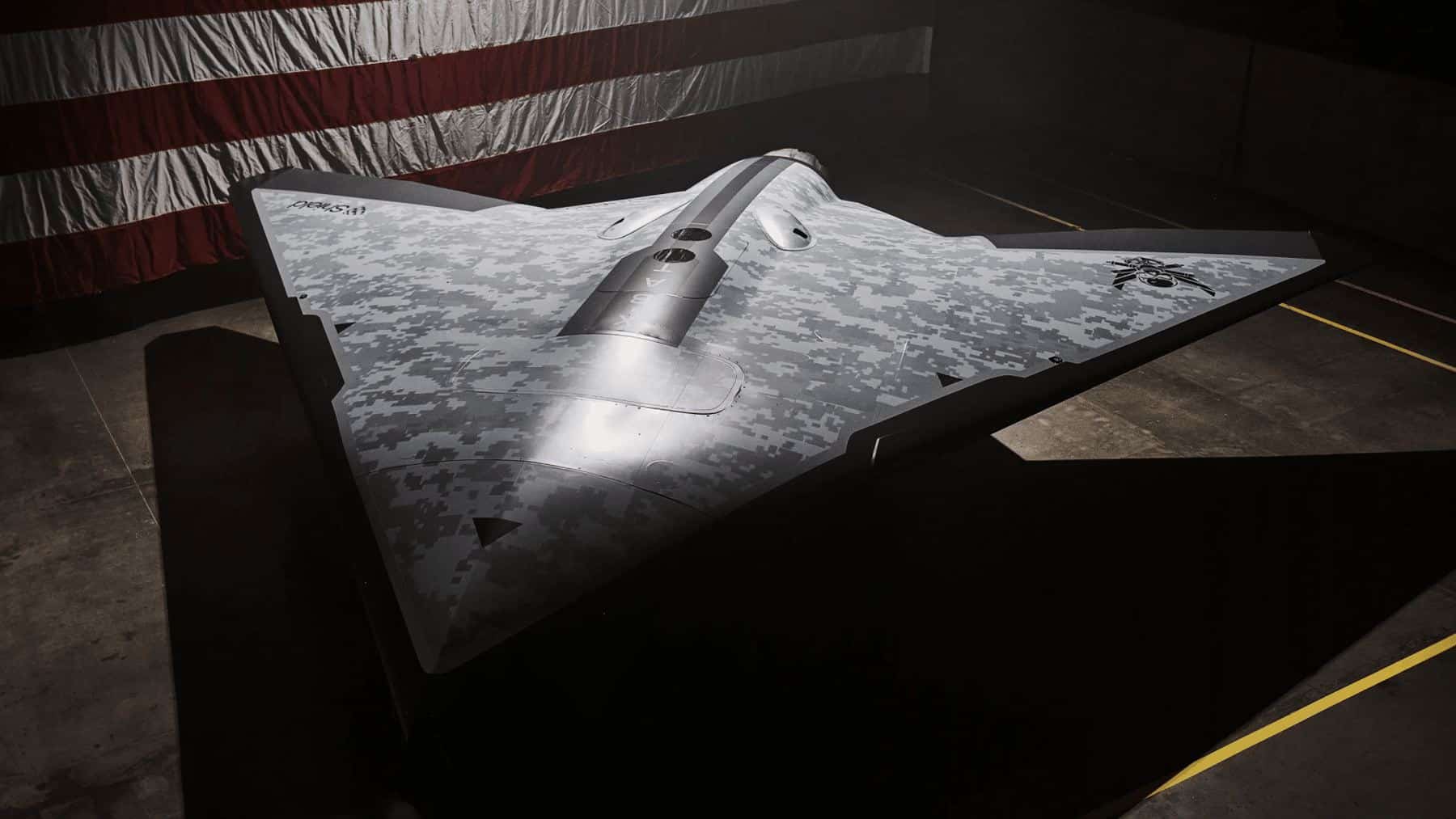
So Shield AI, the San Diego defense company behind the Hivemind autonomy software, has spent the past year building a jet drone that doesn’t need one. It’s called X-BAT. The first full-scale prototype, X-BAT 001, rolled out of the company’s development facility in Frisco, Texas, earlier this month, and it’s been shipped to a flight test site the company runs in Newton, Kansas. The test plan there involves a very large crane, which I’ll get to.
So how does a jet take off standing up?
X-BAT is what engineers call a tail-sitter. It basically sits on its tail with its nose pointed at the sky, lights its engine and climbs straight up like a rocket before tipping over into normal forward flight. Coming home, it does the same thing backward and settles onto its tail again. It doesn’t have landing gear at all, according to The War Zone. It also skips the auxiliary power unit most jets carry and starts its engine from an external lithium-ion battery pack that stays on the trailer, which saves weight on the aircraft.
You may be thinking this sounds like something the Navy tried decades ago, and you’d be right. The Convair XFY-1 Pogo was a propeller-driven tail-sitter from the Eisenhower years, and by most accounts it was a nightmare to land. X-BAT doesn’t have a pilot to worry about, because software does the flying.
The engine is a GE Aerospace F110-GE-129E, from the same family of turbofans you’ll find in some F-15 and F-16 fighters. For a jet to hang on its own exhaust, the engine has to push harder than the whole aircraft weighs. That’s why X-BAT lights its afterburner for vertical takeoff, then comes back down on military power, which is the engine’s full thrust without the afterburner.
So how do you steer something that’s hovering on a column of hot air?
When you’re hovering, there isn’t much air moving over the wings, so normal control surfaces don’t do a lot. X-BAT gets around that with an Axisymmetric Vectoring Exhaust Nozzle, or AVEN, which swivels the exhaust to point the nose up and down (pitch) and side to side (yaw). Roll comes from somewhere else. The company has said it bleeds air off the engine and routes it to small thrusters in the wings.
And here’s my favorite detail. AVEN was first developed in the 1990s for an experimental thrust-vectoring F-16, and TWZ reports that X-BAT is using the original test nozzle, pulled out after decades in storage. So a brand-new AI fighter drone steers with a part that spent most of its life on a shelf. I find that pretty charming, frankly.
GE and Shield AI already lit the engine, moved the nozzle and ran integration tests together in July at GE’s facility in Peebles, Ohio.
Why hang a jet from a crane?
No one’s going to point X-BAT 001 at the sky and floor it on day one. According to the company, the Kansas campaign starts with the aircraft lying flat on its launch and recovery vehicle, which is basically a custom trailer, while engineers run the engine. Then they’ll tip it up and run the engine with the aircraft vertical.
After that, the drone gets hung from a big crane. Armor Harris, Shield AI’s senior vice president of aircraft engineering, says the crane is purely a safety measure: if the engine stalls or something else goes wrong during a hover, X-BAT dangles instead of hitting the ground. That’s pretty sensible insurance when you’ve only built one of these things. Once the tethered tests go well, Harris told TWZ, “then we take the crane away, and then we do the actual untethered flights.”
I’d keep the closest eye on the landings. The trailer has a built-in blast deflector to throw the exhaust away from the aircraft and anything else nearby, and X-BAT is supposed to come in from the side, touch the trailer and power into a latch that locks it in place. Pulling that off at a Kansas airport is hard enough. Doing it again and again on a moving ship is arguably what this whole program has to prove.
X-BAT 001 doesn’t quite match the model
If you saw the renderings from last year’s reveal, the real thing looks a bit different. The exhaust nozzle now sticks out well past the trailing edges of the wings, where earlier models had it tucked into the rear fuselage. The wing has gone from a “cranked kite” shape to an arrowhead with a straight leading edge, a change the company first showed on a roughly half-size model at the Sea-Air-Space show in April.
Then there’s the spine. TWZ spotted two bulges on either side of it, each with a small opening at the front, plus two round, mesh-covered holes on top. The company declined to say what they’re for. A spokesperson told TWZ that X-BAT 001 is a development aircraft and the design will keep evolving, and the prototype’s nozzle doesn’t have stealth features yet.
As for size, Shield AI listed X-BAT at 26 feet long with a 39-foot wingspan when it first showed the design, and 39 feet is still the wingspan on its official spec page. Since the wing has been redrawn, I’d treat the length as a ballpark until the company updates it. I couldn’t find a published weight anywhere, which is a little frustrating for an aircraft whose whole trick is lifting itself. It does have a tail number, though: Aviation Week reports X-BAT 001 carries the civil registration N228XB.
It’s a lot bigger than the Air Force’s first drone wingmen
Some quick background. The Air Force’s Collaborative Combat Aircraft, or CCAs, are drones built to fly alongside crewed fighters and take on jobs you’d rather not hand a pilot. The first two, General Atomics’ FQ-42A and Anduril’s FQ-44A, are mainly air-to-air machines, and we covered the Air Force’s first two combat drones back in August.
Harris says X-BAT is twice the size of those first CCAs, carries a lot more sensors and is built to hit ground targets as well, Air & Space Forces Magazine reports. The company’s headline figures are below. None of them has been proven in flight yet.
Those are pretty ambitious figures for a single-engine drone that has to haul all of its fuel straight up, and I wouldn’t be shocked if a few of them shift once it starts flying. If you want a combat drone that’s further along, Australia’s Ghost Bat is already in the air.
X-BAT isn’t short on backing, at least. Shield AI says U.S. government and company investment in X-BAT has reached $400 million.
As for timing, Aviation Week reports that Shield AI wants X-BAT 001 off the ground before the end of 2026. After that, the company is aiming to fly a fully missionized X-BAT in 2028 and start production in 2029.
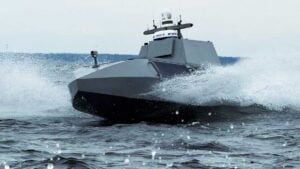 A 19-foot drone boat that can stay out at sea for weeks carries six remote-piloted quadcopters sealed inside its hull and has launched them in trials, then fired a longer-range winged drone from the same compartment, with all of it flown from a control room anywhere in the worldMilitary · 2 hours ago
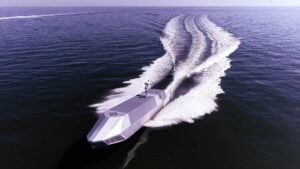 A 37-foot drone boat that carries a third of its own weight in diesel can sit on station for up to 23 days on one 790-gallon tank, sprint at 40 knots and haul 2,000 pounds in an enclosed bay, and it’s meant to be built in under three months for about $1 millionMilitary · 8 hours ago
 A 43-foot-wide nuclear attack submarine, about 9 feet fatter than the boats it is meant to replace, is being drawn as a mothership that launches, catches and recharges its own underwater drones without tying up its torpedo tubes, and each one could cost about $9 billionMilitary · 1 day ago