
The Pacific is mostly water. That sounds like a pretty dumb thing to point out, unless you’re an army.
Soldiers need ground to stand on, and across a lot of the Pacific, that ground comes in small pieces with a whole lot of ocean in between. So it makes sense that the Army division now built to fight out there would want to get comfortable around boats. For its latest round of drone testing, though, it went to Michigan.
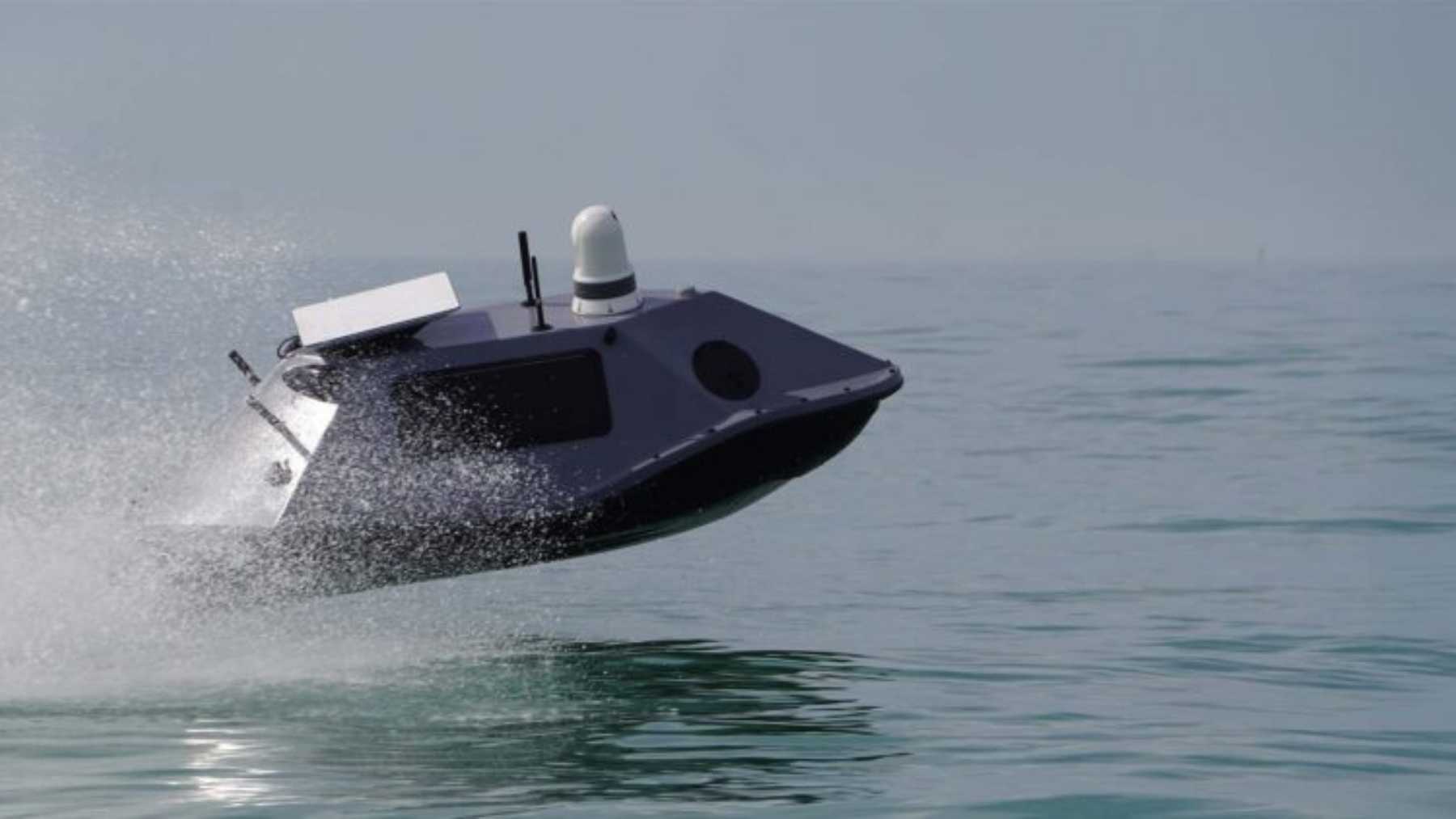
During Bayonet Quest 26, an exercise that ran across the state from September 26 to October 6, soldiers from the 7th Infantry Division (Multi-Domain Command-Pacific) ran tests on autonomous drones at several sites. One of those tests put a Mark VI patrol boat, with a crew aboard, at the head of a formation of drone boats, according to Army Recognition and Baird Maritime, which both reported on the Army’s footage. Drone aircraft flew from the boat as well, and one of them was recovered on its fantail while the boat was still underway.
If you don’t speak boat, the fantail is the open deck at the very back. On a Mark VI, that’s where a ramp lets the crew launch and pick up small boats.
The crew driving it wasn’t Army, by the way. SIX Maritime, a small veteran-owned company out of San Diego, ran the boat during the water phase, and Army Recognition says the company described the work as formation maneuvers with the drone boats and recovering an aircraft at sea.
So what’s an 85-ton boat doing in the middle of a drone test?
Basically, it’s playing mothership. The boat brings the people and the radios, and the drones range out ahead of it to look around and take the risks. If the boat can take an aircraft back aboard without stopping, the whole group doesn’t have to park every time a drone comes home. That’s a pretty big deal if you’re trying to keep moving.
So what is a Mark VI, anyway?
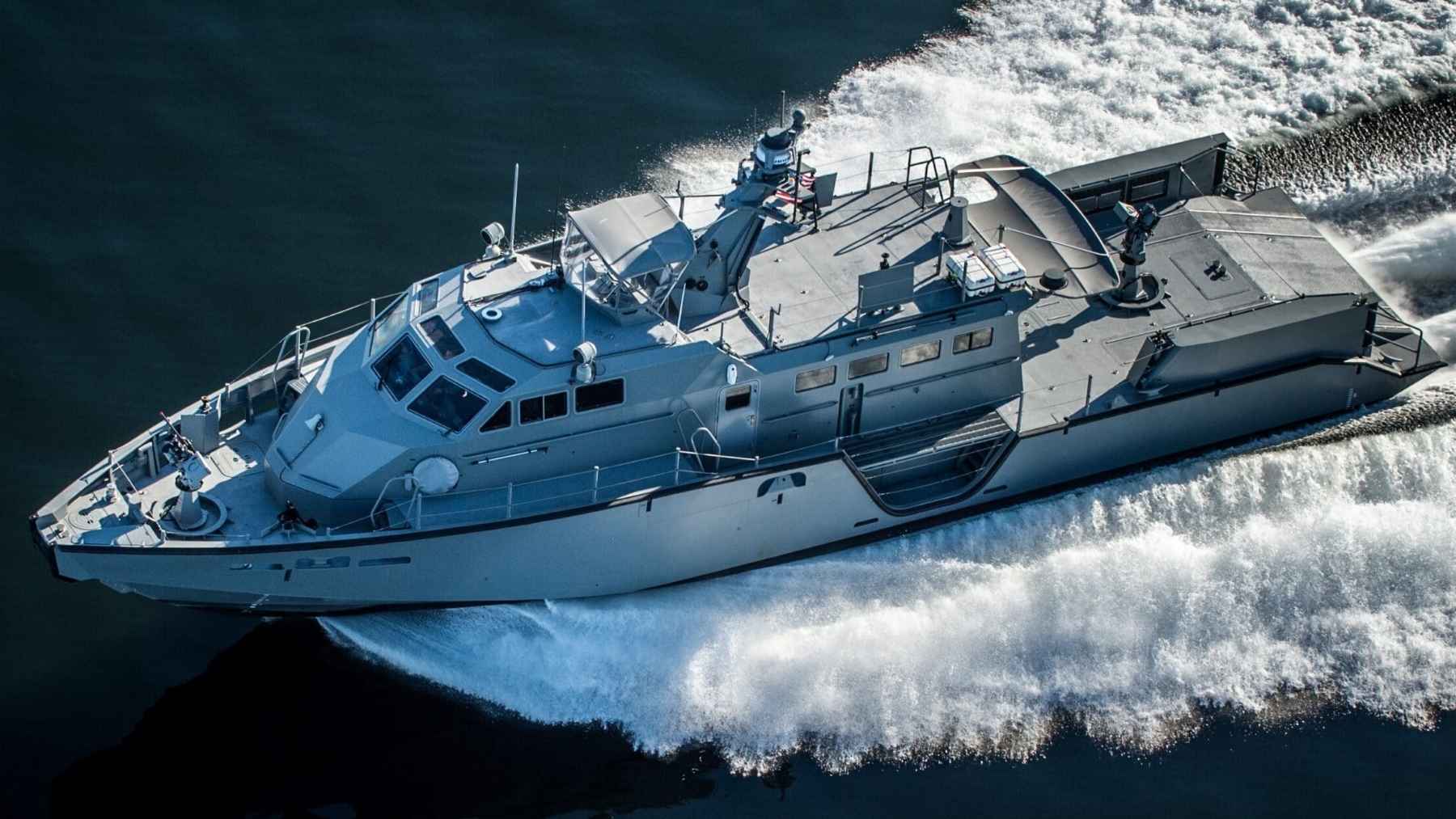
It’s a patrol boat SAFE Boats International built for the Navy’s Coastal Riverine Force, the sailors who guard harbors, escort ships and board suspicious vessels close to shore. According to the Navy’s fact file on the Mark VI, it runs 84.8 feet long and weighs 170,000 pounds fully loaded. So call it 85 feet and 85 tons. That’s either a coincidence or one very tidy engineer.
Two 16-cylinder MTU diesels make 5,200 horsepower between them and drive a pair of waterjets. A waterjet sucks water in through the bottom of the hull and fires it out the back. It’s the same trick a jet ski uses. With no propellers hanging underneath, the Mark VI draws less than 5 feet of water, so it can work close to shore. Flat out, the Navy says it’ll do more than 35 knots, which is north of 40 mph.
The fact file also has a features list, and frankly, it’s more fun to read than the specs. It says the Mark VI supports aerial drones, surface drones and underwater drones, along with the small rubber raiding boats special operations teams use. So the Army’s mothership trick has been right there on paper the whole time.
The Navy stopped at 12
The Mark VI program topped out at 12 boats, per the fact file. In early 2023, a Navy spokesperson told Naval News that the service hadn’t asked for any Mark VI money that fiscal year or any year after it. By then, a number of the boats were already sitting in storage at a shipyard in Newport News, Virginia.
That’s where Michigan comes in. I went digging through federal contract records, and they show the Michigan National Guard paying SAFE Boats to inspect and reactivate three Mark VIs ahead of a move from Virginia to Alpena. In August 2025, the Guard hired a crew to bring them north. That crew came from SIX Maritime.
If you’re wondering how an 85-foot patrol boat gets from Virginia to a Great Lake, the answer is by water, the long way around. The Guard’s paperwork planned on up to 11 days for the trip. I couldn’t find out how many of the three actually came north, though. Everything I’ve seen from the Guard talks about one boat.
The Guard has put its Mark VI to work since. During the Northern Strike exercise in August, it used the boat on Lake Huron to give visiting aircrews something to work against, according to the Pentagon’s write-up of the exercise, and the Guard’s own video shows the boat dodging pursuers. Back in June, the Guard also asked contractors to bid on running Mark VI operations out of Alpena, for jobs that include high-speed maneuvering and playing the target.
So whose boat was it at Bayonet Quest? The Army hasn’t said, and its video caption only places the testing “in Michigan.” Baird Maritime does point to separate Army footage of drone activity at Alpena on Friday, October 2. SIX Maritime got the contract to move the Guard’s boats north and crewed this one, so I’d say it’s a pretty safe bet the boat was the Guard’s. That’s my read, though, not the Army’s.
So why test it in Michigan?
The 7th Infantry Division got its long new name in June, when the Army merged it with the 1st Multi-Domain Task Force at Joint Base Lewis-McChord in Washington state. The new command has roughly 12,000 soldiers, and the Army calls it “theater-enabling.” Basically, it’s a division that’s supposed to bring its own drones, long-range weapons, cyber and electronic warfare gear to a fight in the Pacific instead of borrowing them from somebody else.
And you can’t drive a Stryker from one island to the next. So boats and drones that work together are probably high on its to-do list. The Army as a whole has been on a bit of a boat kick lately, too, with one of its labs sending an 8-foot drone boat into breaking surf on purpose to map the bottom.
Michigan, meanwhile, has room to try that kind of thing. The Guard runs what it calls the National All-Domain Warfighting Center, which pairs nearly 148,000 acres of ground at Camp Grayling with 17,000 square miles of airspace set aside for the military, part of it out over Lake Huron. That’s a bigger patch of sky than the whole state of Maryland, which covers about 12,400 square miles, water and all. The Pentagon picked the center in February as a national site for drone training and testing.
The drones are still a bit of a mystery
I can’t tell you exactly which drones were out there. The Army hasn’t released a full list. Baird Maritime describes “several” drone boats in the formation, and fixed-wing drone aircraft took part as well. Army Recognition, which looked over the footage, says one of the boats looks consistent with an American design and another resembles a Ukrainian one. The Army hasn’t confirmed either.
A Ukrainian-designed drone boat turning up in an Army test in Michigan would arguably be the biggest news here, if it holds up. Right now, it’s a defense site’s read of a video.
The Army also hasn’t said how that drone aircraft got back aboard. It could’ve flown into a net, set itself down on the deck or been grabbed by somebody standing on the fantail. Getting a drone into the air from a boat is the easy half of the job. Bringing it back down on a deck that’s moving, pitching and rolling all at once is a lot harder, and we’ve written before about how it’s still a sticking point for drone boats that don’t have anyone on deck to help.
The Mark VI gets to cheat a little there, since it’s got a crew aboard. It’s pretty much the mirror image of something we covered last month, when a crewed special operations Chinook set down on a self-driving barge.
Bayonet Quest 26 wrapped up on October 6, and the 7th Infantry Division posted its video from the drone testing on DVIDS, the Pentagon’s media site, the same day. It runs a minute and 11 seconds, so it won’t eat much of your lunch break.