
- 3 MONTHS AGO · ENERGYA 70-kilowatt American solar array is floating on a rice irrigation reservoir in Stuttgart, Arkansas, 96 panels covering 0.1 acre of a 40-acre pond — and the first reviewers will be ducks, because this town winters more mallards than anywhere else on Earth
- 2 MONTHS AGO · ENERGYA 19.7-foot rotor floating on a Dutch lake tilts back toward horizontal when the wind gets up instead of parking the way every offshore turbine does, and it makes 12 kilowatts against the 15,000 of the 774-foot rotor it is meant to replace one day
- 1 MONTH AGO · ENERGYA 671-megawatt reactor on the Mississippi shut down for repairs the day before a winter bass tournament, the warm water it sends back to the river stopped with it, and 84 anglers found thousands of dead bass, walleye and pike where a shutdown three years earlier killed 230
- 2 WEEKS AGO · ENERGYA 42-megawatt Idaho dam can only swing nine of its 10 spillway gates fully open or fully shut since engineers found delaminated steel in the 70-year-old gates, and the 1,150-foot-deep lake behind it gets the first of 11 new gates next summer
- TODAY · THIS ARTICLEMore than 55,000 floating solar panels cover half of an 82-foot-deep Dutch quarry lake, and three years of sensors found up to 41% less oxygen beneath them in winter and about a third less algae growth than in open water
The Netherlands has a land problem. It’s one of the most crowded countries in Europe; much of it sits below sea level, and pretty much every flat acre that isn’t a town is already a farm, a greenhouse, or a cow pasture.
So when Dutch developers looked for somewhere to put solar panels, many ended up on the water. Specifically, on old sand pits. Decades of digging sand out of the ground for construction left the country with deep, flooded holes that nobody farms and hardly anybody swims in. GroenLeven, one of the bigger Dutch solar developers, says on its website that more than half a million of its panels float on pits like these.
Covering them in solar panels sounds like a pretty tidy solution. Free real estate, no farmland lost, and the neighbors are mostly ducks.
But what happens to the water underneath?
Deltares, the independent Dutch institute that does much of the country’s water research, spent just over three years trying to answer that question at one lake in Friesland, in the north of the Netherlands. And the answer is arguably a bit less rosy than what developers tend to put on their websites.
So what’s on the lake?
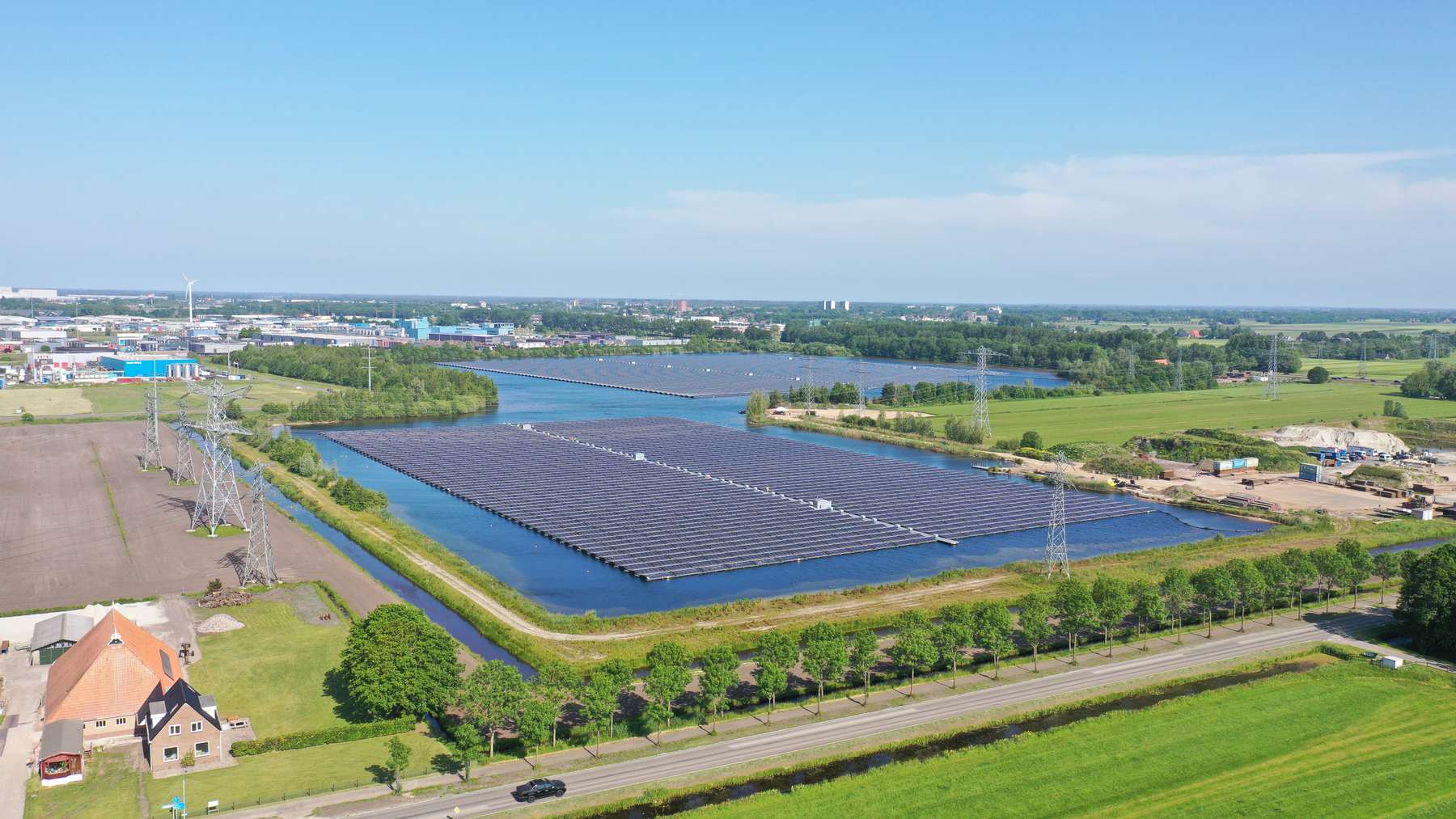
The lake is called De Dolten, and it sits just outside the village of Oudehaske, squeezed between the A7 highway, a landfill, and a high-voltage substation. Not exactly prime vacation property. It covers 79.4 acres and gets down to 82 feet at its deepest point, according to Deltares.
Two separate floating solar farms share it. The first, Oudehaske I, has about 17,000 panels and covers roughly 15% of the lake. Oudehaske II came online a couple of years later with about 38,800 panels and covers around 36%. Together, they cover slightly more than half the water.
Both arrays are anchored to the lake bed instead of being tied off to the banks, and GroenLeven’s project page says they sit at least 66 feet from the shoreline. That gap is on purpose. In a pit this deep, most of the wildlife lives along the edges, so the setback leaves room for birds, bats, and otters.
The company also built its floats with open lanes it calls light and air streets, so some sunlight and wind still reach the water between the rows. GroenLeven says the two farms make enough electricity for about 9,000 homes.
Why does a lake need oxygen anyway?
Dissolved oxygen is exactly what it sounds like. It’s oxygen gas mixed into the water. And fish, insects, and pretty much everything else living in a lake breathe it. If you’re a fish, it’s the only air you get. Scientists measure it in milligrams per liter, which is basically the same thing as parts per million. You’ll usually see it written as mg/L.
A lake gets most of its oxygen from two places. Wind stirs air into the surface, and algae make it through photosynthesis, the same way the grass in your yard does. Put a roof over the water, and you cut into both at once.
That’s the theory, anyway. Deltares and its partner TNO wanted real numbers, so they put two identical probes in De Dolten. One floated in open water, and the other hung under the older Oudehaske I array, both about 3.3 feet below the surface. They logged readings every hour and kept going until early September last year.
So what did the sensors find?
Over the whole stretch, the water under the panels averaged 7.65 milligrams of oxygen per liter, while open water averaged 8.73. By my math, that’s about 12% less under the solar farm.
Winter is where it gets a lot more lopsided. The report says oxygen under the panels ran up to 41% lower than in open water during the cold months. That’s the biggest gap Deltares recorded, not the average, so don’t read it as a typical day on the lake.
The algae took a hit too. Deltares used the oxygen data to estimate how much the algae were producing and found production under the panels was about 35% lower than in open water. Its computer model came up with a 43% drop, which the authors treat as a decent match.
Frankly, that algae number probably matters more than the oxygen one. Algae sit at the very bottom of a lake’s food chain, and the report itself says cutting their output could have serious consequences for everything that eats them.
There was actually one result I didn’t expect. At that 3.3-foot depth, the water under the panels was actually slightly warmer than open water, by about half a degree Fahrenheit on average. I’d have bet the shade would cool it down. Shows what I know about science and water…
Deltares’ model does predict cooler surface water once panels go in, so the measurements and the simulations don’t quite agree on this one.
There’s a lot this study can’t tell you
So are the fish down there gasping for air? Honestly, nobody can say from this report, because it doesn’t look at fish at all. Quite suspenseful, I know.
It’s also a side-by-side comparison, panels versus open water over the same hours and days. Deltares’ monitoring started after the first farm was already floating, so this isn’t a before-and-after study of the lake. Only one probe was under the panels, hanging beneath the older and smaller of the two farms.
The lowest readings don’t settle much, either. The probe under the panels bottomed out at 0.72 milligrams per liter at one point, but the open-water probe dipped as low as 1.07, so low-oxygen spells happened on both sides of the lake.
Then there’s the open-water buoy. It runs on a small solar panel, and during the dark Dutch winter that panel sometimes couldn’t keep up, which left gaps in the buoy’s data in exactly the season where the biggest differences showed up. It’s a pretty ironic problem for a solar study to have.
So how much of a lake should you cover?
Deltares does put a number on it. Based on its modeling, the report proposes capping floating solar at 15% of the surface on isolated quarry lakes like De Dolten, so the effects on the lake’s ecology don’t get out of hand.
The authors are careful, though. They say 15% is a cautious pick rather than something they’ve studied in depth, and that their simulations can’t tell you exactly where the tipping point sits.
Which is a bit awkward for this particular lake. Oudehaske I covers about 15% of De Dolten on its own, so the second farm pushed the lake well past the line Deltares is now suggesting. I’d guess Dutch planners will hear that number quite a bit when the next sand pit comes up for solar.
Other projects have gone a lot lighter. The Bavarian lake we covered in July stood its panels upright and covered only 4.65% of the water. And if you want the other side of the argument, GroenLeven’s own Bomhofsplas farm near Zwolle hung fish shelters under about 73,000 panels, and researchers counted more than 400 fish moving in.
GroenLeven says on its project page that it plans to measure water quality at De Dolten every year. The Dutch Ministry of Economic Affairs paid for the study, and on April 8, Deltares signed off on the final version of the 39-page report it wrote with TNO.
 A reactor built from 664 two-inch uranium cubes hung on wires in heavy water under a German castle was Heisenberg’s last shot at a chain reaction, and two of the surviving cubes now show it needed about twice the uranium and heavy water it held, more of both than Nazi Germany hadEnergy · 11 hours ago
 A 66-foot-deep gravel pit in Finland just started taking in about 100 million gallons of tap water, and once a nine-acre lid goes on top, it’s meant to hold enough summer heat at up to 194°F to cover as much as nearly a quarter of the town’s yearly heat demandEnergy · 13 hours ago
 A 375,000-pound turbine now spins inside a Tennessee dam in place of one that ran for more than 80 years, and a federal watchdog just found that 196 of the 240 welds on the ring guiding water out of it failed on a job where some welders weren’t qualifiedEnergy · 16 hours ago

 @remi ROOKIE2 weeks ago