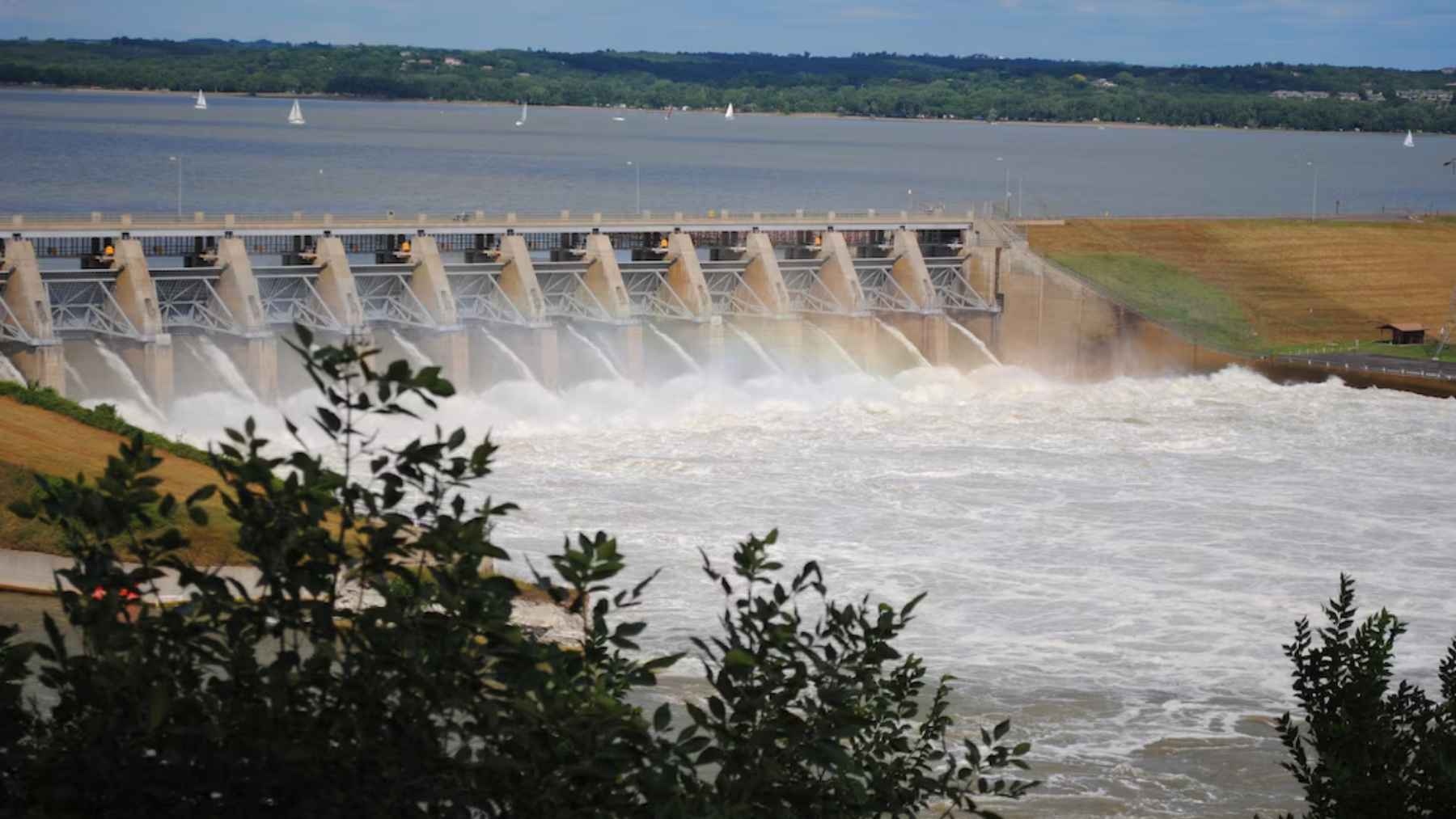

An intake gate has one of the least glamorous jobs on a dam. It is a big steel door that slides up and down to control the water feeding the powerhouse, and at Gavins Point Dam on the Missouri River near Yankton, South Dakota, a clean one weighs about 88,000 pounds (roughly 40 metric tons).
So when crews recently pulled three of those gates for cleaning, the scales should have read somewhere near that number. Instead, the three averaged about 113,000 pounds apiece, Dakota News Now reports.
The extra 25,000 pounds (about 11 metric tons) per gate was not steel. It was zebra mussels and debris, growing quietly on hardware that spends its working life underwater.
Eric Johnson, who runs maintenance and operations at the dam and serves as assistant powerplant superintendent, says the invasive mussel has been the powerhouse’s biggest problem for the past ten years. This is a facility that deals with ice, floods and the general moods of the Missouri, so that is quite a ranking for a mussel that tops out at 1.9 inches.
The gates came out of the water 25,000 pounds overweight
The numbers surfaced during recent maintenance at the dam, which sits on the South Dakota and Nebraska line and holds back Lewis and Clark Lake. Three intake gates went through cleaning, and the average haul worked out to roughly 25,000 pounds of mussels and debris per gate.
Run the math and each door was carrying more than a quarter of its own weight in freeloaders. That extra load leans on the mechanisms that have to move the gates, according to KELO-FM, and getting it off costs time, money and manpower.
The job did not stay inside the fence, either. Nebraska’s Game and Parks Commission flagged periodic road closures across the dam in early August while gate cleaning went on, and pointed readers toward the Corps’ photos of the growth. State wildlife agencies do not usually run traffic advisories for shellfish.
Nobody designing a dam in the 1950s planned for shellfish
Gavins Point is the smallest of the six mainstem dams the U.S. Army Corps of Engineers operates on the Missouri, which still means 7 million cubic yards of earth and three Kaplan generators that can power around 68,000 homes, per the Corps.
Engineers sizing hardware for moving water think in pressure and flow, the same math behind France’s six-turbine FloWatt tidal farm. Biology is not on the spec sheet. “The dams weren’t engineered to deal with this nuisance,” Michael Schnetzer, a senior power plant mechanic at Gavins Point, said in that same Corps write-up. The mainstem dams were drawn in the thirties, forties and fifties, decades before anyone on this river had heard the species’ name.
Zebra mussels are native to the Caspian, Black and Azov seas, and they showed up in the United States in 1988 in Lake St. Clair, most likely after riding over in ship ballast water. A single female can release up to one million eggs per year. They reached Gavins Point in 2014, found stuck to the underside of a dock being pulled from the water for winter at the Midway Recreation Area.
Hard structure sitting in open water always picks up tenants. Sometimes the arrangement is almost charming, like the seals GPS-tagged hunting the turbine rows of North Sea wind farms, or the crocodile nursery that grew out of a Florida nuclear plant’s cooling canals. A dam intake gets the other kind of tenant.
Once the adults establish in a reservoir, they release microscopic larvae called veligers. The larvae ride the current into the dam’s raw water piping, the systems that pull unfiltered lake water for cooling, then attach and grow until some component downstream stops getting the flow it was designed around.
Dead mussels are not much of an upgrade. Shells let go in clumps and travel through the plumbing until they find a fresh place to jam.
A generator down once or twice a month
By 2019, the infestation was forcing one of the dam’s three generators offline once or twice a month, according to the Corps. Every one of those was an unplanned outage, which in hydropower accounting means electricity that simply never got made.
“A lot of unexpected shutdowns, a lot of lost generation,” Johnson told Dakota News Now, describing what happened as mussels worked through anything at the plant touching raw reservoir water.
The Corps put a number on the labor early on. Between 2014 and December 2018, Schnetzer estimated 2,500 man-hours went to mussel problems instead of regular maintenance. That is 62.5 full workweeks of somebody dealing with shellfish rather than the dam.
The facility has fought back with actual engineering. In 2019, Gavins Point installed an ultraviolet light system that kills drifting larvae before they can settle, plus self-cleaning strainers that block anything larger than an eighth of an inch.
Seven years later, Johnson still ranks the mussel as the toughest thing the powerhouse deals with. The UV lights protect the plumbing they cover. The gates sit out in the open lake, and the lake keeps sending new tenants.
One boat trip can seed the next reservoir
The mussels have not stayed put. Johnson believes they have spread upstream as far as Big Bend, and the Corps had already logged them in Big Bend’s Lake Sharpe reservoir by 2019.
That reaches well past hydropower. Johnson points out that everything drawing water off this stretch of the Missouri, from cooling systems to water treatment plants to the potable supply around Yankton, is dealing with the same organism gluing itself to the same pipes.
The transport mechanism is depressingly simple. Mussels can survive out of the water for a while, larvae ride along in any water you forget to drain, and Johnson told the station a single boat could carry them to another reservoir within the same day.
Which is why the Corps keeps repeating the one countermeasure that costs nothing: clean the boat, drain the live wells, dry everything before the next launch. Johnson’s ask to boaters amounts to that same checklist, done thoroughly, every single time.
There is no version of this where the lake gets fixed, and the Corps’ own reporting is honest about it. The only local eradications on record involved draining two small Omaha lakes and letting winter freeze what was left, and you cannot drain a reservoir that waters a region.
So the fight stays manual. The matchup is an 88,000-pound steel door, three Kaplan turbines and a federal engineering agency against a mussel shorter than your thumb that breeds by the million. Ten years in, the score reads 25,000 pounds per gate, and the dam is not the one winning.