
Sonar comes in two flavors and they want opposite things. Passive sonar listens and says nothing, which keeps you hidden and leaves you guessing about how far away anything is. Active sonar pings, tells you exactly where the target sits, and tells the target exactly where you are. Navies have been trading one against the other since the 1940s.
An American company spent this summer trying to run both at once, and the half that does the pinging is a tube built to be thrown in the ocean and left there.
Ultra Maritime announced the result on August 13. At the Navy’s Lanternfish 2026 exercise, the company paired its Sea Spear deployable array with the AN/SSQ-125B, an active sonobuoy it started building for the Navy in April. Sea Spear listened. The 125B pinged. Between them, the company says, they picked up uncrewed underwater vehicles and then worked out where those vehicles actually were.
A passive array cannot do that second part on its own.
Listening quietly gets you a direction, not a position
A hydrophone hears a propeller and tells you which way the noise came from. That gets you a bearing. Turning a bearing into a position means either moving your sensor around and watching how the angle changes, which takes time you may not have, or putting energy into the water and timing the echo.
The second option is what the Navy calls multistatic. One machine makes the noise. Other machines scattered across the area listen for the sound bouncing off whatever is down there. The noisemaker and the listeners sit in different places, so the geometry does work that a single sensor cannot.
The SSQ-125 family has been the noisemaker in that arrangement for over a decade. Navy documentation lists it as a multistatic active coherent source, paired with the AN/SSQ-53F, AN/SSQ-77C and AN/SSQ-101 receivers, and it can be told after it hits the water to change its settings, go deeper, or fire.
Ultra Maritime calls the 125B the only active sonobuoy of its type in service. That is the manufacturer’s claim about its own product, and no independent test data has been published against it.
One machine unrolls like a tape measure, the other one sinks on purpose
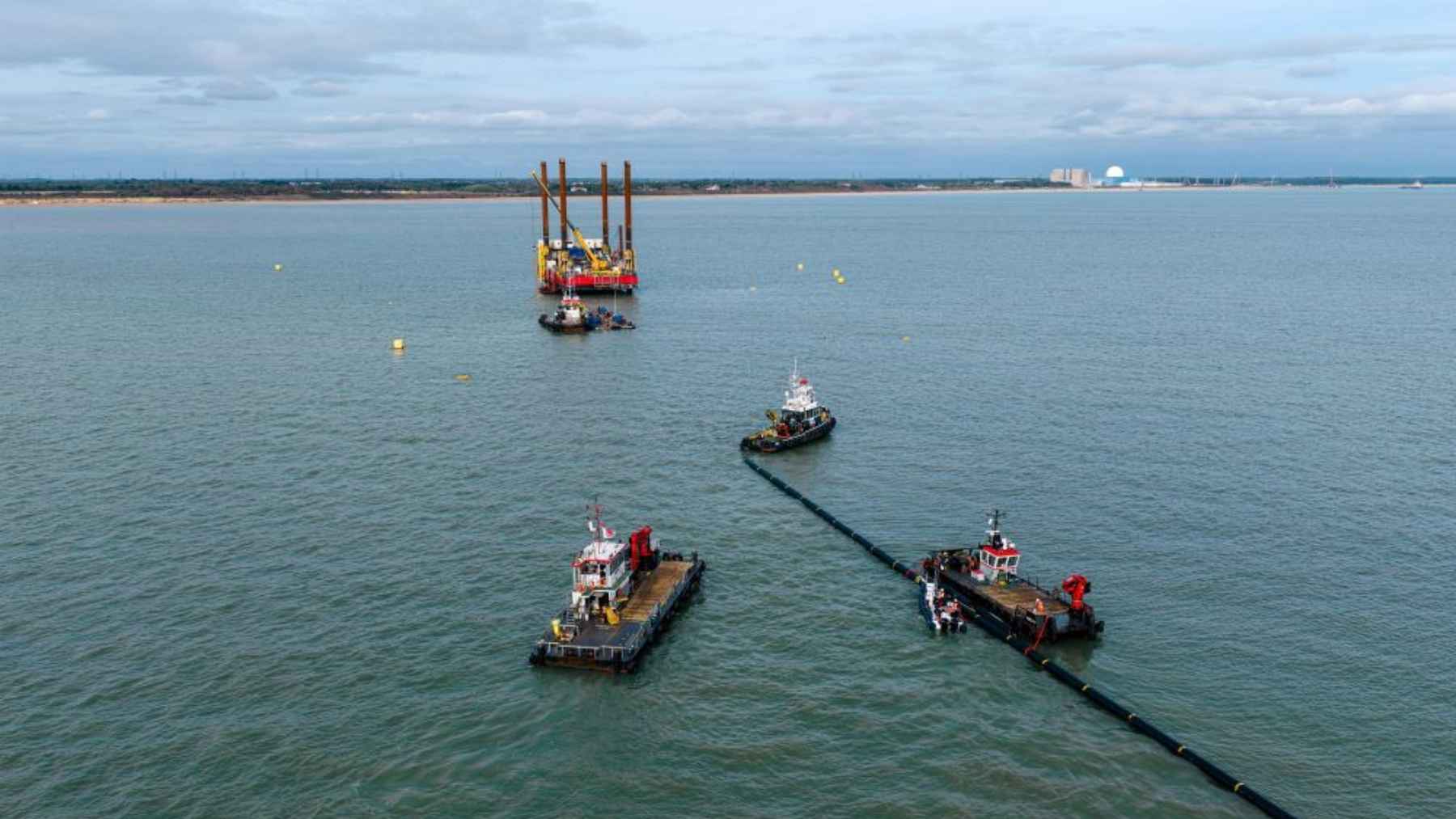
Sea Spear arrives as a cylinder 21 inches (53 cm) in diameter and unspools into a wide array once it is in position. Carlo Zaffanella, Ultra Maritime’s president and chief executive, told The War Zone in 2025 that the extending trusswork borrows from lightweight arms built for spacecraft, because a structure that has to hold itself out in neutral buoyancy runs into similar physics. Crewed and uncrewed platforms can both put it in the water, and it spends most of its working life in passive mode.
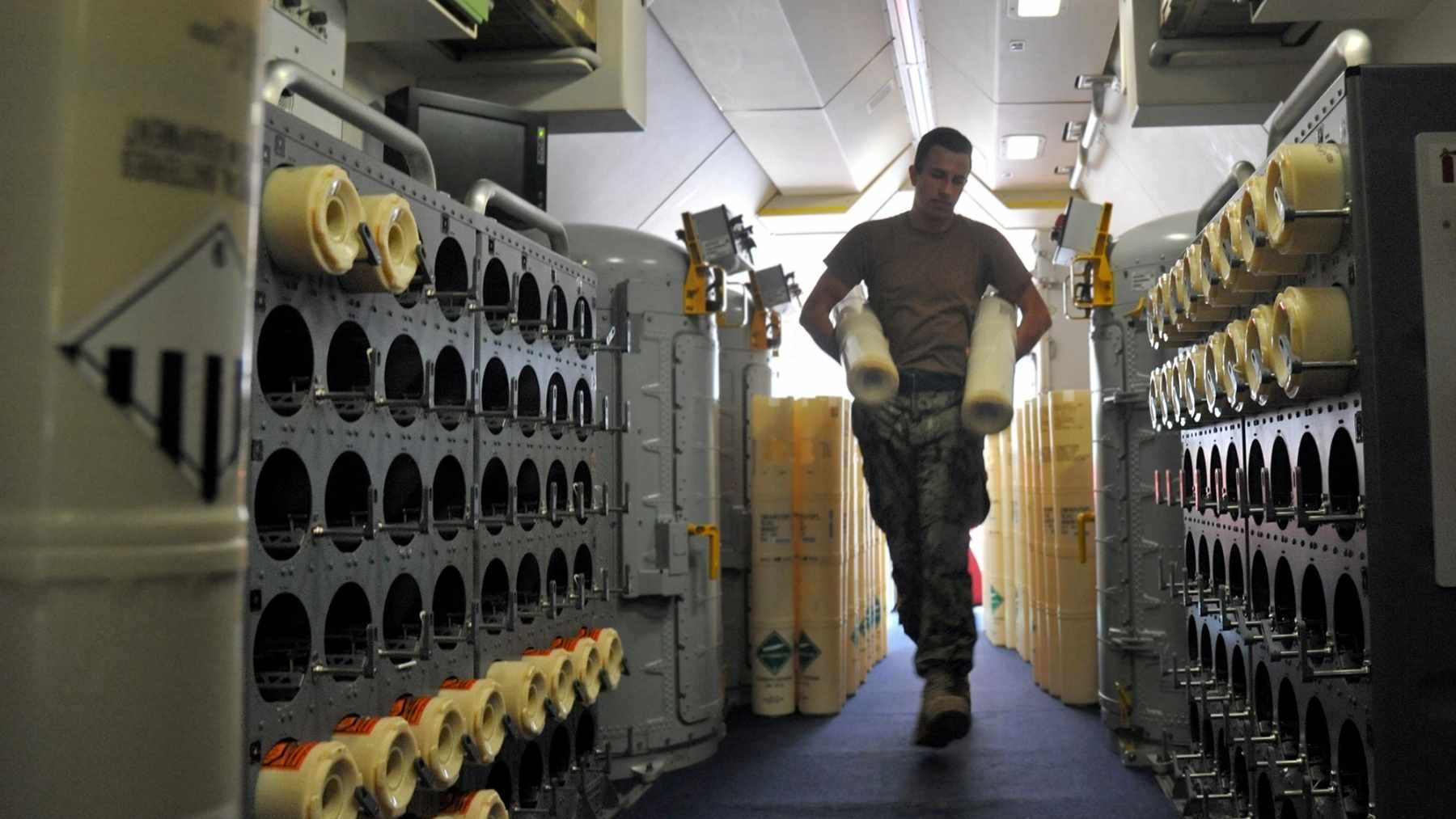
The 125B is the opposite kind of object. It is an A-size sonobuoy, 4.875 inches by 36 inches (12.4 by 91 cm), weighing up to 39 pounds (18 kg), the same shape every American sonobuoy launcher has been built around since the Second World War. It works once and it is gone.
Neither company said how the buoy got into the water at Lanternfish.
Sea Spear reached the exercise through a different route. Ultra Maritime supplies it to Anduril under an exclusive arrangement, riding on the Seabed Sentry nodes that sit on the bottom and carry their own processing. We covered that half of the Lanternfish results in July, when both companies reported that the array had detected, tracked and classified medium and large-diameter uncrewed vehicles and pushed the track to a Navy screen without a person relaying it.
The government spent years trying to get two sonobuoy makers
For more than 35 years, almost every American sonobuoy came out of a joint venture called ERAPSCO, short for Expendable Reliable Acoustic Path Sonobuoy Company. Sparton and Ultra owned it together and split the work between plants in DeLeon Springs, Florida and Columbia City, Indiana. The Justice Department did not love the arrangement. Janes reported in February 2022 that the two owners were expected to dissolve the venture and bid separately, on the department’s concerns about a lack of competition for air-launched submarine trackers. ERAPSCO announced it was dissolving as of September 30, 2023.
The A-model shows what competition looked like. On November 30, 2021, the Pentagon put ERAPSCO and Lockheed Martin on the same award for up to 18,000 AN/SSQ-125A buoys, with an aggregate ceiling of $222,266,700 and the two companies competing for individual orders.
The B-model went the other way. Ultra Maritime announced on April 6 that it had received a sole source, firm fixed price contract for low rate initial production of the 125B, covering training, peacetime operations, testing and war reserve stock. One supplier, no competition, four and a half months before the machine showed up at Lanternfish.
Then the competitor bought the company
Lockheed Martin signed a definitive agreement on July 6 to buy Ultra Maritime from Advent for $3.45 billion, folding it into Rotary and Mission Systems. Stephanie C. Hill, who runs that business area, said in the announcement that undersea superiority belongs to whoever moves fastest.
The two names on that 2021 award are now on the same side of the table, assuming the deal closes.
Germany looked at it first. Lockheed filed with the Bundeskartellamt on July 30 under case number B11-79/26, and the regulator wrote the relevant product market on the file as the development and sale of sonobuoys. It cleared the purchase on August 26, in first phase, finding that the two portfolios mostly complement each other, that the overlaps are limited, and that strong competitors remain where they do overlap. That reasoning leaned on the parties operating largely outside Germany and Europe. Other approvals are still outstanding and Advent still owns the business until they land.
An exercise is not a score
Everything published about the Lanternfish pairing came from Ultra Maritime. The Navy has not released its own assessment, no third party measured detection ranges, and the exercise ran as a scheduled event rather than an encounter with anything hostile.
The target set matters too. Both companies reported catching medium and large-diameter uncrewed vehicles, which are the loud, easy end of the problem. The threat that worries port authorities is a swarm of small cheap machines, and small is not what anyone said they caught.
Detection is also the part of counter-drone work that already functions. In July, the Coast Guard told industry outright that plenty of systems can find an underwater drone while very few can stop one, and refused to consider detection-only submissions, a gap we went through when the Navy tested air curtains and artificial kelp nets in a Latvian harbor. One American firm has answered by laying a mile of physical barrier across a harbor floor, which we covered when the Pentagon asked for exactly that four days later.
A ping that says where the drone is does not remove the drone.
No customer count for the pairing exists in public. Ultra Maritime has not said how many 125Bs the low rate contract covers or what it is worth, and neither company has named a program that would buy the passive array and the active buoy as one item. The Bundeskartellamt logged Lockheed’s file on July 30 and cleared it 27 days later, on August 26, with one line describing what the two companies actually sell: sonobuoys.