
Back in October 2025, Guelph’s city council signed off on a plan for Allan’s Dam that sounded pretty low-key. The city’s environmental assessment had looked at the dam’s spillway and sluiceway, rated them in fair to good condition, and settled on rehabilitation, mostly in the form of concrete patch repair.
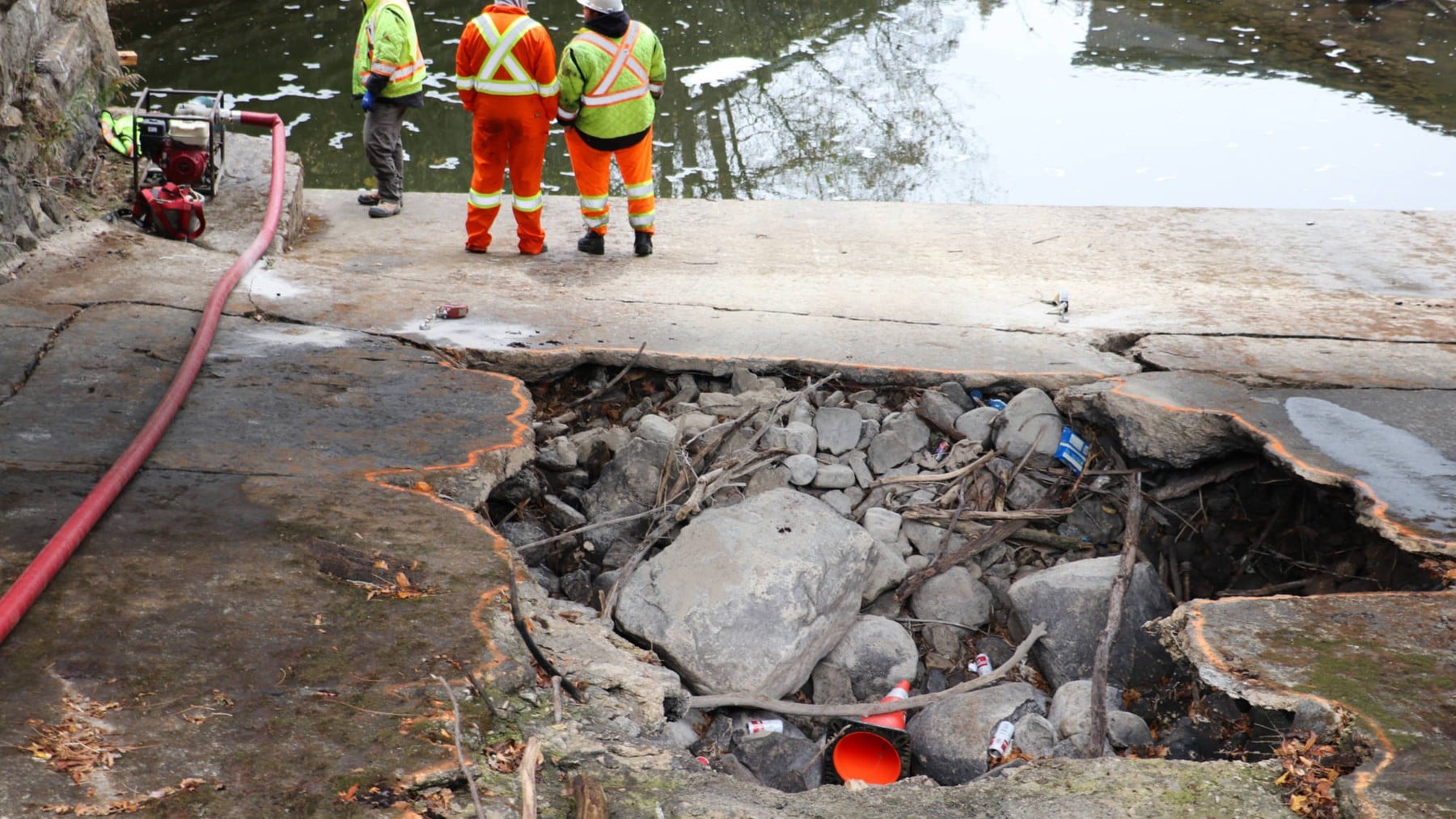
Then came a planned inspection in July 2026. According to the City of Guelph, that inspection turned up some areas of the dam that needed a closer look, and the city kept the water behind it low while engineers followed up.
Now a contractor is doing what the city itself calls emergency stabilization work on the spillway. That means placing stone beneath parts of the dam and a lot of grouting. Work was set to begin on or about November 9, and the city expects it to take two to three months, weather permitting.
If you’ve never been to Guelph, Allan’s Dam sits on the Speed River downtown, about 65 feet south of the Macdonell Street Bridge. Its spillway basically works as a weir, which is a low wall that holds a river back and lets the extra water spill over the top. The calm stretch of water it holds back upstream is the Mill Pond, and it’s there because someone needed a head of water to run a mill.
This spot has had a dam since the 1830s
According to a heritage report prepared for the city’s assessment, the first dam and spillway went in sometime in the 1830s or 1840s to serve William Allan’s mill. The concrete spillway you’d see today is a lot newer than that. The same report says it most likely dates to 1938. A concrete pier down the middle splits it into two chutes, one north and one south. The mill’s long gone, but the pond is still there, and so is the dam holding it back.
What I couldn’t find, after going through the city’s assessment documents, is a height or a length for the spillway, so I can’t tell you how tall the thing is. The structure’s materials are spelled out (reinforced concrete, with limestone and concrete walls along the sluiceway beside it), but the overall dimensions aren’t.
So what does stone and grout actually do?
If you’ve ever retiled a bathroom, you already know grout as the stuff that fills the gaps between tiles. On a dam it’s a similar idea at a much bigger scale. Contractors generally pump a runny cement-based mix into gaps in and around a structure, and it hardens in place, filling space that water could otherwise move through. Stone placed underneath does a related job, giving the structure something solid to bear on. Put the two together and you’ve got a pretty standard way to firm up an old concrete structure without tearing it out.
The city hasn’t said exactly what the July inspection found, though. Its notice describes the findings as areas that needed further investigation without going into detail, so I’m not going to guess at what’s under there.
Still, stone and grout is a clear step up from the concrete patching the 2025 plan described. Which tells you the inspection found enough to change the plan, even if we don’t know the specifics.
The permanent fix is still a couple of years out
So why not just wait?
Because of spring. The city says the interim repairs are meant to extend the dam’s service life, particularly ahead of the potentially higher flows that come with the spring thaw. Snowmelt and spring rain push a lot more water down a river like the Speed than you’d see in August, and the spillway has to pass all of it.
The permanent solution is tied to Phase 2 of the Macdonell Street and Structures Reconstruction, part of Guelph’s downtown infrastructure renewal work, and the city says that phase is set to begin in 2028. That leaves the dam with at least one more spring thaw to get through, and probably two, before anything permanent happens.
So is the interim job worth the money? I’d say so. Paying for a fix you’ll partly redo a couple of years later is frankly a bit of a tough sell, but the alternative is crossing your fingers through two spring thaws on a structure your own engineers wanted to look at more closely. The city hasn’t put a price on the work in its notice, so I can’t tell you what this interim job costs.
Spillways come in all shapes and sizes, from the Australian outback dam we covered on Saturday that lets floodwater pour straight over its arches, down to a downtown weir like this one. They all do the same basic job of passing a river’s extra water downstream, though.
The Mill Pond stays low for a while
If you live in Guelph or walk along the Speed River, the most obvious sign of all this is going to be the water. The city says levels in the Mill Pond will stay low until the work is finished. I’d assume that also makes the job a lot easier, since it’s simpler to place stone and grout around a spillway when there isn’t a full pond leaning on it. If the two-to-three-month estimate holds, that puts the end of the work sometime early next year. The city hasn’t given a date for when the pond goes back to normal, though.
Drivers get off fairly lightly. The Macdonell Street Bridge, which sits right next to the dam, will periodically narrow, though the city says traffic will keep moving in both directions and the sidewalk stays open behind fencing or traffic control. Guelph Transit, waste collection, property access and on-street parking aren’t affected.
According to the City of Guelph’s notice, dated November 5, the contractor was scheduled to mobilize on November 6, with the stabilization work starting on or about November 9 and two to three months on the clock if the weather cooperates.