
If you’ve spent any time reading about nuclear power, you’ve probably run into the old joke that a reactor is just a really expensive way to boil water. And honestly, it’s hard to argue with. The reactor makes heat, the heat turns water into steam, and the steam spins a turbine. A coal plant does pretty much the same thing, just with a lot more smoke.
Russia’s BREST-OD-300 is about as far from a conventional reactor as anything being built right now. Its core is cooled by molten lead instead of water, and Rosatom, Russia’s state nuclear company, says it’ll be the first power reactor in the world to use lead that way. But even BREST ends the way every other plant does, with steam and a turbine.
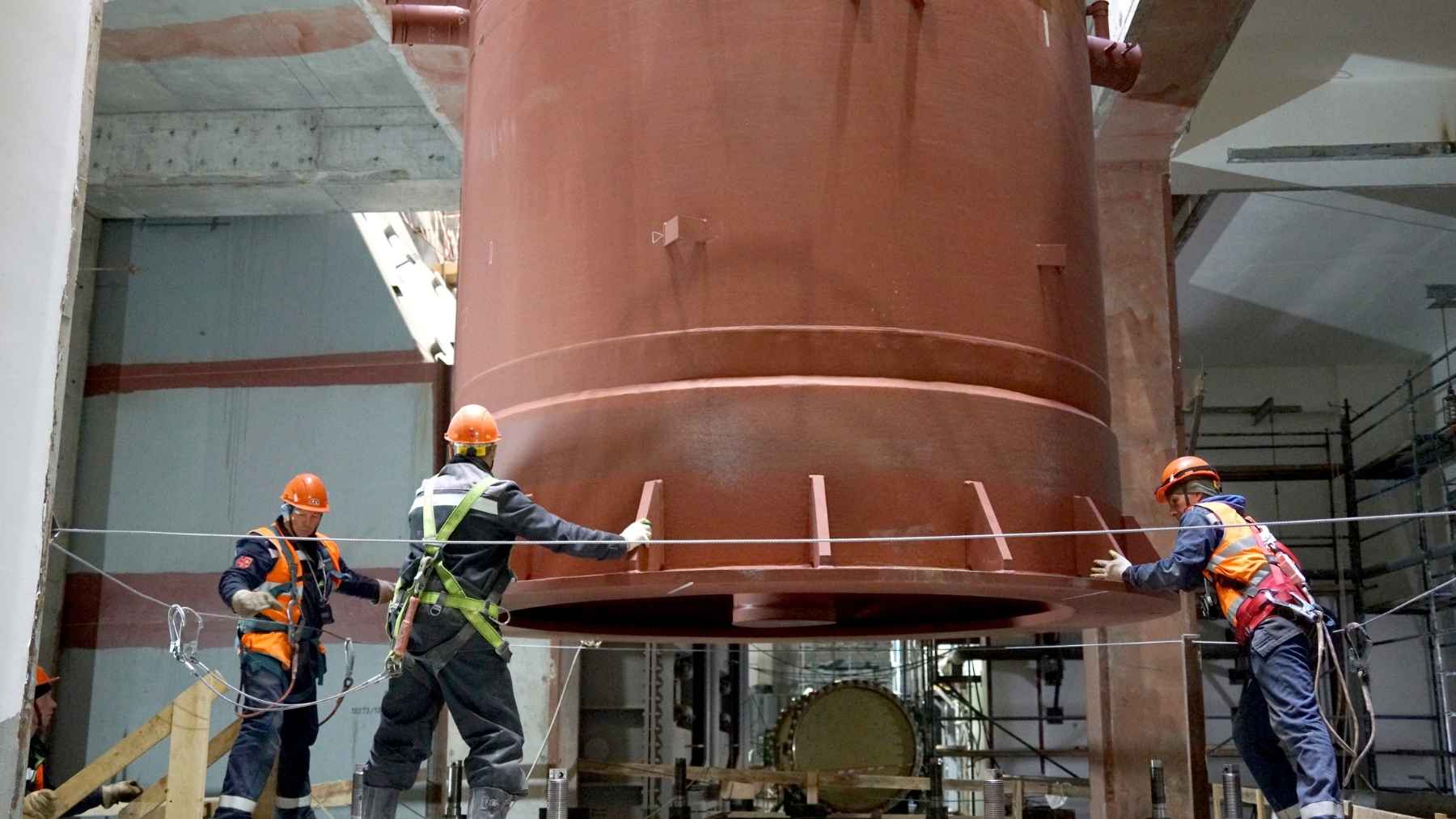
So it’s a little funny that the newest hardware at the plant is all about water. On October 7, Rosatom’s press office said workers at the construction site in Seversk, a city just outside Tomsk in Siberia, had set two separator-superheaters in place in the plant’s turbine hall.
Each one weighs about 105 tons and stands about 52 feet tall, which is roughly the height of a five-story building. They’re both sitting in their final positions now. The release doesn’t say who built them or how they got to Siberia, though.
So what’s a separator-superheater?
If the name doesn’t ring a bell, you’re not alone. American plants call this kind of equipment a moisture separator reheater, and it’s basically a giant dehumidifier for steam.
Steam cools off and starts turning back into droplets of water as it pushes through the first, high-pressure section of a turbine. Those droplets would hit the much bigger low-pressure blades further down the line at high speed and wear them away over time, so plants wring the water out and heat the steam back up before it gets there.
Rosatom says that’s the job here, too. The two units get the steam ready before it heads into the low-pressure end of the turbine, which keeps droplets from chewing up the blades and squeezes a bit more efficiency out of the whole setup.
If you live near a nuclear plant in the US, there’s a decent chance it has something similar sitting between its turbines. Westinghouse’s AP1000, the design behind the two newest units at Georgia’s Plant Vogtle, sends its steam through two of them, according to the design documents filed with the NRC. By the time that steam comes out of the high-pressure turbine, it’s about 10 to 13 percent water. The separators knock that down to half a percent or less.
So why does a reactor cooled by lead need 210 tons of equipment to get water out of its steam?
The lead never touches the turbine. BREST moves its heat through two separate circuits, according to the IAEA’s reactor database. The molten lead carries heat out of the core to steam generators tucked inside the reactor vessel itself. On the other side of those steam generators, ordinary water gets turned into steam. That’s the steam that heads over to the turbine hall.
From the turbine’s point of view, BREST is basically just another steam plant. Which arguably makes the turbine hall the least experimental part of this whole experiment. All the weird stuff lives on the reactor side.
BREST is cooled by molten lead
Most reactors running today use water to slow their neutrons down, since slow neutrons are much better at splitting the uranium in regular fuel. A fast reactor like BREST keeps its neutrons fast, so it needs a coolant that won’t slow them down, and that’s where the lead comes in.
The IAEA lists BREST at 300 megawatts of electricity from 700 megawatts of heat. The lead comes out of the core at around 1,000°F. Back in May, the company said it was still endurance-testing a prototype of the main pump, which is built to push about 12 tons of molten lead every second.
Then there’s the fuel. Rosatom says BREST will run on a dense nitride fuel made from depleted uranium (what’s left over after uranium gets enriched for regular reactors) and plutonium recovered from spent fuel. The idea’s to make that fuel, burn it, and eventually reprocess it all on the same site, which Rosatom calls a closed fuel cycle.
It’s the lead that lets Rosatom call BREST a world first, and that claim holds up pretty well, as far as I can tell. The Soviet Navy did run a class of attack submarines on reactors cooled by a lead-bismuth mix, but those pushed submarines through the water rather than electricity into a grid, and the coolant wasn’t pure lead.
If lead-cooled reactors are new to you, we’ve also covered a full-size lead test rig in Italy that swaps the fuel for electric heaters and a Swedish design that wants its first demonstration unit built in America.
The turbine hall is filling up
The separators aren’t the first big pieces of hardware to show up in this building. The turbine rotor is already on site, and so is the generator’s stator.
If you’re wondering what a stator is, it’s the big stationary shell the generator’s spinning rotor sits inside. This one weighs about 270 tons and runs about 26 feet long. According to the company, both pieces came in by sea along the Northern Sea Route, Russia’s Arctic shipping lane, then up the Tom River, and finally by road. That’s a pretty wild commute for a generator part.
Concrete for the turbine’s foundation started going in back in May. The design sets the turbine and generator on 36 springs to soak up vibration, and Ivan Babich, one of the project’s managers at the Siberian Chemical Combine, put the equipment going on top at more than 1,870 tons. For what it’s worth, the AP1000’s turbine sits on springs too, according to those same NRC documents.
Figures: Rosatom, the IAEA and World Nuclear News.
So when does BREST actually make electricity?
Not this year, anyway. Rosatom’s October 7 release doesn’t give a startup date. When construction started, the target was to have BREST running in 2026, and Rosatom’s director general, Alexey Likhachev, has since talked about launching the reactor, and the complex around it, in 2028 or 2029.
Frankly, I’d pencil those years in rather than ink them. First-of-a-kind reactors have a habit of running late, and this one already has.
World Nuclear News reported the reactor vessel was about 70 percent assembled at the end of last year. We covered the giant steel shells going into that vessel back in July.
Next up is the turbine itself. Rosatom says it plans to finish the turbine foundation in Seversk and start installing the turbine before the end of 2026.