

- 2 MONTHS AGO · ENERGYA 10-foot-high field of solar panels covering 2.2 acres let a Massachusetts farmer pull sweet corn at about 80 percent of his open rows, at the same quality, while 832 modules on 28 tracker motors made 445 kilowatts over the same dirt
- 1 MONTH AGO · ENERGY755,000 solar panels in Australia hide 4,200 sheep so well that drivers kept posting there were none inside, because a merino stands knee-high and the tilting rows read as one sheet of glass from the road — so the farmer rounded the flock up between the panels and hit record
- 1 MONTH AGO · ENERGYNearly 12,000 solar panels raised 10 to 13 feet over a blueberry field went live in eastern Germany, set high enough for farm machinery to pass underneath, and before the first post went in, ordnance crews pulled hand grenades out of the soil the bushes now grow in
- 1 MONTH AGO · ENERGYRows of solar panels 9.2 feet tall fold 70 degrees apart to let the combine drive through an Austrian wheat field, and in a drought year the wheat between them came in 14 percent ahead of the open field next door, because a moving band of shade keeps the soil damp
- TODAY · THIS ARTICLE24,264 solar panels on trackers over an organic oat field near Germany’s Danish border kept the soil under them so wet that sowing ran four weeks behind the field’s open ends, and a tractor driver looking back over his shoulder drove into a row of modules and broke several
Every agrivoltaics press release I’ve read this year makes more or less the same promise. Stand the solar panels up high, keep farming underneath, and the shade turns out to be a bonus: cooler soil, less water baking off, greener grass in August. We ran one of those two weeks ago, about a Normandy dairy pasture where the cows under the canopy kept grazing until noon while the herd out in the sun quit at 9:30.
So it was pretty refreshing, in a grim sort of way, to hear a German solar developer get up at an industry webinar and tell the other side of it. On his company’s oat field, the shade wasn’t the bonus. It was the problem.
The developer is Wattmanufactur, based in the far north of Germany a few miles from the Danish border, and the field is its agri-PV park in Freienwill, just outside Flensburg. Thies Jensen, who runs land development for the company, walked through the first farming season on October 14 at a webinar held by bne, a German energy industry association, and the farm trade paper top agrar wrote it up on October 20.
The short version: the soil under the panels stayed wet into spring, the oats went in about four weeks late, the whole season ran late after that, and the farming side of the operation lost money. His words, not mine.
So what’s actually standing in that field?
Agrivoltaics, if you haven’t run into the term, just means farming and solar on one piece of ground at the same time. The Germans call it Agri-PV, and they’ve written a technical standard for it, DIN SPEC 91434, that spells out things like how high the panels have to be and how much of the field has to stay in production for it to count.
Freienwill meets it. According to the company’s own page on the project, there are 24,264 solar panels on the site, enough for 14.5 megawatts of peak capacity and about 17 million kilowatt-hours a year.
By the U.S. Energy Information Administration’s figure for what an average American household uses, that’s power for roughly 1,500 homes. The panels are bifacial, meaning they pick up light bouncing off the ground as well as the sun hitting the front, and they sit on single-axis trackers that turn them from east to west over the course of the day.
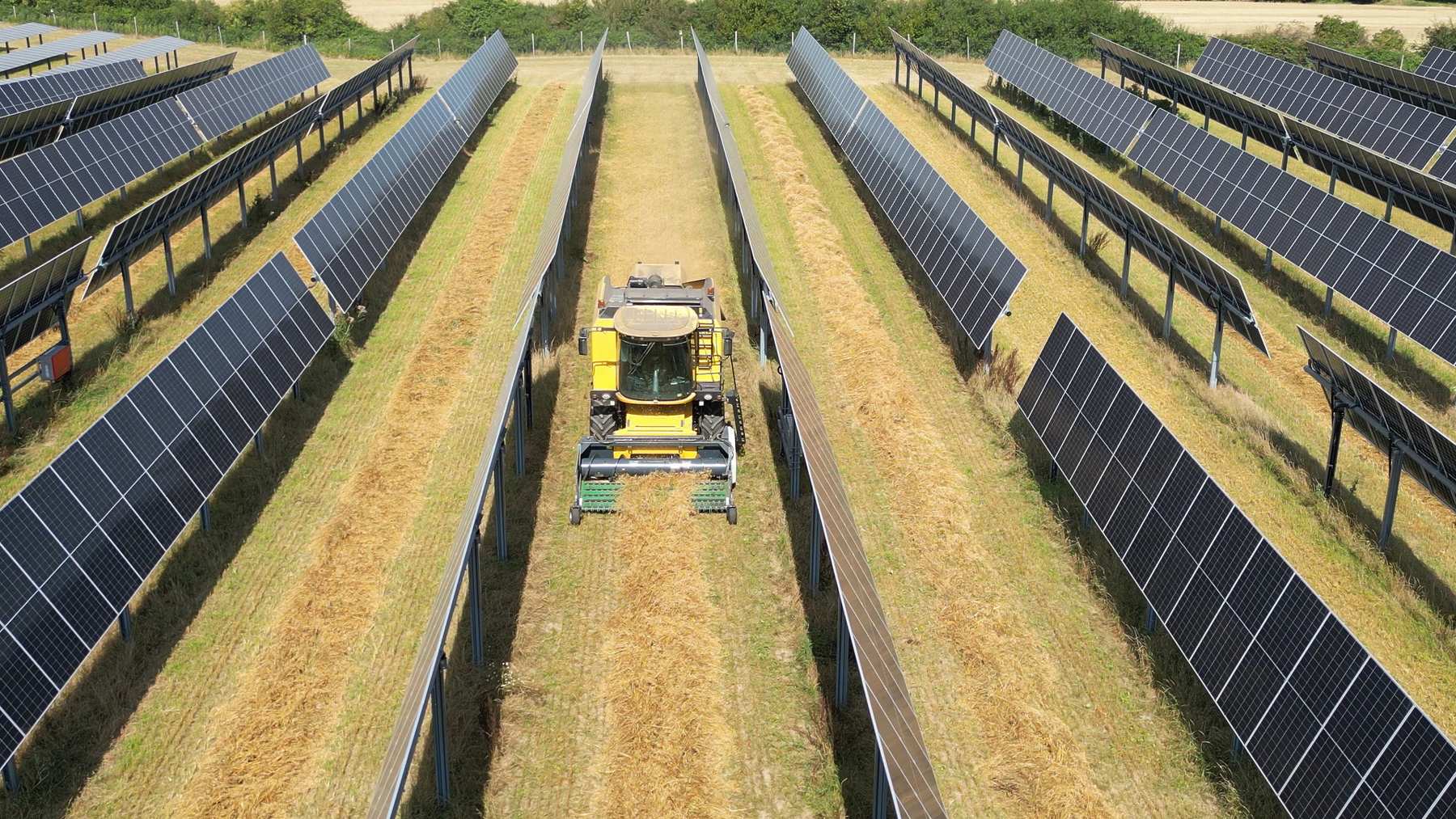
The racking is what a tractor cares about. Each row pivots 8.2 feet off the ground, with 6.9 feet of clearance at the low end of the swing, and the rows run about 20 feet apart.
Per top agrar, the park covers about 56 acres, and roughly 92 percent of that ground is still farmed. The farm doing the farming, an organic outfit called Osterhof, works around 1,500 acres across Germany and Denmark, so this isn’t a hobby plot bolted onto a solar farm.
Building the rows that tall isn’t cheap. Jensen said the racking and installation alone cost about 90 percent more than a standard ground-mounted solar farm, and the whole project came in 20 to 30 percent over a conventional one.
The contractor, apparently, couldn’t quote a fixed price for mounting modules that high and billed by the hour instead. What made the math work was a German subsidy bonus of one euro cent per kilowatt-hour for elevated agri-PV, paid on top of the normal feed-in rate.
So why was the dirt still wet in April?
Think about the strip of lawn on the north side of your house in early spring. The rest of the yard’s dried out enough to mow, and that strip’s still mud. Now put that strip under 24,264 panels that follow the sun all day.
That’s basically what happened. Jensen said the ground under the module rows dried out more slowly than the open ends of the field where the tractor turns around, and you can’t push a seed drill through mud, so the oats went in about four weeks later than they would’ve on an open field.
Everything after that slipped too, including a harvest that started later than on the farm’s fields without panels. An organic crop can’t be sprayed, so the oats should’ve been harrowed several times to knock back weeds, and with the season running that late, Jensen said the crew never got to it. The fertilizer plan didn’t happen as intended either.
So why wet here, when the Normandy canopy kept the grass green? Different month, I’d argue.
In Normandy the comparison was July, in a drought, and shade that holds water in the ground is a gift in July. In northern Germany in March, soil that holds water is soil you can’t drive on.
Farming between thousands of posts
Then there’s the equipment. A tractor working rows 20 feet apart, with a steel post every few yards, can’t use the wide gear a 1,500-acre farm normally runs. Osterhof first bought a trailed cultivator, the kind you tow behind you, and Jensen said it was no good on the hilly ground.
They ended up with an 18-foot unit hung on the tractor’s three-point hitch, and it took three passes to get a seedbed worth planting in. They also couldn’t lay their tramlines out diagonally, the way you’d normally work a field efficiently, because the module rows don’t allow it.
The crop plan went out the window too. The farm wanted a classic organic rotation: two years of clover-grass, then oats, spelt, beans and rye. Clover-grass pulls nitrogen out of the air, which is pretty much how an organic farm feeds the next crop without buying fertilizer.
But Germany’s federal network agency, the BNetzA, which enforces the agri-PV subsidy rules, wouldn’t accept a multi-year forage crop as farming, so the clover had to be plowed under and the rotation rebuilt on short notice. Jensen’s line on that was that the agency’s rules don’t fit standard farming practice, and frankly it’s hard to argue with him.
Harvest was its own project. On one field, the oats never made it to grain at all.
The crop went to whole-plant silage, baled up and sold to a local dairy farmer, and Jensen admitted the quality was poor after the late start. At the company’s second park, Manhagen, near Heiligenhafen on the Baltic coast, a combine cut the open ends of the field while a swather, a machine that cuts the crop and lays it in a row, ran between the modules so the combine could pick the oats up afterward with a special header.
GPS helped the drivers thread all that, Jensen said, but it didn’t take the risk away. “Farming between thousands of posts is very strenuous,” he told the webinar, per top agrar.
One more wrinkle I liked. The company’s website pitches the wildflower strips up to 3 feet wide under each row as roughly 12 miles of habitat across 50 acres.
Jensen told the webinar those strips spread into the crop rows and compete with the grain as weeds, and that keeping them in check would take more mechanical weeding. That’s the weeding the crew already couldn’t get done.
Then somebody drove into a row
Yes, with GPS.
In the first year a tractor damaged several modules, and Jensen’s reconstruction is that the driver probably glanced back over his shoulder, caught the steering wheel, and went straight into a row. He also pointed out that the signal can drop or a driver can misjudge the turn into a row, so a map of every post only gets you so far.
Who pays for that isn’t settled, and from the looks of things nobody’s written it down. Who covers damage to the panels when a farm tool hits them?
And the bigger one: if the farmer misses a farming requirement and that puts the subsidy at risk, who’s on the hook for the lost power revenue? Jensen raised both as open questions.
Top agrar’s write-up doesn’t say which of the two parks the tractor hit, or which field went to silage, so I can’t tell you it was Freienwill. Both parks are worked by one farm under one set of rules, and that’s as close as I can get you.
The farming side lost money, and he says so
Jensen summed up year one in a sentence: the farming came out clearly negative. There’s no yield figure and no euro figure attached to that, so take “clearly” as his word, not a balance sheet. His list of reasons reads like a cost accountant’s: extra machines, narrow working widths, poor use of the acreage, labor costs that went way up, and specialized gear that sits idle most of the year and costs a fortune per hour when it does run.
His fix is arguably the most honest thing in the whole presentation. He thinks the solar operator should subsidize the farming for now, and he floated paying the farmer by the hour, the way you’d pay a contractor, instead of expecting the crop to carry itself. So the farming bends around the power plant, and he’s upfront about that: legally, farming has to stay the main use of the land, but economically the panels are what pay the bills.
He’d rather plant grass, and the rules say no
Ask Jensen what he’d do with this ground if the rules let him, and the answer isn’t oats. He’d put it in grassland, or farm it lightly, or set it aside, and he figures most farmers would do the same if those options were on the table.
Grass is easier to manage between posts, and it lines up with German policy goals on biodiversity. But the current rules say land that was arable before the panels went up has to stay arable for the full 20-year subsidy term, so grass is off the table for the life of the project.
He doesn’t expect technology to bail him out either. Only a few of these problems, he said, will get solved by better equipment. People get used to the work and it runs smoother, but growing grain between tight rows stays hard and expensive on its own terms.
I’ll admit I find that more useful than another press release about green grass. The Thuringian blueberry farm we covered this month put its panels 10 to 13 feet up so machinery could pass, and berries don’t need a combine. Oats do, and Jensen’s the first operator I’ve seen say out loud what that costs.
Wattmanufactur’s own page still calls Freienwill one of the first agri-PV projects of its size in Germany, and the company says this year’s oats were its first full harvest under running solar panels. Jensen presented the results at the bne webinar on October 14, and the farm goes into its second season under the same 20-year rule.
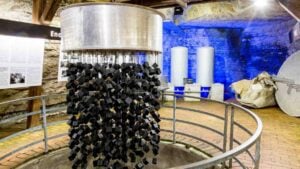 A reactor built from 664 two-inch uranium cubes hung on wires in heavy water under a German castle was Heisenberg’s last shot at a chain reaction, and two of the surviving cubes now show it needed about twice the uranium and heavy water it held, more of both than Nazi Germany hadEnergy · 12 hours ago
 A 66-foot-deep gravel pit in Finland just started taking in about 100 million gallons of tap water, and once a nine-acre lid goes on top, it’s meant to hold enough summer heat at up to 194°F to cover as much as nearly a quarter of the town’s yearly heat demandEnergy · 14 hours ago
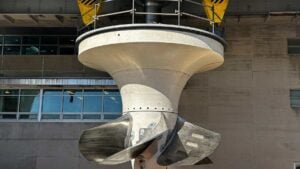 A 375,000-pound turbine now spins inside a Tennessee dam in place of one that ran for more than 80 years, and a federal watchdog just found that 196 of the 240 welds on the ring guiding water out of it failed on a job where some welders weren’t qualifiedEnergy · 17 hours ago














Not spacing the panels to fit the existing equipment is a huge oversight and would have been the biggest single expense
Spacing wider to fit that equipment would have been smarter it also would have left more of the field open to dry out faster not putting the season as far behind.
Seeding the unusable zone with things that are not controllable in an organic farm for weeding is an over site and not understanding and planning the crop rotation around the rules is not the fault of the panels
Im failing to see how this is a reckoning when its looks like a master class In poor planning