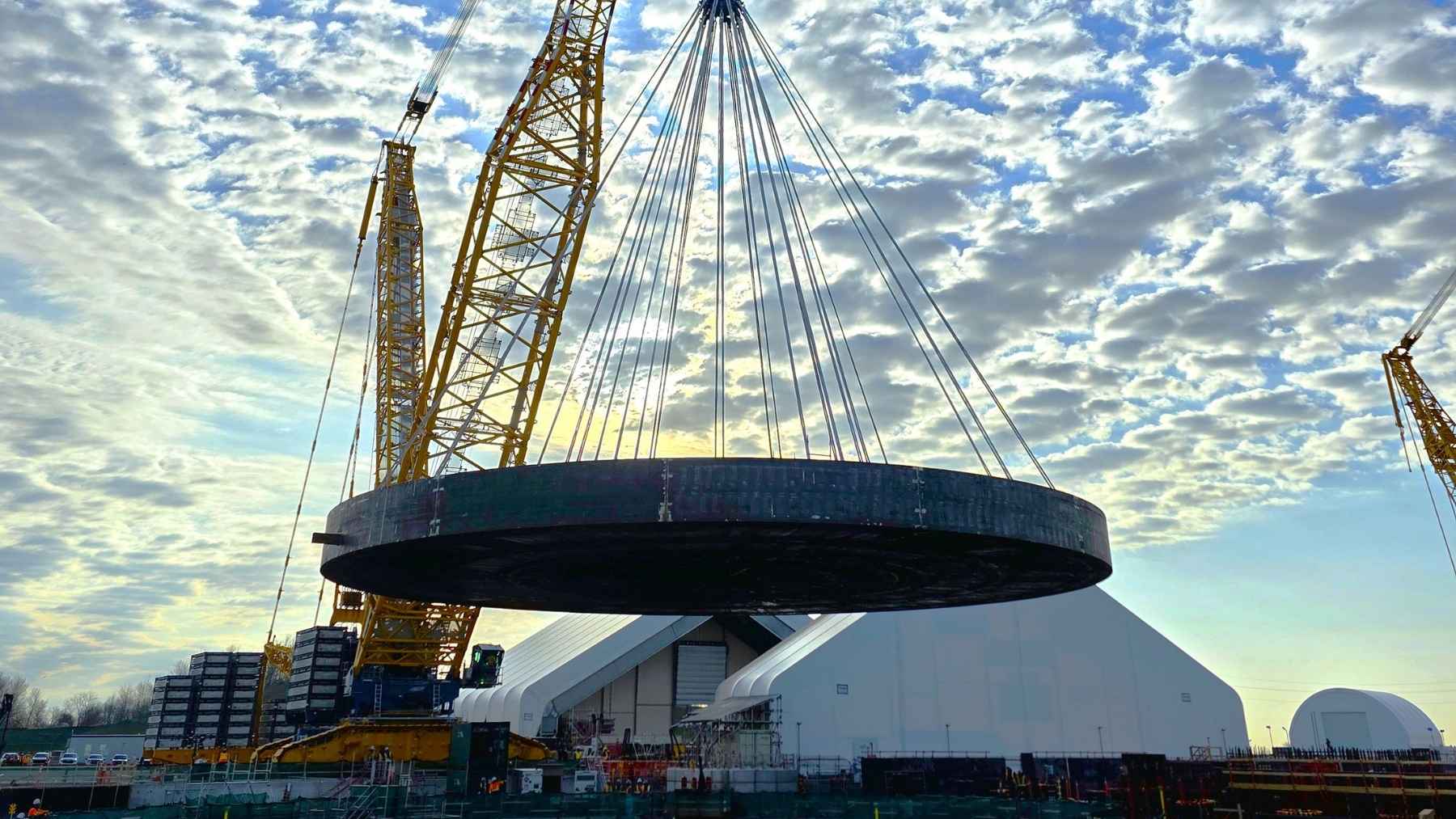

Nuclear construction updates tend to look identical from the outside. A hole in the ground, a very large crane, a slab of concrete going in, and a press release calling it a milestone. Ontario ran that exact sequence in April at the Darlington site east of Toronto, lowering a 2.1-million-pound foundation module 115 feet down a shaft to start the first grid-scale small modular reactor in the G7.
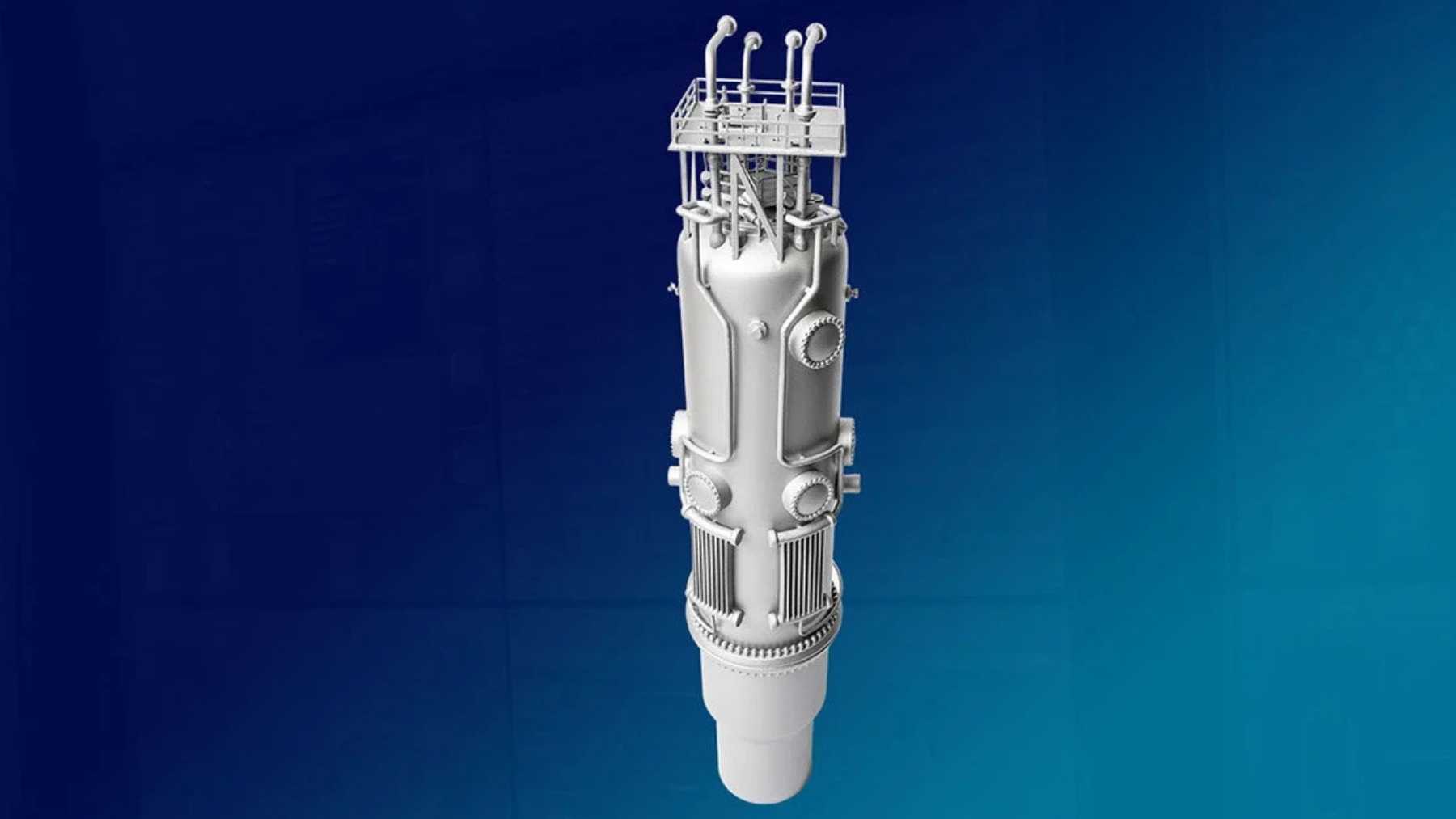
The piece that turns all of that into an actual reactor is nowhere near the hole. It sits on the far side of Toronto, in a factory in Cambridge, Ontario, where BWX Technologies is building a steel can that Ontario Power Generation describes as more than 30 meters long, more than six meters across and 550 metric tons. In US numbers, roughly 98 feet of steel weighing about 606 tons.
That can is the reactor pressure vessel, the largest single component in the machine. GE Vernova’s nuclear business awarded the contract to BWXT in January 2025, and BWXT says it is the first manufacturer in North America to take on that kind of work for a small modular reactor.
Work started early. When OPG’s project team went to Cambridge to watch fabrication begin, crews back at Darlington were still excavating the shaft the finished reactor building would sit in.
Canada built an entire nuclear fleet without ever needing one of these
This counts as a first for the country, and not just as another supplier contract, for a reason most people outside the industry never hear. Canada’s reactors are CANDUs, and a CANDU has no reactor pressure vessel at all.
The fuel and the hot coolant sit inside several hundred narrow pressure tubes, and those tubes run through a large tank of heavy water called a calandria that is not pressurized. Split the pressure across hundreds of small tubes and you never need one enormous thick-walled can. You also skip the heavy forging industry that builds them.
The BWRX-300 flips that trade. It is a boiling water reactor, so almost everything of consequence happens inside the vessel: the fuel sits in it, the water boils in it, and the steam that spins the turbine comes off the top of it. Get the can wrong and there is no plant.
The first job on a reactor vessel is lining it with a different metal
The work OPG went to Cambridge to see was not the shell. It was cladding.
A reactor vessel is built out of thick low-alloy steel, which is strong, affordable and rusts like any other steel. Every interior surface that will ever touch water gets a layer of stainless steel welded onto it instead. It is slow, unglamorous work, and it is the sort of thing that gets inspected repeatedly rather than admired.
GE Vernova Hitachi’s pitch for the design leans on exactly that point. The vessel uses the same materials and fabrication processes as the ABWR and ESBWR, boiling water designs the industry has already built, which is the whole argument for the BWRX-300: a smaller machine assembled out of parts somebody already knows how to make.
Cambridge got this job because the vessel is welded, not forged
Vessels for full-size reactors are a separate industrial problem. The gold standard there is a seamless forged ring, which needs a press in the 14,000-ton class squeezing an ingot of 500 to 600 tons, and there are almost none of those on the planet. That is why the vessels for America’s next big reactors are being forged in South Korea, and why a single line in northern Japan has such a grip on the world’s heaviest reactor forgings.
The BWRX-300 vessel is a different animal. In the design documentation GE Hitachi filed with the US Nuclear Regulatory Commission, the vessel is a vertical cylinder built from rings and rolled plate welded together, closed with a removable top head on a bolted flange.
So it is a welding, machining and inspection job at industrial scale, which happens to be exactly what a heavy nuclear component shop does all day. It also puts the vessel in the same category as the small-reactor can a British forge closed up with four electron beam welds in under a day, rather than the category that requires a 17,000-ton press and an ocean crossing.
The shop has been building CANDU hardware for 60 years
BWXT Canada is headquartered in Cambridge and says it has more than 60 years in designing, building and servicing nuclear power equipment, mostly steam generators and heavy plant components. The Cambridge plant is, by the company’s own description, the largest commercial nuclear equipment manufacturing facility in North America.
The SMR vessel is not even the biggest thing on its order book. The same site is building 48 replacement steam generators for the Pickering life extension, a job that runs more than seven years and adds over 250 skilled trades positions. Both contracts were announced on the same January day in 2025, worth more than C$1 billion between them.
To fit the work, BWXT put C$80 million into the plant, adding 55,000 square feet for a total footprint of 280,000 square feet, with completion targeted for the middle of this year. Roughly C$50 million of that went into the building and C$30 million into equipment.
BWXT just bought 500,000 square feet of the same capability in the US
On July 6, the company closed its acquisition of Precision Components Group, which brings plants in York, Pennsylvania and Florence, New Jersey. The deal adds more than 500,000 square feet of US heavy manufacturing, over 450 employees, and the specific list of skills that matters here: pressure vessels, heat exchangers, heavy weldments, large-envelope machining and ASME-certified fabrication.
BWXT commercial president John MacQuarrie framed it around “the urgent need to strengthen the U.S. nuclear manufacturing base.” On the company’s May earnings call, CEO Rex Geveden called the deal BWXT’s “first step in establishing U.S.-based commercial nuclear manufacturing capacity.”
The July announcement does not tie either plant to a specific reactor program, and BWXT has not said it will build BWRX-300 vessels in Pennsylvania. The timing is still worth reading.
NRC staff recommended in June that the commission issue the Tennessee Valley Authority a construction permit for a BWRX-300 at Clinch River in Oak Ridge, ahead of the original review schedule. The mandatory hearing on that permit is scheduled for August 13. And in March, the Commerce Department listed a US-Japan deal worth up to $40 billion to build 3 GW of the same reactor in Tennessee and Alabama.
Every one of those units needs a 606-ton can, and so far exactly one shop, in Ontario, has started one.
The hole is ready before the vessel is
Darlington is moving. All three major shafts are excavated, the basemat went in during April, and OPG is now preparing a foundation pad beside the reactor shaft for the tower crane that will lower components in. Piles at the turbine building are nearly finished, and the tunnel boring machine nicknamed Harriet Brooks is being assembled for tunneling later this summer.
“We are now able to begin building up,” OPG president and CEO Nicolle Butcher said when the foundation went in. The regulator cleared the first hold point on the construction license in late March, and OPG applied for its operating license days earlier.
The money has followed. OPG puts the first unit at $6.1 billion and the full four-unit program at $20.9 billion in Canadian dollars, and in June the Williams Treaties First Nations announced a $700 million investment in the project. The utility’s stated goal is to finish construction by the end of the decade and connect to the grid by the end of 2030.
What nobody has published is a delivery date for the vessel. The generator rotor, another long-lead item, has been forged and is expected on site by summer 2027. The can that holds the reactor is still a Cambridge shop-floor item, and Ontario’s reactor building will be waiting for it either way, since the foundation went in months ago.
The tonnage is not the hard part
The weight is the number everyone quotes and the least interesting thing about the job. A vessel is not difficult because it is heavy. It is difficult because every seam gets inspected, every repair costs schedule, and the first-of-a-kind unit sets the pace for everything behind it.
Ontario spent six decades building a nuclear industry that specialized in not needing a reactor pressure vessel, and it is now building the first one on the continent for a small modular reactor. The question that decides whether the second BWRX-300 costs less than the first is not the tonnage. It is how many of these a shop like Cambridge can turn out in a year once Tennessee, Alabama and three more Ontario units are all asking for the same part.
That number does not show up in press releases.
 @malcolmnovar ROOKIE1 month ago