
If you’ve ever worked construction, you know what happens to jobsite trailers over a weekend. Someone shows up with bolt cutters, and by Monday the generators, the saws and anything with scrap value are gone.
That’s pretty much what happened in Michigan City, Indiana, over the last weekend of September 2022, when thieves cut the locks on up to ten storage containers at a jobsite and cleaned them out. The difference is that one of the things they walked off with was a Troxler Model 3440 moisture density gauge, a yellow box with two sealed radioactive sources inside it.
Four years later, that same gauge turned up for sale on eBay.
I’ll admit the Nuclear Regulatory Commission’s daily event log isn’t where most people go looking for a story, and on a normal day it’s a fairly dry read. It’s where I found this one.
The NRC’s report for October 20 carries an update on event 56124 that runs four sentences. On October 13, NRC staff told the Illinois Emergency Management Agency that the stolen gauge was listed on eBay.
The seller was in Indiana. Illinois coordinated with the FBI and the state of Indiana, and per the update, “The gauge was successfully returned to the licensee on October 19, 2026.”
That’s six days from a listing to a handoff, which for three government agencies and a federal law enforcement bureau is frankly quick.
What the update doesn’t say is the asking price, how the listing got spotted, who the seller was, or how the gauge made its way from whoever cut those locks to whoever typed up the ad. I couldn’t find a police statement or a line of local press on the recovery either, so for now the NRC’s four sentences are the whole public record.
So what exactly got stolen?
A nuclear density gauge is one of those tools almost no one outside construction has heard of, and the industry can’t really work without. When a contractor builds up a road base or a building pad in layers, someone has to confirm each layer is packed down to spec before the next one goes on top. The gauge will do that in about a minute.
A small cesium-137 source fires gamma rays into the ground, detectors in the base count how many come back, and fewer rays means denser material. A second source, americium-241 mixed with beryllium, throws off neutrons that slow down when they hit hydrogen, and since nearly all the hydrogen in dirt is in water, that count gives you the moisture content.
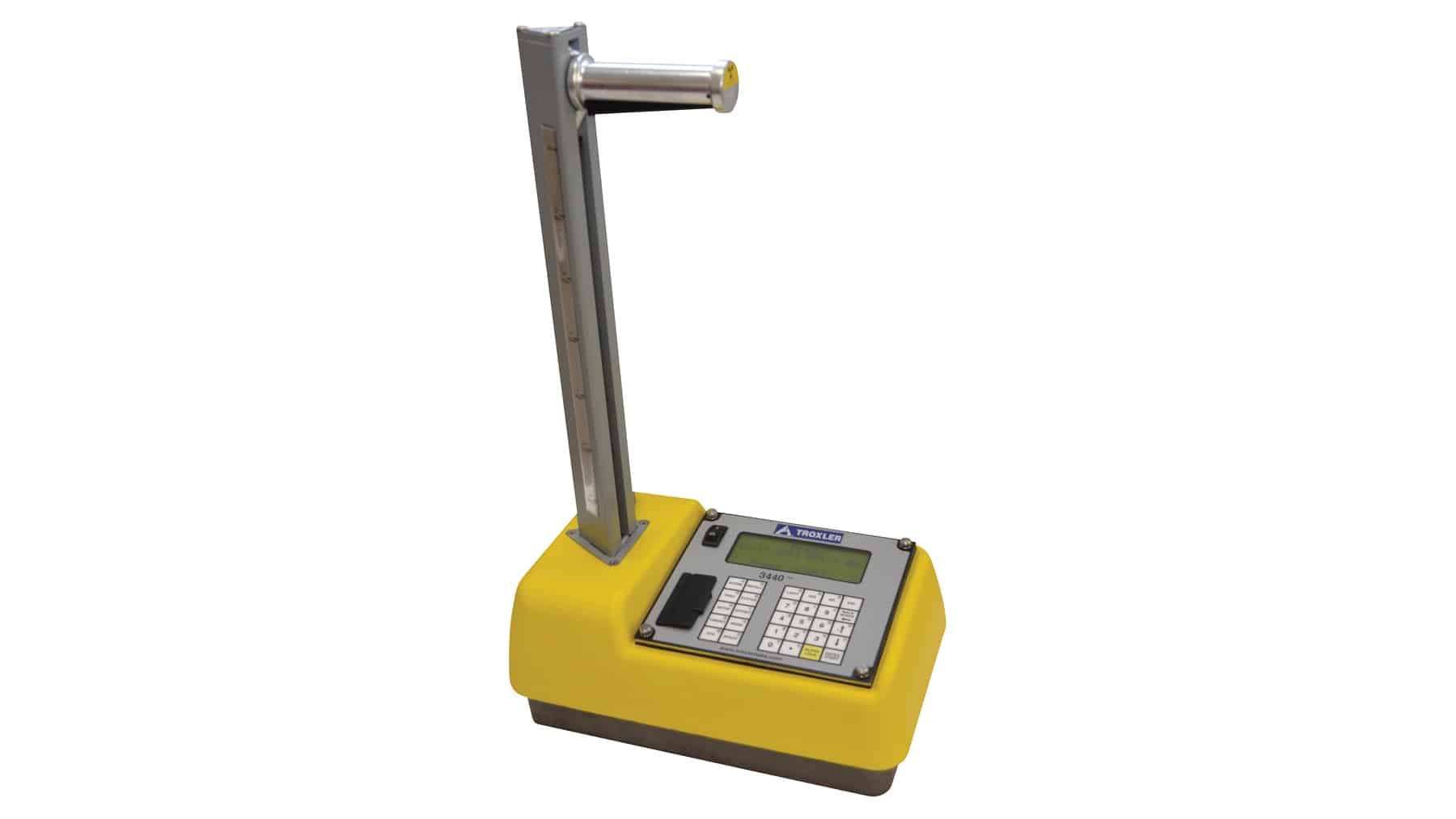
The 3440 is Troxler’s mid-range model and, from the looks of things, the most common gauge on American jobsites. Troxler’s spec sheet puts it at 31 pounds and about 23.5 inches tall with the handles and the source rod, 9 inches wide and 14.5 inches deep, so picture a large yellow shoebox with a keypad on top and a steel rod sticking up out of it. It ships in a case that brings the whole package to 83 pounds.
Inside the Michigan City unit, per the owner’s own written report to the NRC, were 8 millicuries of cesium-137 and 40 millicuries of americium-241/beryllium. The owner is NASHnal Soil Testing, a company based in Plainfield, Illinois, that holds an Illinois radioactive materials license and was working in Indiana under what regulators call reciprocity. Reciprocity is basically a visitor’s permit: a license from one state gets honored across the line for a set number of days a year, as long as you file notice first.
Two locks, two police reports and a paperwork violation
The company told the NRC the gauge was chained and locked with two locks inside a jobsite trailer, which is what the rules require. Thieves broke the trailer door and both locks and took the gauge along with other testing equipment, and an authorized user found it missing the morning of September 25, 2022.
The original Illinois report to the NRC put the theft window between the afternoon of the 24th and 7:00 a.m. on the 26th, and added that two more gauges belonging to a different company were taken from the same site and recovered on the spot. The one from NASHnal wasn’t.
The company filed theft reports with the Michigan City Police Department and with the police force of the Northern Indiana Commuter Transportation District, the agency that runs the South Shore Line commuter trains. Then it waited on the police paperwork, and that’s where it ran into trouble with the NRC.
Federal rules give a licensee 30 days to follow up a phone report of a stolen source with a written one. NASHnal didn’t, and in July 2023 the NRC issued the company a Notice of Violation after a reactive inspection.
The company’s response, dated October 16, 2023, explains that its radiation safety officer was waiting for the police report before sending anything in, and promises “this delay in reporting will not happen again.” It also lists what the company planned to change: double locks on interior and exterior storage, no unsupervised weekend storage in jobsite trailers, and a tracking device on the gauge container. Which, in fairness, is the kind of upgrade you only think about after you’ve already lost one.
How does a radioactive gauge end up on eBay?
There’s a legitimate secondhand market for this gear. Used gauges and gauge parts get listed online by dealers and by companies thinning out their fleets, and a 3440 in working order is worth real money to a testing firm.
The catch is you can’t legally own one without a radioactive materials license, and Troxler’s own FAQ spells out that federal rules require a seller to verify the buyer’s license before a gauge changes hands. So a listing from an unlicensed seller to the general public is a flare over the whole regulatory system, and apparently the NRC treated it like one.
That’s presumably why NRC staff caught it. Troxler notes on its safety page that every nuclear gauge theft gets turned over to the FBI, and the NRC keeps the serial number of a stolen source on its event file for years (this one’s been open since September 2022).
Whether someone at the NRC was actively searching eBay for the serial number or just stumbled onto the listing, the report doesn’t say. I’d like to know, and I suspect a few radiation safety officers would too.
The update also doesn’t say whether the seller had any idea what was sitting in that box, and I’m not going to guess. A Troxler case doesn’t look like much, just another beat-up equipment case, and the gauge inside could pass for survey gear. The radiation trefoil on the label is the giveaway, assuming the label is still on it.
How dangerous is 8 millicuries of cesium, really?
Not very, as long as no one takes it apart. The NRC filed this event as involving less than a Category 3 level of radioactive material, and moisture density gauges sit in the IAEA’s Category 4. In the agency’s own language, a source like this is very unlikely to cause permanent injury, and unshielded, it could possibly, though it’s unlikely, temporarily hurt someone who handled it or stayed right next to it for many weeks.
The cesium and americium sit in double-encapsulated stainless steel capsules behind lead and tungsten shielding, which is the whole point of the design. Troxler’s emergency procedure for a damaged gauge is to clear a 15-foot radius and wait for someone with a meter.
So four years in someone’s garage isn’t a Chernobyl situation. It’s also not something you want your kid using as a step stool.
The NRC’s update doesn’t describe what condition the gauge came back in, or whether the source rod was still locked in its shielded position, and I’m not going to speculate on that either. Most licensees have to leak-test their gauges every six months, so NASHnal will presumably have this one wiped and checked before it goes back on a jobsite, if it ever does.
This happens more than you’d think
The same October 20 report that carries the eBay update has four other entries, and three of them are gauges. A Virginia company left a Troxler 3440 sitting on a jobsite at the Hampton Roads Bridge-Tunnel for about 25 hours on October 11 and 12 after the operator drove back to the office with an empty case.
A Louisiana highway department gauge got backed over by a vehicle on October 10, crushing the housing with the sources still shielded. And in Alabama, a radiography camera holding a 7.7-curie iridium-192 source, which is a different league of radioactive entirely, went missing in a shipping carrier’s Memphis sorting facility for about two weeks before turning up with its label torn off. That’s one day of the log.
Thefts specifically are harder to put a number on, and I’ve tried. Troxler’s safety page cites NRC statistics showing 156 reported gauge thefts between January 1996 and October 2000, with only 40 percent ever recovered, and that’s still the figure the company has up, a quarter century later.
The NRC’s log from the last year alone has a 3440 cut out of a pickup bed with bolt cutters in August 2025 after the thief broke through the truck’s canopy window, and two cesium-137 gauges that rode a fracking trailer through a Texas equipment auction to a buyer with no license at all. Cesium-137 gets around in this country, and most of the time it isn’t in an 80-ton cask at Hanford.
Against that record, a gauge coming home four years after it was stolen is the unusual outcome, and the FBI getting it done in six days is more unusual still. NASHnal Soil Testing told the NRC in 2023 that it was looking into putting a tracker on its gauge boxes. The NRC’s October 20 report says serial number 29187 was back with the company on October 19, 2026, four years and three weeks after it left a locked trailer in Michigan City.