
- 2 MONTHS AGO · ENERGYWater boils at 202 degrees in Denver because there is a mile less air pressing on the pot, and a concrete building in eastern Washington takes that much further, boiling radioactive tank waste at 125. One run freed up 353,000 gallons of room underground
- 2 MONTHS AGO · ENERGYWhile researchers keep working in the buildings next door, crews on a Tennessee campus are knocking down ten contaminated isotope labs one at a time in the late afternoon, after six years spent stripping out hot cells and four 2,000-pound krypton tanks, and all ten free up 12,000 square feet
- 2 MONTHS AGO · ENERGYThree 24,000-pound nuclear waste filters in Washington state are catching radioactive cesium again after a six-month pause caused by the tank they drain into, which holds about a million gallons, roughly four times what the glass furnace downstream has taken from it
- 6 DAYS AGO · ENERGYA drum crusher is replacing the reciprocating saw workers used on nuclear waste drums inside a three-room enclosure in Tennessee, where a conveyor and a soil mixer came out and new cameras and ventilation went in so it can take large waste boxes from Oak Ridge demolition jobs
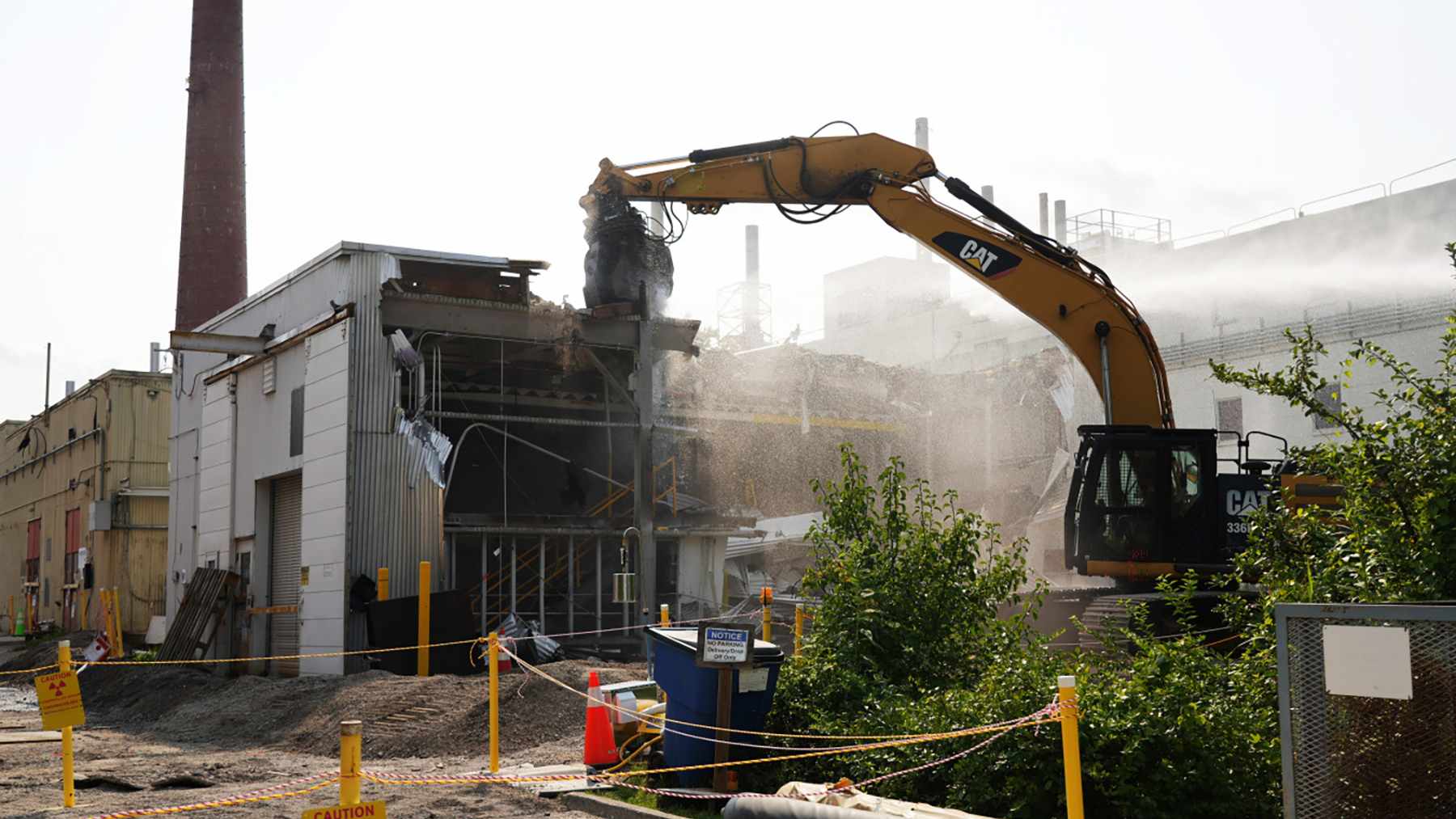
- TODAY · THIS ARTICLEWhile scientists kept working in the buildings on either side, a row of ten isotope labs in Tennessee came down in two months, each one in the late afternoon, and the six hot cells, the gloveboxes and four 2,000-pound gas tanks inside left as part of nearly 3 million pounds of waste
Back in September, we covered the first of ten old isotope labs coming down at Oak Ridge National Laboratory in Tennessee. At the time, the plan was to have the rest of them gone by the end of the year, which seemed fairly ambitious for buildings that used to make radioactive material.
Well, they’re all gone. United Cleanup Oak Ridge (UCOR), the cleanup contractor working for the Energy Department at the site, announced on November 2 that demolition of Isotope Row is complete. DOE’s Oak Ridge Office of Environmental Management followed with its own write-up on November 10, and both say the knocking-down part took two months.
So how do you tear down ten contaminated buildings in two months?
You spend six years getting them ready first. That’s how long the whole project ran, and almost all of it happened before anyone brought in an excavator.
Isotope Row was a cluster of ten facilities built from the late 1940s through the early 1960s. They turned out radioisotopes for medicine, industry, science and national defense, and they stopped operating in the early 1990s. The buildings didn’t go anywhere after that, though. They sat in ORNL’s central campus for decades, still full of mercury, asbestos, leftover radioactive isotopes, contaminated gloveboxes and hot cells, plus old process systems that were hazardous in their own right.
So what was actually inside?
The headline items are the six hot cells. If you’ve never seen one, a hot cell is basically a room with heavily shielded concrete walls, shielded windows and mechanical arms that reach through the wall. A worker stands outside, moves a handle, and the arm inside copies the motion, so nobody has to share a room with the stuff that’s giving off radiation. (We wrote about one of those arms breaking and then being used to fix the other one back in October.)
Then you have the gloveboxes, which are sealed boxes with gloves built into the side. You put your hands in the gloves and work on whatever’s inside without touching it or breathing it in. Isotope Row’s gloveboxes were contaminated, and they had to come out too.
UCOR’s list also includes four 2,000-pound krypton tanks. DOE just calls them tanks that held an inert gas, which is the same thing, only a little more vague (krypton is a noble gas, so it doesn’t really react with anything). Those tanks weren’t there anymore by the time the demolition started.
One of the toughest jobs, according to DOE, was the overhead off-gas and ventilation piping. Off-gas is basically the exhaust side of a lab like this, meaning the ducts and pipes that pulled air and fumes away from the radioactive work so they could be cleaned up. Some of Isotope Row’s piping was made with a concrete mix that contained asbestos, it had become highly contaminated, and it ran 10 to 15 feet above the floor. So workers were dealing with radioactive contamination and asbestos at the same time, over their heads. DOE says that took specialized controls and packaging to pull off. Frankly, that’s a pretty miserable-sounding way to spend a shift.
All told, the project pulled out nearly 3 million pounds of waste. That figure covers all six years of cleanup and demolition.
DOE says the cleanup started with cutting off the utilities and clearing out hazardous waste, asbestos and anything that could burn. Workers didn’t get to the dirtiest stuff, the old process equipment and the ventilation, until that was done. Each building had to reach what’s called cold-and-dark status, which is the cleanup world’s way of saying every utility is shut off. DOE’s Oak Ridge office, UCOR, UT-Battelle (the contractor that runs ORNL) and DOE’s Office of Science worked on that together.
The lab kept working the whole time
Isotope Row sat right in the middle of ORNL’s central campus, and the lab kept running around it. UCOR and DOE both say the heavy equipment did its work in the afternoons, so it’d get in the way of active research as little as possible.
Neither announcement says why afternoons work better than mornings, and I’m not going to start guessing about scheduling on a nuclear site. Still, if you’re a researcher working nearby, you’d presumably at least know when the noise is coming.
Building 3033 went last on purpose
Of the ten, only one building gets named in UCOR’s write-up. That’s Building 3033, and it went last because it had elevated levels of tritium along with other contaminants.
Tritium is a radioactive form of hydrogen. Since it behaves chemically like regular hydrogen, it can work its way into things like water and concrete, and that’s what makes it a pain to keep in one place.
So what happens if you knock 3033 down first? According to UCOR, you risk its contamination spreading into the debris from the surrounding buildings. That could’ve meant tougher disposal requirements, higher costs and a longer project. It’s a pretty sensible bit of planning. You don’t want one building’s worth of tritium turning nine buildings’ worth of rubble into the expensive kind of waste.
Most of the rubble stayed on site
Once the buildings were down, most of the rubble stayed on site for disposal, which saved the cost of shipping it somewhere else. UCOR posted a video update on October 20 saying the buildings were demolished and debris removal was underway, so the November announcements are really the wrap-up.
UCOR puts the total at more than 12,000 square feet of buildings torn down and more than 375,000 work hours completed safely. I’ll admit 12,000 square feet sounded small to me for ten buildings. Then again, almost all of the hard work on Isotope Row happened inside those walls, years before the first one came down.
There are a couple of things these announcements don’t cover. Neither DOE nor UCOR puts a price on the six-year project in its write-up, and DOE hasn’t said what will go where Isotope Row stood. It only says the cleared ground opens up space for future research in the middle of the campus. Federal Project Director Michael Griswold says the work “reduces risks today while opening new opportunities for the laboratory’s tomorrow.”
So that’s ten for ten. DOE’s Oak Ridge cleanup office marked the end of the six-year Isotope Row project on November 10, eight days after UCOR announced demolition was complete.
 A wall of turbines and ship locks that would hold back a 33-foot tide for 120 years has finally been told where to stand, on a 1.5-mile line across an English estuary from one bank to the other, and its planners now want up to 1,000 megawatts out of it instead of 700Energy · 3 hours ago
 A Dutch strawberry grower hung nearly 2,000 solar modules under the glass of a 2.5-acre greenhouse in four weeks without stopping the harvest, and they take only the heat-carrying part of the sunlight, because on bright days the berries overheat and come out smallEnergy · 6 hours ago
 A British company laid three fiberglass pipes 200 feet long up a Devon hillside and filled them with a fluid dense enough to float concrete, and the government’s final report says the plant hit 500 kilowatts but can hold that output for about 15 minutes, not the four hours it was built forEnergy · 8 hours ago