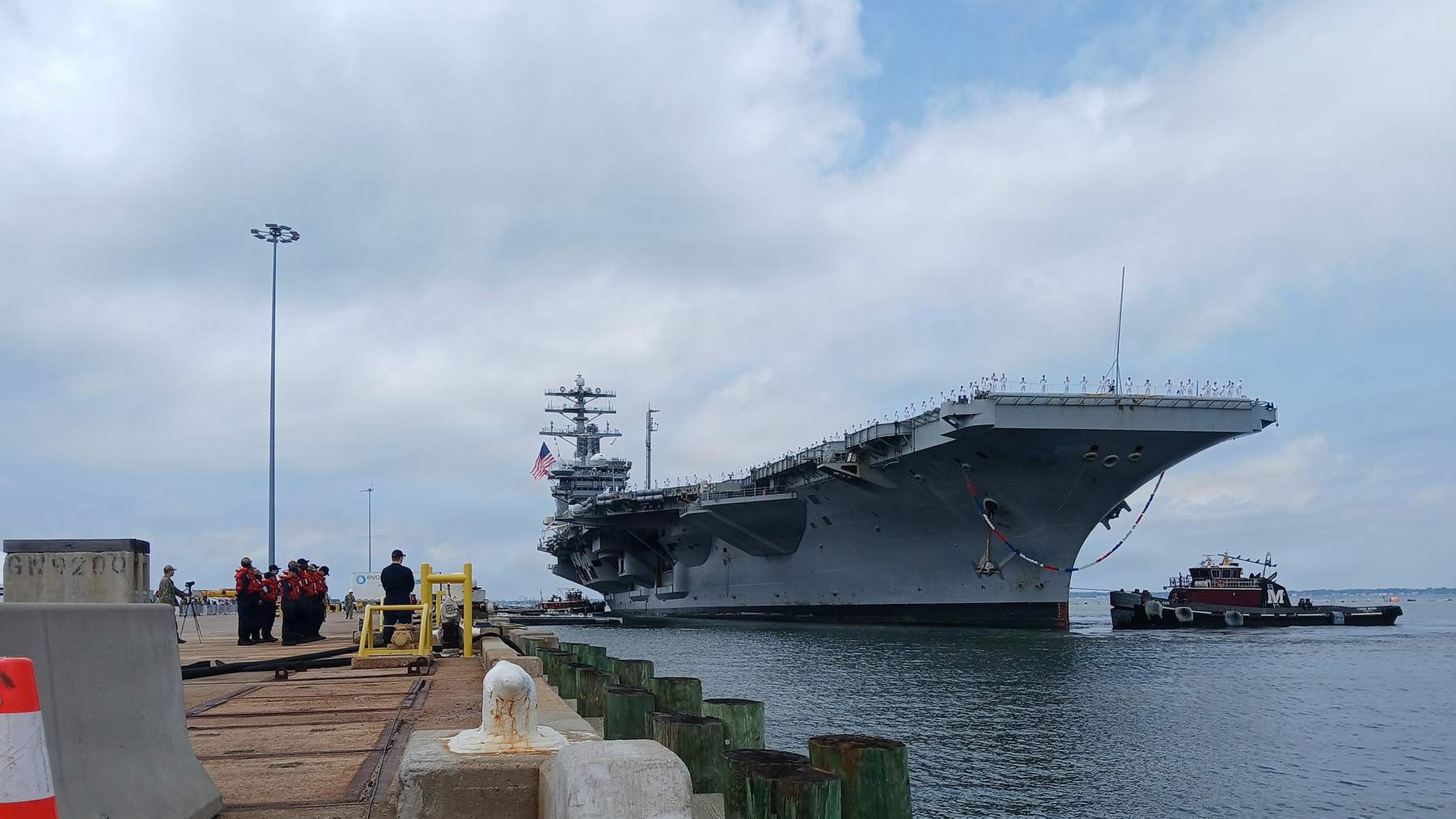

- 1 MONTH AGO · MILITARYA 1,092-foot nuclear aircraft carrier moved from her pier in Norfolk to the shipyard that built her, starting a five-year overhaul where the yard cuts through the hull to swap the reactor cores, the only refueling she gets in a service life built to run past 50 years
- 4 WEEKS AGO · MILITARYAn 18,750-ton submarine, the biggest America ever built, came home for the last time after firing in the strikes on Iran, and the week she tied up the Navy signed for nine attack submarines that haul 40 cruise missiles apiece, four of them to match the 154 she carried alone
- 1 WEEK AGO · MILITARYA 97,000-ton nuclear aircraft carrier has now spent more than 2,000 days at the Virginia shipyard that built her, getting a new mast and work on over 600 tanks, and Navy documents point to one more year of it, with her sister ship already there for a five-year overhaul
- 6 DAYS AGO · MILITARYA 72,000-ton aircraft carrier sailed up a fjord to a Norwegian military jetty and loaded ammunition from shore, the first time a carrier of its class has rearmed in a port outside the UK, so it can keep operating when its supply ship isn’t available
- TODAY · THIS ARTICLEA 100,000-ton nuclear carrier left her Pacific home port for the last time, rounded South America and tied up in Virginia to be retired, and she is still in commission and landing jets months later because her replacement is late, with her reactors to be emptied once she retires in March
If you followed the USS Nimitz at all this year, you’ve probably seen what looked a lot like a farewell tour. The Navy’s oldest aircraft carrier left her home port in Bremerton, Wash., for the last time on March 7, sailed all the way around South America, showed up in New York for the Fourth of July and then pulled into Naval Station Norfolk, Va. That was supposed to be the end of the road.
It hasn’t been, at least not yet. Four months after that arrival, the Nimitz is still a commissioned warship, and on Monday, Nov. 9, she came back into Norfolk after a stretch at sea spent catching jets.
So what’s a 51-year-old carrier doing landing fighters when she’s already tied up at her retirement home?
Basically, she’s filling in. The ship that’s lined up to replace her is running late, and while the Navy waits, the Nimitz has picked up a new job as a training carrier on the East Coast. It’s arguably the most useful thing anyone could do with her right now.
So why hasn’t she retired yet?
The Nimitz was due to be decommissioned this past May. Then, in March, the Navy pushed that back about 10 months. According to USNI News, the new date lines up with the delivery of the John F. Kennedy (CVN-79), the second carrier of the newer Ford class and the ship that’s taking the Nimitz’s spot in the fleet.
The timing was a bit awkward, frankly. Breaking Defense, which broke the story, reported that the Nimitz had already left Bremerton on March 7 for the move east. The extension went public about a week later, so she’d already been at sea for a week on what everyone had called her last trip when her last day got moved.
That trip was a long one. The Nimitz spent about four months on a deployment the Navy called Southern Seas, working her way around South America with port visits in Panama, Chile, Brazil and Jamaica. After that came a big multinational exercise off the East Coast, and then the International Naval Review in New York, which lined up with the country’s 250th birthday.
Then she tied up at Norfolk on July 9 with nearly 3,000 sailors aboard. If that sounds like a homecoming, it kind of is. The Nimitz was commissioned at Naval Station Norfolk, and the Navy’s arrival announcement makes the point that the base was her first home port and will be her last one too.
The Nimitz is a training carrier now
For the rest of her career, the Nimitz is where Navy pilots go to qualify on a carrier deck. Her first East Coast training trip wrapped up on Nov. 9, and the Navy’s write-up of that underway counts 442 arrested landings, 152 touch-and-goes and 103 sorties.
If you don’t speak carrier, here’s what that means. An arrested landing is the classic carrier trap: the jet drops a hook on its tail, snags one of the steel cables stretched across the deck and gets dragged to a stop. A touch-and-go is a practice pass where the wheels hit the deck but the pilot keeps the power up and flies off again without hooking anything. The Nimitz has four of those cables, according to the Navy.
The pilots were a mixed bunch. Some were with Strike Fighter Squadron 106, a fleet replacement squadron, which is the Navy’s name for the unit that teaches pilots a specific jet before they join a frontline squadron. For the new ones, this trip meant their very first arrested landings and catapult launches in an F/A-18E/F Super Hornet. Others were experienced aviators who’d spent their last sea tours in jobs that kept them out of the cockpit.
Carrier Air Wing 1 got its qualifications done too. And after that, student naval aviators from Training Air Wings 1 and 2 made their first-ever carrier landings and launches, flying T-45C Goshawk trainers.
Capt. Joseph Furco, the ship’s commanding officer, noted that his crew has done two deployments to three different regions in under two years, and said “this crew has invaluable knowledge and experience to pass on.” That’s a pretty fair pitch, I’d say. A crew that’s just come off back-to-back deployments is about as good a group as you’ll find to show a rookie what a busy flight deck actually feels like.
The Navy says more of these qualification trips are scheduled before she’s deactivated. As far as I can tell, it hasn’t said how many, or when the last one goes out.
What happens to her two reactors?
Here’s where the size of the ship really comes into it. The Nimitz is a 100,000-ton carrier, 1,092 feet long, and she runs on two nuclear reactors, going by the Navy’s own figures for the ship. You can’t just hand something like that to a scrap dealer.
So the plan is to retire her in March 2027 and then defuel her at the yard that built her, HII’s Newport News Shipbuilding in Virginia. Inactivation is basically the Navy’s word for shutting a ship down for good and stripping her out so she can be stored or eventually taken apart. Defueling is the nuclear side of that job, where the yard pulls the used fuel out of the reactors so the hull isn’t carrying it around anymore.
It makes sense, more or less, that the shipyard that put the reactors in is the one that takes the fuel out. In March, HII got a contract worth about $96 million to start planning the inactivation and defueling and to order parts that take a long time to get, USNI News reported. That’s planning money, though. I couldn’t find a published figure for what the whole job will cost, or a date for when the fuel actually comes out.
We’ve covered where that road ends up. The old USS Enterprise, the Navy’s first nuclear-powered carrier, has already been defueled and sent off under tow to be scrapped. And the Nimitz has a sister ship that’s spent far longer than planned at a Virginia shipyard, which is a decent reminder that carrier schedules don’t always go the way they’re drawn up.
The Nimitz is homeported at Norfolk as flagship of Carrier Strike Group 8, and the Navy’s current plan still has her leaving service in March 2027, which is when USNI News reported the Kennedy is set to be delivered.
 A 1,123-foot aircraft carrier with eight defueled reactors is under tow from Newport News to Mobile, where a scrapyard will cut the hulk apart around those reactors over the next four years while a 100-yard safety zone moves with herMilitary · 4 days ago
 A 27,000-ton battleship that once had 45 pumps taking thousands of tons of water out of her hull is having a 32,000-square-foot wood deck finished at a Texas yard she has occupied since 2022, and she’ll move about a mile to a pier where officials hope to open her by the end of 2027Military · 18 hours ago
 A 22-foot underwater drone shaped like a stingray glides by sinking and rising, its American builder says tests have kept its drones submerged for up to 70 days, and the next version it wants is over 100 feet long, built to carry up to 96 smaller drones and stay out for yearsMilitary · 20 hours ago