- 4 MONTHS AGO · ENERGYA 190-foot free-fall tower drops riders inside the cooling tower of a 327-megawatt German reactor that was finished, filled with liquid sodium and never handed a single fuel rod, and a Dutch scrap dealer bought the site for about $3 million
- 2 MONTHS AGO · ENERGYWhile the twin domes of a California nuclear plant start coming down early next year, the 3.6 million pounds of fuel they held stays behind in 123 steel canisters about 100 feet from a seawall on the Pacific, built to take twice the shaking of the biggest quake expected
- 2 MONTHS AGO · ENERGYA 215,000-square-foot nuclear fuel plant got its frame, walls and roof finished in Tennessee, built to press uranium into billiard-ball spheres at 700,000 a year for up to 11 reactors, and the machines that do the pressing still have to move indoors
- 2 MONTHS AGO · ENERGYThe first new commercial nuclear fuel plant America has built in more than 50 years finished its shell in 10 months, sized to press uranium into 700,000 billiard-ball spheres a year, and the first reactor it will feed is still waiting for permission to pour concrete
- TODAY · THIS ARTICLEA 516-foot cooling tower stands unused beside its working twin at a Lake Erie nuclear plant, built for a second reactor that was canceled with the tower already finished, and the plant is now preparing to squeeze 213 more megawatts out of the one reactor it did get
There’s a decent chance you’ll be hearing the name Perry a lot next week. Reuters reported over the weekend that the Department of Energy plans to lend Vistra, the plant’s owner, about $4.2 billion to boost output across its nuclear fleet. Additionally, the Energy Secretary Chris Wright is expected to announce it at Perry, on the shores of Lake Erie in Ohio, on Monday. Meta already agreed back in January to buy everything the plant makes for 20 years. Not too shabby when you learn it wasn’t even supposed to make it this far.
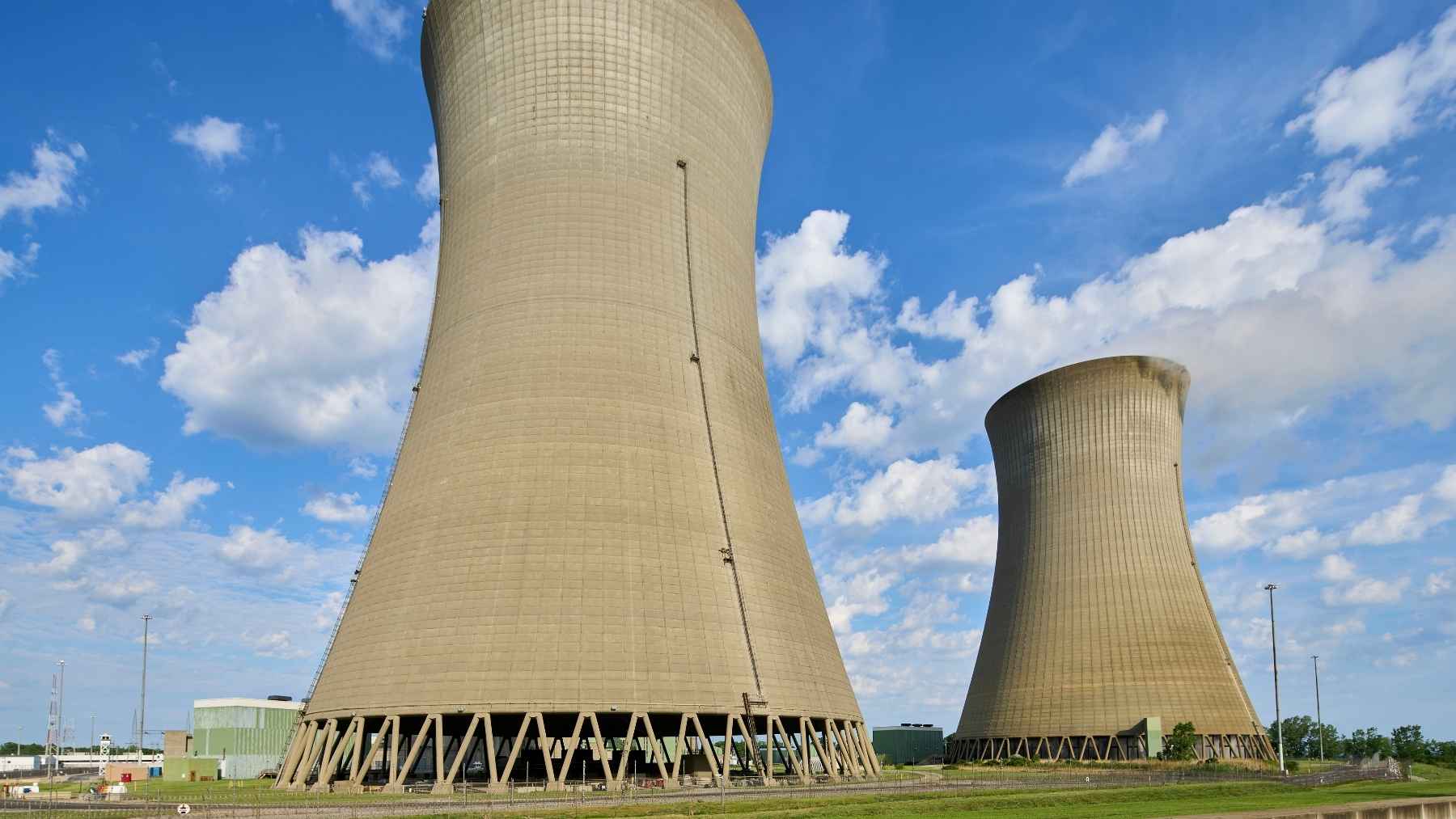
But forget the money for a second, because Perry’s most interesting feature is something visible from the road. The plant has two identical 516-foot concrete cooling towers standing side by side. One of them puffs out a steam plume all day. The other one hasn’t worked a single shift in its life.
So how does a nuclear plant end up with a spare skyscraper?
Perry was supposed to be twice as big
We’ll gotta go back to the beginning.
Cleveland Electric Illuminating and a group of partner utilities ordered Perry in the early 1970s as a two-reactor plant, with a large General Electric boiling-water reactor and a 516-foot cooling tower for each unit. Ground broke in 1974, and both units went up together for a while.
Then demand forecasts sagged. This meant work on the second unit stalled in the mid-1980s, and by the end of that decade, Unit 2 sat on hold at roughly 45% complete. The company formally canceled it in 1994, with most major structures already completed, including the entire second tower. Unit 1, meanwhile, loaded fuel in 1986 and went commercial in November 1987 as the 100th nuclear plant built in the United States, by Vistra’s count.
Unit 2’s tower never got a reactor to cool. It’s still standing today, and as far as I can tell, there’s never been a serious plan to either hook it up or tear it down. Finished nuclear hardware that never runs is rarer than you’d think, though it happens. Germany built an entire fast breeder reactor, loaded it with liquid sodium, never gave it a single fuel rod, and eventually put a free-fall ride inside its cooling tower.
Perry’s spare is basically the restrained American version of that story.
What does a cooling tower do all day, anyway?
Here’s the short version: a reactor boils water into steam, the steam spins a turbine, and then you’ve got to turn all that steam back into water so it can go around again. The cooling tower is where the leftover heat ends up. Warm water pours through the base of the shell, air rushing up the 516-foot chimney carries the heat away, and the cooled water heads back for another lap. A tower like Perry’s doesn’t use fans at all. The shape does the work. Which also means an unused one is basically an enormous, very expensive piece of architecture. (And that’s the short version.) Not every plant bothers with towers, either; California’s last nuclear plant pulls the Pacific straight through itself instead.
That prominent steam plume isn’t radioactive, and neither is the idle tower. Water running between the condenser and the tower stays inside its own closed piping loop and never touches reactor water, a point both the operator and Lake County’s emergency planners spell out in writing. That plume you see from the highway? It’s plain water vapor, interestingly enough.
The tower that does work handles a serious load. The reactor it serves produces 1,268 megawatts at full power, making it among the largest boiling water reactors in the country, following a 5% power bump regulators approved in 2000. The plant’s 2006 engineering documentation describes a cooling loop designed to circulate 545,000 gallons per minute, fed by three pumps rated at 185,000 gallons per minute each, through buried pipes 12 feet in diameter. That’s roughly an Olympic swimming pool’s worth of water every 75 seconds, going in a circle.
The rest of the 1,100-acre site is greener than you’d expect from a nuclear station. More than 850 acres of forest and marsh are kept as a certified urban wildlife sanctuary, which puts Perry in the same odd club as the Florida plant whose cooling canals turned into the country’s densest crocodile nursery.
Perry is about to be pushed harder than ever
Which brings us back to the money we first mentioned.
Perry’s original 40-year license was due to run out this November, and for a long stretch, the smart bet was that the plant wouldn’t outlive it. Vistra’s chief strategy and sustainability officer, Stacey Doré, has said the company’s three nuclear plants in Ohio and Pennsylvania “were on a path to retirement” as recently as 2020. Instead, regulators renewed Perry’s license in 2025, and it’s now good through 2046.
Then came the buyers. In January, Vistra told investors in an SEC filing that Meta will purchase Perry’s full 1,268 megawatts for 20 years, with deliveries starting in late 2026, plus another 213 megawatts Vistra plans to wring out of the same reactor through an uprate, arriving in stages between 2031 and 2034. That’s a lot of promises hanging off one reactor and one tower.
An uprate, if you haven’t run into the term, is the nuclear industry’s version of tuning the engine you already own. You swap in beefier components, push more steam through the plant, and get more megawatts from the same reactor, and you don’t have to license a whole new reactor to do it. The Energy Department’s environmental review of the Perry project, published in September, describes the planned scope as new turbine hardware, a replacement steam dryer, and a set of additional small cooling cells to deal with the extra heat.
The fix for the need for more cooling at Perry is a set of small new cooling cells at a site with a spare 516-foot cooling tower standing fully built a few hundred feet away. I’m sure there are perfectly sound engineering reasons, starting with the fact that the idle tower was never piped into Unit 1’s condenser, and connecting it now would be a huge project in its own right. It’s still a pretty funny sentence to type.
As for the $4.2 billion, nothing’s signed yet. The Energy Department’s own paperwork frames it as a loan guarantee that the government hasn’t finished evaluating. It’s penciled in for now; the permanent marker figures come in later. Nobody is in a rush to spend billions, I’m sure.
Vistra says Meta’s deliveries from Perry begin in late 2026, the first of the extra 213 megawatts is due by 2031, and the renewed license runs through 2046. If Reuters has it right, Secretary Wright will make the loan official at the plant on Monday, October 6th, with both towers in the background and exactly one of them earning its keep.
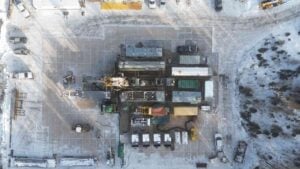 A 5,100-foot well in the woods of northern Minnesota flows gas that is 8 percent helium, more than 25 times the grade the industry calls worth producing, with no water and no pumping, and it sits in a state where no gas has ever been producedEnergy · 2 weeks ago
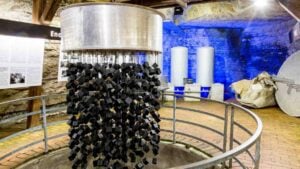 A reactor built from 664 two-inch uranium cubes hung on wires in heavy water under a German castle was Heisenberg’s last shot at a chain reaction, and two of the surviving cubes now show it needed about twice the uranium and heavy water it held, more of both than Nazi Germany hadEnergy · 2 weeks ago
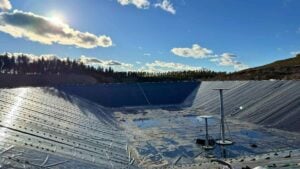 A 66-foot-deep gravel pit in Finland just started taking in about 100 million gallons of tap water, and once a nine-acre lid goes on top, it’s meant to hold enough summer heat at up to 194°F to cover as much as nearly a quarter of the town’s yearly heat demandEnergy · 2 weeks ago
 @rickyglass ROOKIE2 months ago