
- 2 MONTHS AGO · ENERGYA 10-foot-high field of solar panels covering 2.2 acres let a Massachusetts farmer pull sweet corn at about 80 percent of his open rows, at the same quality, while 832 modules on 28 tracker motors made 445 kilowatts over the same dirt
- 2 MONTHS AGO · ENERGYNew Jersey stood 378 solar panels dead upright in a cattle pasture, edge-on to the sun, because an upright panel gives you two production humps instead of one noon spike, and six cows are now grazing between the rows with a camera on them every five minutes
- 1 MONTH AGO · ENERGY755,000 solar panels in Australia hide 4,200 sheep so well that drivers kept posting there were none inside, because a merino stands knee-high and the tilting rows read as one sheet of glass from the road — so the farmer rounded the flock up between the panels and hit record
- 1 MONTH AGO · ENERGY79,000 solar panels on a New York farm had two, four and eight sheep per 2.5 acres grazing under them for three summers, and the lightest flock left 38 percent more bees and ladybugs than a mower did while the heaviest kept the grass shortest and cut the honeybees nearly in half
- TODAY · THIS ARTICLE183,600 solar panels went up on 480 acres of old Alberta farmland, and hay is still being cut between the rows while about 260 sheep eat the weeds on the 60-acre patch the hay equipment struggled with and more than two million bees made about 1,000 pounds of honey
Sit through enough county meetings about a proposed solar farm and you’ll hear pretty much the same complaint every time. Those panels are going on good farmland, and nothing’s ever going to grow there again.
A group of neighbors made a version of that argument to Alberta’s utility regulator about a 75-megawatt project just north of Airdrie, a city right up the highway from Calgary. The City of Airdrie raised concerns about losing some of the area’s most productive farmland too (it later settled those with the developer), and Rocky View County had already turned down the rezoning.
The Alberta Utilities Commission approved it anyway, though it noted some concern about how the developer had consulted a few of those neighbors.
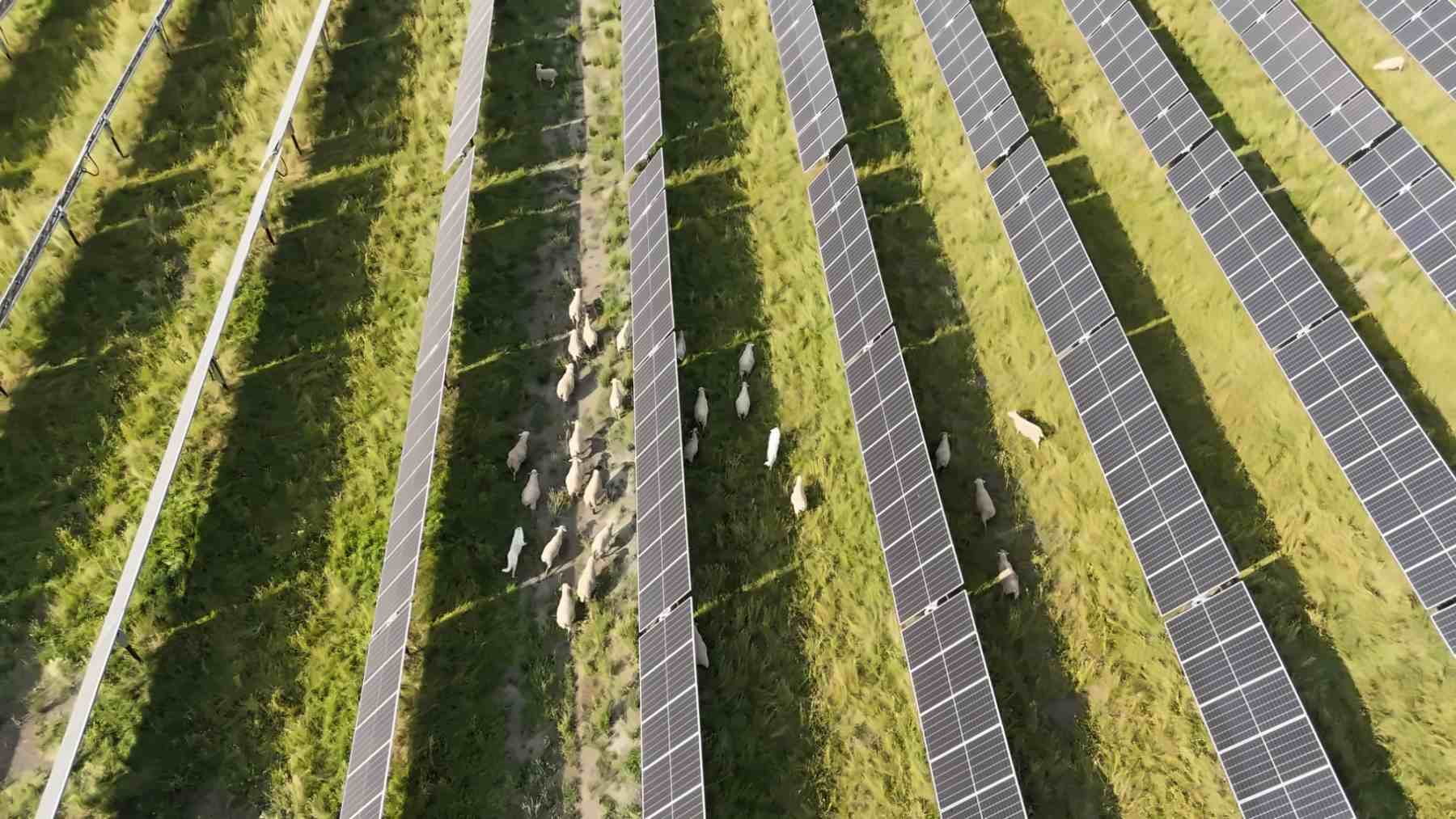
Now the owner, General Land & Power, says in an October 28 release that about 260 sheep, more than two million bees and a hay crop are all sharing the ground with the panels.
So is the Sollair Energy Project a real farm, or just a sheep-shaped press release?
From what I can tell, it’s a bit of both. I went through that release, the regulator’s decision and an interview that Mark Owerko, the company’s managing partner, gave Energi Media. The farm’s real. The yields that’d prove it’s a good farm mostly aren’t public. So let’s start with what is.
The word you’ll see attached to all this is agrivoltaics. It basically means farming the same ground a solar array sits on, so the land makes food and electricity at once and nobody has to pick one.
The company puts the site at 480 acres, with enough power for about 23,000 homes. (The regulator’s decision says about 476 acres and Energi’s write-up says 448, but I’m sticking with what the owner publishes.) I’d take that homes figure with a grain of salt, as you should with any solar farm, since none of those houses are running on Sollair at midnight. It’s basically a yearly average.
The sheep and the hay traded places
The plan the regulator reviewed looks pretty different from what’s out there today. It gave 377 acres to sheep grazing on seeded native grass, and about 176 acres to crops, forage and a 3-acre market garden. That adds up to about 553 acres, more than the 480 the company quotes now, since 100 of those crop acres sat outside the fence.
Today, the release lists about 400 acres the company can seed and cut for hay. Energi puts the flock of about 260 behind a fence on roughly 60 acres at the north end of the property. So the sheep went from 377 acres to about 60, and crops and forage went from about 176 acres to about 400.
Plans change, and the regulator did call this a pilot, so I wouldn’t read anything sinister into that. Owerko told Energi that grazing began with about 60 animals after terrain and setbacks made parts of the site tough to hay.
A setback, if you’ve never had to deal with one, is a strip of land you have to keep clear around something like a wetland or a pipeline. So the sheep pretty much got the ground the hay equipment didn’t want.
What I can’t tell you is why the company drifted so far from the sheep-heavy plan. My guess is that hay just made more sense on ground that had been cultivated for years, but that’s only a guess.
Also, keep in mind that 400 acres is what the company says it can seed and cut. It hasn’t said how many acres it actually cut this year, how many bales came off them, or how that stacks up against what the field grew before the panels. That’s the figure I’d most want to see.
Put 260 sheep on 60 acres and you’ve got a little over four an acre, compared with about three an acre at the heaviest rate in Cornell’s three-summer study in New York, where honeybee counts came in 45% below a mowed plot.
It’s a different climate and different grass. I also don’t know how many weeks a year the flock stays in that paddock or where it spends an Alberta winter, so I wouldn’t treat that comparison as a verdict.
Owerko told Energi the grazing lease isn’t much of a moneymaker. The payoff, he says, is the labor, equipment and fuel the company doesn’t have to spend keeping weeds down.
So why keep farming it at all?
I can think of two pretty good reasons, and neither one’s sentimental. Farming helped get this thing built. When the regulator explained why the project served the public interest, it specifically pointed to the agrivoltaic pilot as a way of dealing with the loss of productive farmland.
The company’s also farming its own dirt. Owerko told Energi that’s unusual for a solar developer, and that owning the place instead of leasing it gives the company a reason to protect its long-term value.
The owners have held this land for well over a decade, he says, and it got picked for solar because a 138-kilovolt transmission line runs right past it. That’s a high-voltage line, and the connection the regulator approved is only about 130 feet long, which is probably about as easy as hooking up a power plant gets.
Then there’s the soil. A big construction job usually starts by scraping a field, and topsoil isn’t something you can just order more of.
The release says about 20% of the site’s soil got disturbed, roughly 96 of the 480 acres by my math, and the regulator’s decision found that picking this site had all but eliminated the need for stripping and grading. I’d argue that’s the most useful figure in the whole release, even if it’s nowhere near as cute as a sheep.
What happens when a tractor shows up?
Sollair’s panels sit on single-axis trackers. Picture a rotisserie that only turns partway: a motor tips each row toward the east in the morning and toward the west in the afternoon, so the panels follow the sun.
The regulator’s decision counted 190 trackers and about 183,600 panels in the plan it approved. The company says it worked with Nextpower, a solar hardware supplier, to adapt the system so the panels can be repositioned whenever the farm work calls for it.
Energi says the layout lets machinery run between the rows. As far as I can tell, though, nobody’s published the row spacing or the clearance under the panels, and that’s the first thing a farmer would ask.
It’s a long way from the canopy we covered in Normandy, where the lowest point sits 16.4 feet up and most farm machinery can drive underneath. Sollair’s own site describes its hardware as low-profile, so you’re driving between rows here rather than under a roof.
Those missing measurements matter because of what the company wants to do next. The release says the goal is higher-value grain crops down the road, and grain’s a different animal from hay. You need a combine, and the cutting header on the front of a big one commonly runs 30 to 45 feet wide.
Heather MacKenzie, then the executive director of Solar Alberta, told The Western Producer a few years back that wheat and barley weren’t options under solar arrays because the harvest equipment’s too big.
Smaller machines exist, of course, and they’re slower. But if General Land & Power really does pull a grain crop from between those rows, that’s arguably a bigger deal than anything in this release.
Two million bees sounds like more than it is
You may be picturing something biblical. An Oregon State extension guide says a strong colony can reach 50,000 to 60,000 workers by midsummer, so two million bees could be as few as 33 to 40 hives. General Land & Power hasn’t said how many hives it’s got, so that’s my math and not theirs.
Now run the honey past that. About 1,000 pounds from 33 to 40 hives is 25 to 30 pounds a hive, compared with the roughly 120 to 130 pounds per colony Alberta’s government has historically reported as the provincial average.
Maybe my hive count’s off, maybe the colonies are new, or maybe the beekeeper’s leaving more honey in the boxes for winter. I can’t tell you which. (Owerko told Energi it was more than 1,000 pounds last year, while the release pins about 1,000 on this year, so I went with the release.)
So the honey’s basically a side gig on a project Alberta’s major projects database lists at an estimated $150 million, presumably in Canadian dollars. It’s arguably the sweetest talking point in the whole release, and yes, I know what I just did.
Could anyone build another one in Alberta?
General Land & Power’s project page talks about committing to the “largest scale purpose-built” agrivoltaic project in the world. Sollair’s own website calls the same place “entry-scale.” I’d lean toward the second one, since Capital Power’s smaller solar farm east of Calgary had about 400 sheep, 40 pigs and 100 chickens last year, according to CBC, against Sollair’s 260 sheep.
As for building more of them, the timing’s been rough. The regulator approved Sollair about three months before Alberta froze new renewable approvals, a pause that lasted seven months. “The moratorium drove power pricing into a ditch,” Owerko told the Calgary Herald, in a line I could only read secondhand through Futurism.
Energi got a calmer version: shareholders apparently accepted modest first-year returns, and Owerko insists the project still works financially with Alberta power prices at what he calls historic lows.
Futurism’s summary of the Herald story also says projects like this are nearly impossible under Alberta’s current rules. I’d push back on that a little. A regulator bulletin says new solar applications touching Class 1 or Class 2 land, the province’s best farmland on a national rating scale, need an agricultural impact assessment covering the soil and the farming plan.
Some Class 3 land gets the same treatment, owners have to report on productivity within 36 months of starting up, and plants in certain scenic zones owe a visual impact assessment on top of that. Those were published as interim requirements, and I haven’t seen the final version.
That sounds to me like a rulebook for building more Sollairs, just with a lot of paperwork and a market that isn’t paying much.
General Land & Power says its farming practices helped shape standards the regulator later adopted. I can’t confirm how much, but it’d be a little funny if the project the neighbors fought ended up as the template. And if you live in American farm country, there’s a decent chance your county’s having this same argument right now.
So if you run a solar company and want to see it for yourself, you might just get a tour. Other developers have already been through the place, Owerko told Energi Media in an interview published November 2, and he says the company’s willing to share what it’s picked up instead of guarding it as a trade secret.
 A 135-foot concrete tower standing in an Orange County lake has had its four lowest gates buried in silt for more than 30 years, and the water behind the 93-year-old dam is now three weeks into a drop from 23 feet deep to 5 that clears the way for a new outlet set in bedrockEnergy · 2 hours ago
 While scientists kept working in the buildings on either side, a row of ten isotope labs in Tennessee came down in two months, each one in the late afternoon, and the six hot cells, the gloveboxes and four 2,000-pound gas tanks inside left as part of nearly 3 million pounds of wasteEnergy · 14 hours ago
 A wall of turbines and ship locks that would hold back a 33-foot tide for 120 years has finally been told where to stand, on a 1.5-mile line across an English estuary from one bank to the other, and its planners now want up to 1,000 megawatts out of it instead of 700Energy · 17 hours ago