
- 4 WEEKS AGO · ENERGYA 502-foot concrete dam on the Green River is letting up to a million acre-feet out of its reservoir to keep Lake Powell above the line where its eight turbines shut down, the lake behind it has dropped 34 feet, and the water keeps flowing for six more months
- 3 WEEKS AGO · ENERGYA 42-megawatt Idaho dam can only swing nine of its 10 spillway gates fully open or fully shut since engineers found delaminated steel in the 70-year-old gates, and the 1,150-foot-deep lake behind it gets the first of 11 new gates next summer
- 1 WEEK AGO · ENERGYA 463-foot concrete dam on Oregon’s North Santiam River will drop Detroit Reservoir to elevation 1,425 feet in late November, hold it there about two weeks, and start a multi-year step-down so young salmon and steelhead can find a safer way past the dam
- 1 WEEK AGO · ENERGYA 135-foot concrete dam in Tennessee that’s more than a century old has wooden boards on top of its spillway built to break away in a flood, and after one roared through, its lake is being lowered about 5 feet so new boards can go in
- TODAY · THIS ARTICLEA 135-foot concrete tower standing in an Orange County lake has had its four lowest gates buried in silt for more than 30 years, and the water behind the 93-year-old dam is now three weeks into a drop from 23 feet deep to 5 that clears the way for a new outlet set in bedrock
A drain goes at the bottom of whatever it’s draining. You don’t need an engineering degree for that one. Your bathtub works that way, your sink works that way, and if someone put the drain halfway up the side of your tub, you’d probably have some questions.
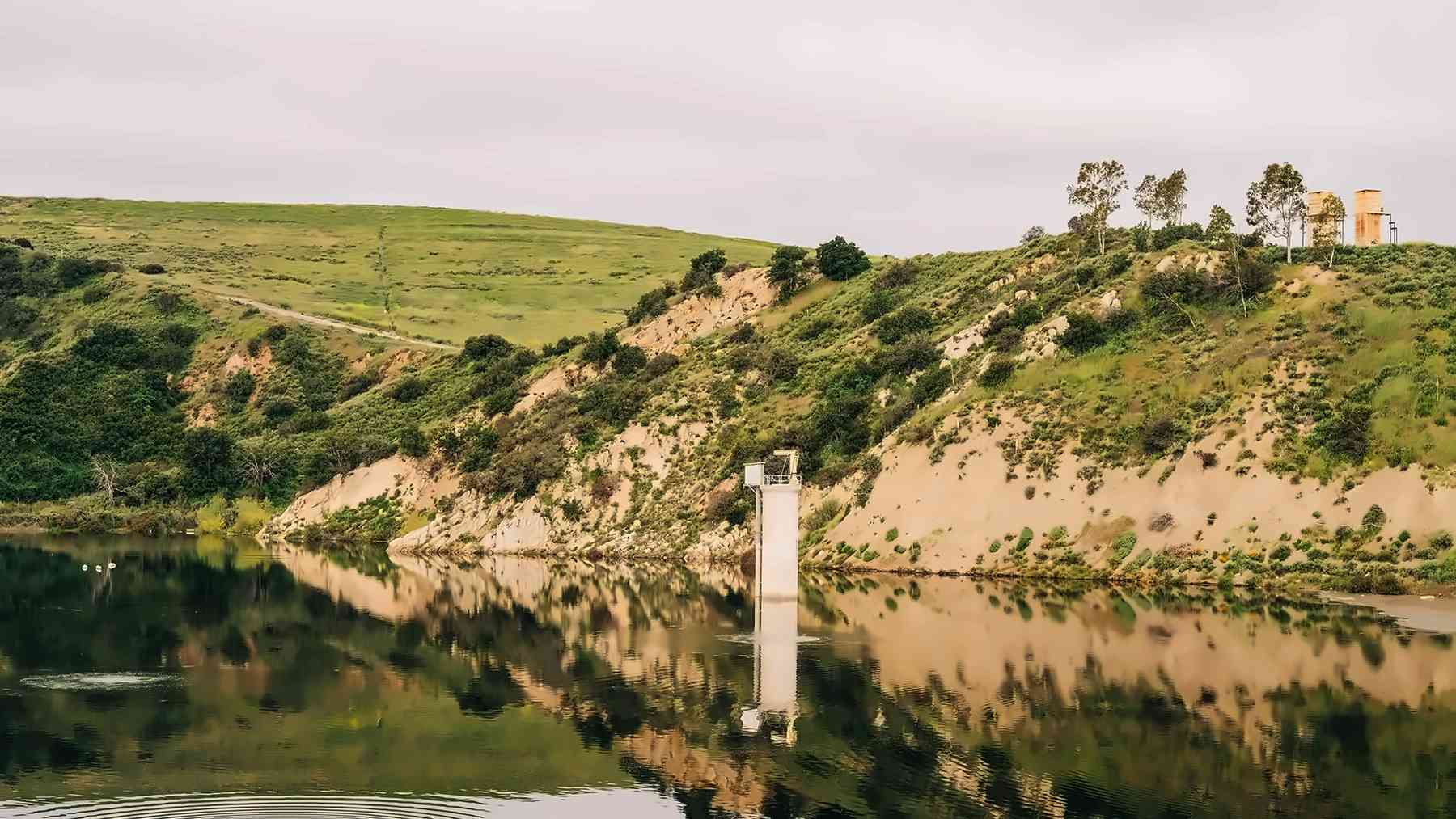
Orange County’s biggest lake has a slightly more complicated setup. Irvine Lake empties through a concrete tower with gates stacked up its side at eight different heights, and the bottom four haven’t worked in more than 30 years because they’re buried in silt. It’s right there in the latest annual surveillance report on Santiago Creek Dam, which the consulting firm GEI wrote for the Irvine Ranch Water District (IRWD) and dated May 1.
Now the lake’s coming down. IRWD started lowering it around Oct. 26, ahead of a $470 million rebuild that’ll take that tower out of service for good. CBS LA reported the water was about 23 feet deep on the morning of Oct. 27 and should be down to about 5 feet roughly three weeks later.
So how do you run a reservoir for three decades with half its gates out of commission?
So what does an outlet tower do?
Pretty much what the name says. It’s basically a giant straw standing in the lake, with gates at different heights so operators can choose which level to pull water from and send it through a pipe under the dam. This one’s a circular reinforced concrete column 135 feet tall, about the same as the 136-foot earthfill dam behind it. It measures 11 feet across on the outside and 8 feet across on the inside. The gates sit 10 feet apart.
Water leaves through a 60-inch welded steel pipe that runs 592 feet. Near the bottom of the dam, that pipe splits in two, with a 36-inch line for customers and a 30-inch emergency release.
The silt’s a pretty boring villain, as these things go. Every creek that feeds a reservoir carries dirt, and when the water slows down, that dirt settles on the bottom. A survey from August 2018 found sediment piled up around the tower to about elevation 715 feet, taking up roughly 2,200 acre-feet of space. (An acre-foot is what it sounds like: enough water to cover one acre a foot deep, or about 326,000 gallons.)
IRWD’s valve log tracks just four gates, at 750, 740, 730 and 720 feet. With 10-foot spacing, the buried four should sit at 710, 700, 690 and 680, though that’s my math and not IRWD’s. The log also says the 720-foot valve took 203 turns to open on May 6, 2025. I can’t tell from the log whether a person or a motor did the turning, but I hope it’s the motor.
Which brings us to a detail I find pretty interesting. SFGATE reports that the plan is to take the lake from 735 feet to about 720 feet, and that’s the same number as the lowest gate on the log. I haven’t seen IRWD connect those two figures, and dam paperwork can use slightly different elevation baselines, so treat it as close rather than exact. Still, it seems safe to assume it’s no coincidence, since water’s generally reluctant to leave through a gate that’s above it.
A bid listing from February for IRWD’s site prep work also calls for modifying “the underwater snorkel” on the tower, a phrase I didn’t expect to type today. I can’t tell you exactly how that fits into the draining. If half-buried dam hardware sounds unusual, it isn’t really. We recently covered an Idaho dam that can only swing nine of its 10 spillway gates fully open or fully shut.
Why is the lake coming down now?
There are two reasons, and only one of them is about construction. Forecasters expect El Niño this winter, and IRWD wants room in the reservoir for big storms. That same forecast is a headache for Hodges Dam in San Diego County too. The other reason is simpler: IRWD can’t do this work with a lake in the way.
You can see how far this already is from a full reservoir.
IRWD plans to hold it near that level through the winter and draw it back down after any major storm.
The spillway has already been rebuilt once
A spillway is the dam’s overflow. When a lake gets too full, water runs over a concrete lip and down a chute instead of over the top of the dam, which you really don’t want happening on an earthfill dam like this one.
This spillway took a beating in the February 1969 flood. The damage was bad enough that repairs in late 1969 or early 1970 took out the old waste channel and the lower stretch of chute, and a flip bucket went on the end of what was left. A flip bucket is basically a ski jump for water. It throws the flow into the air so it doesn’t chew up the ground right below the chute.
An inspector from California’s Division of Safety of Dams (DSOD) looked it over on March 26, 2024 and noted spalls with exposed rebar, plus some damaged concrete toward the far end of the left wall. Spalling just means pieces of the concrete surface have broken off. Once you can see the steel inside, it’s frankly not a great look, and GEI now rates the spillway poor to fair.
That’s why IRWD’s been keeping the lake low already. It’s operating under an interim winter limit 27.5 feet below the spillway crest, meant to keep water off the structure until the new one’s built. In 2025, the lake topped out 32.9 feet below the crest.
So is this dam dangerous?
I get why you’d ask. DSOD classifies Santiago Creek Dam as “Extremely High” hazard, which sounds terrifying, but that label is about what’s downstream and has nothing to do with how likely the dam is to fail. Under California’s rules, a dam gets that rating if a failure would be expected to kill at least one person and flood an area with 1,000 or more people in it. IRWD’s emergency plan lists a dozen cities in that hypothetical flood zone, from Orange and Santa Ana to Huntington Beach.
You’ll also see 1.5 million people attached to this dam. IRWD’s project page puts the count at more than 1.5 million residents, affected by it “directly and indirectly,” while CBS LA places those people in the downstream floodplain. Those aren’t quite the same thing, and I couldn’t find a breakdown. The lake’s water also reaches treatment plants serving about 900,000 people, according to IRWD.
The inspection paperwork is more reassuring than any of that sounds. DSOD’s 2024 report says the dam, reservoir and related structures are “judged safe for continued use.” GEI says it found no signs of structural deficiencies, seepage or instability in the dam, and that the spillway damage is “not considered a significant safety concern” even with heavy rain possible before the replacement.
It’s not a spotless record, though. A state chart posted by IRWD, which looks to be from 2021, rated the dam’s condition as Poor, with a note that the spillway was nearing the end of its useful life. I couldn’t find a newer rating.
The tower’s arguably the bigger worry, and that one comes down to earthquakes. An AECOM analysis from July 2017 found it wouldn’t survive a Maximum Credible Earthquake, which is basically the largest quake engineers think the local faults can produce. Debris or silt could then block the outlet, and you’d have a hard time lowering the lake in a controlled way right when you’d want to.
What does $470 million get you?
A new way to let water out, for starters. The replacement isn’t really a tower at all. It’s an inclined structure running up the slope on the left side of the dam, set into bedrock, with multiple intakes, and each riser gets its own fish screen. “We need to replace the outlet tower and the spillway completely,” IRWD spokesperson John Fabris told CBS LA.
The new spillway goes in on the same side of the dam, with its crest 6 feet higher, and the dam itself gets strengthened. The old tower’s being demolished, although IRWD’s draft environmental report says the section below the sediment may just get plugged with concrete and left there. So those four gates might stay buried for good.
That $470 million is CBS LA’s figure, and it’s a lot more than IRWD was quoting a few years ago. Its scoping materials from May 2023 put the project at $226 million, with construction wrapping up in 2028. Big public projects have a way of doing that, as you may have noticed.
The finish date’s a bit of a moving target too. IRWD’s project page still shows construction running from 2027 to 2030, on a timeline it dates to 2024, while Fabris told CBS LA the project will be done in 2032. I’d bet on the later one, given how the last schedule went.
What happens to the fish?
Probably nothing great, at least for the big ones. Irvine Lake’s a stocked fishery known for trophy catfish, bass and white sturgeon, and anglers like Wendy Tochihara want a full assessment of the fish before the water’s gone. The California Department of Fish and Wildlife told CBS LA it can’t enforce anything, since these are non-native fish in a private lake. It suggested residents ask IRWD or OC Parks about moving them or holding a fishing derby.
IRWD told SFGATE it’s talking with fish experts and the state about relocation, but no plan had been confirmed at that point. The Santa Ana Water Board’s staff report for its Oct. 23 hearing logged about 80 similar comments, mostly about fish dying during the drawdown, and I couldn’t find how that hearing ended.
IRWD plans to drain what’s left in summer 2027, when major construction is due to start, and Fabris told CBS LA he expects OC Parks to restock the lake once the project wraps up in 2032.
 While scientists kept working in the buildings on either side, a row of ten isotope labs in Tennessee came down in two months, each one in the late afternoon, and the six hot cells, the gloveboxes and four 2,000-pound gas tanks inside left as part of nearly 3 million pounds of wasteEnergy · 12 hours ago
 A wall of turbines and ship locks that would hold back a 33-foot tide for 120 years has finally been told where to stand, on a 1.5-mile line across an English estuary from one bank to the other, and its planners now want up to 1,000 megawatts out of it instead of 700Energy · 15 hours ago
 A Dutch strawberry grower hung nearly 2,000 solar modules under the glass of a 2.5-acre greenhouse in four weeks without stopping the harvest, and they take only the heat-carrying part of the sunlight, because on bright days the berries overheat and come out smallEnergy · 18 hours ago