
You cannot crane a tunnel boring machine into a hole at the end of an active runway. Charles de Gaulle has rules about what can stick up into the approach path, and a crawler crane tall enough to lower a 1,000-ton shield into a shaft is exactly the sort of thing those rules exist for.
Which left Razel-Bec with a machine it could not assemble where it needed to start.
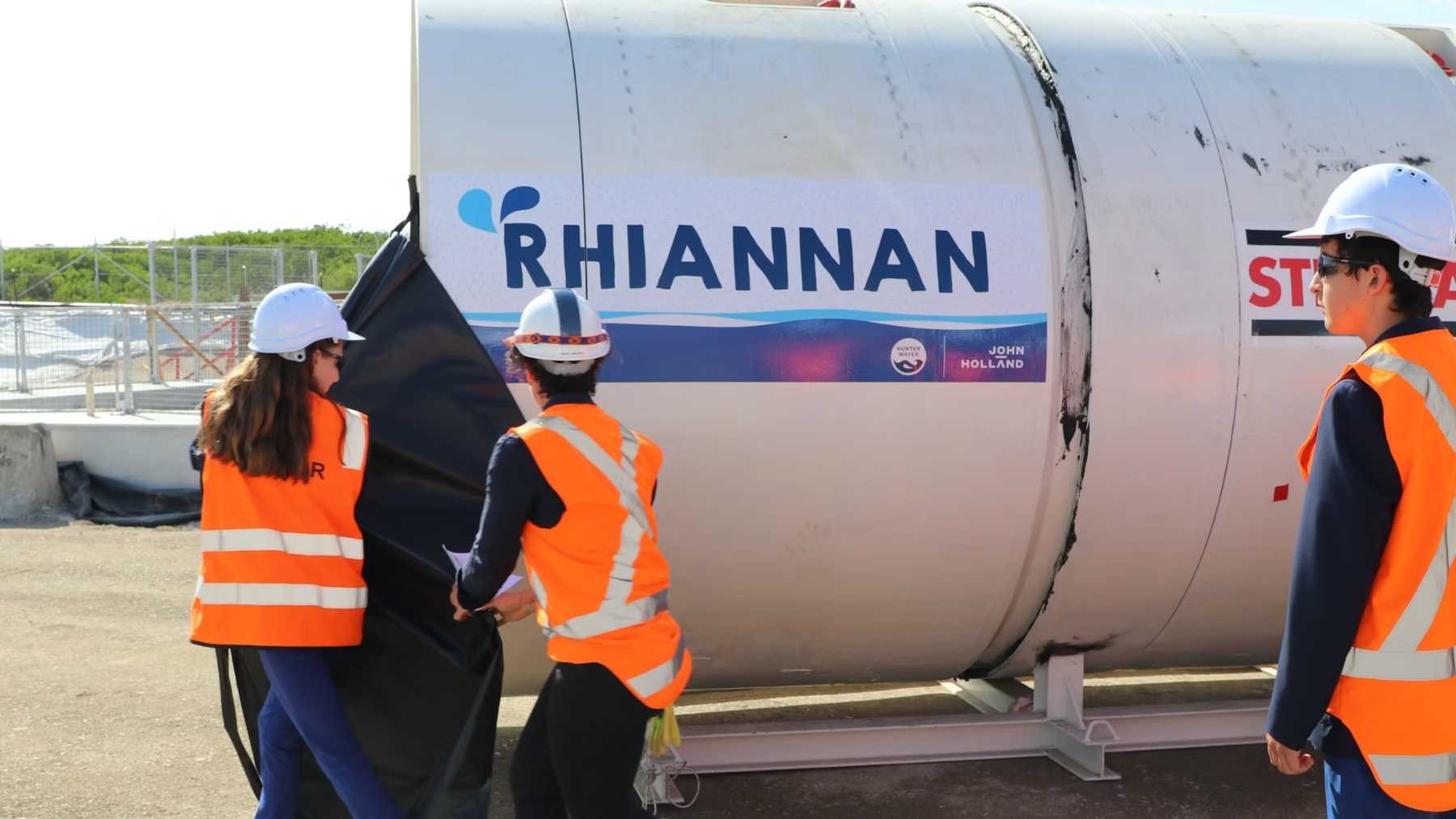
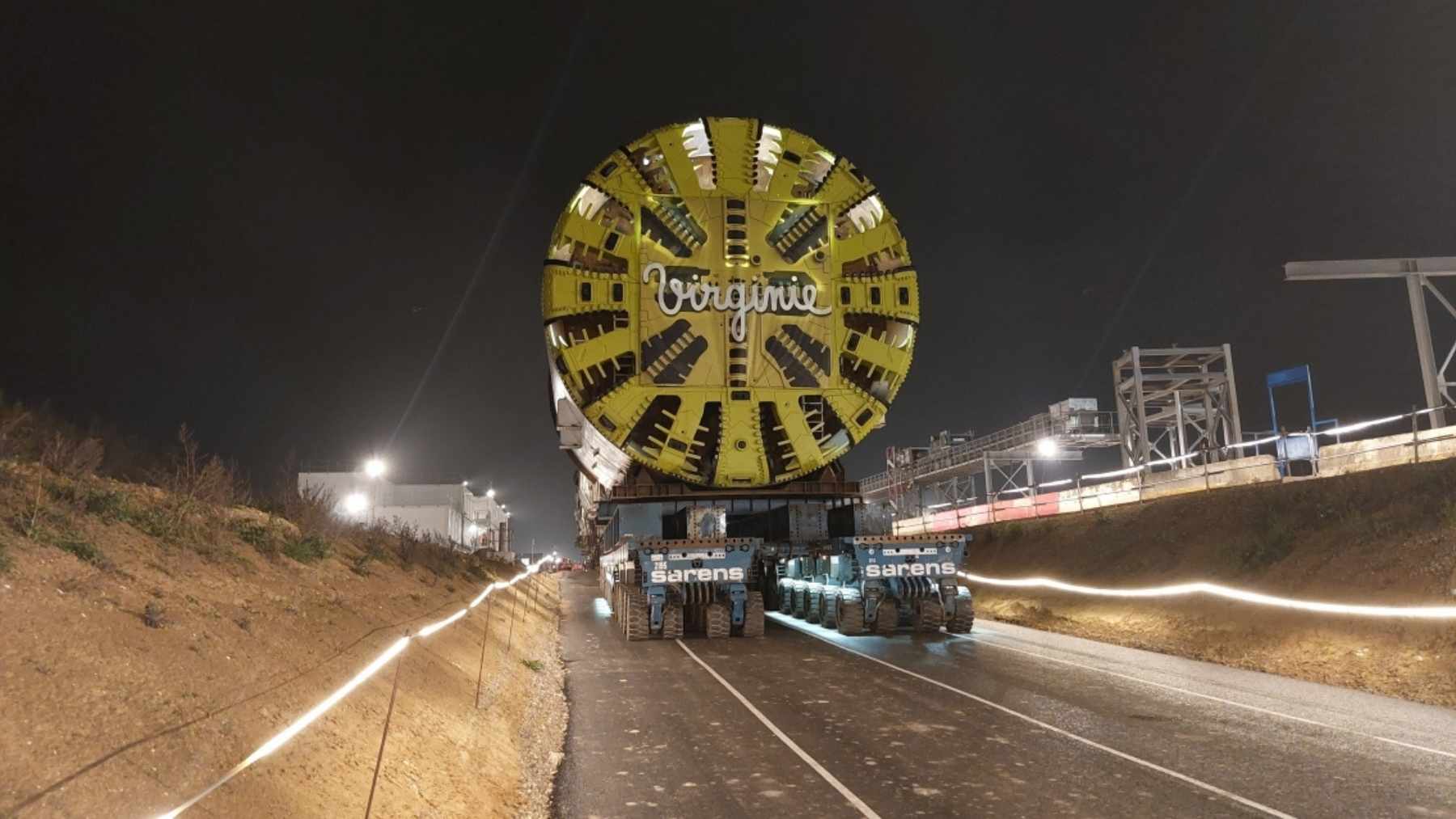
So the crews built her somewhere else and moved her whole. All 1,500 metric tons of her, 120 meters of shield and trailers, rolled 650 meters across the site in a single piece. It took five hours, and it had never been done with a machine that size.
Her name is Virginie, she is digging toward the airport right now, and she is one of only four boring machines left on a job that once had about twenty of them turning under Paris at the same time.
Five hours, 34 axle lines and a winch on the downhill
The contractor’s own account of the move is worth reading for the arithmetic alone. The front end of the machine, cutterhead and drive, weighs about 1,000 metric tons on its own. Four trailers behind it add roughly 500 more.
Crews jacked the shield up more than 2.5 meters, about eight feet, and slid self-propelled modular transporters underneath: 34 axle lines in total, two sets of 17 under the shield and two sets of 10 at the back, each line rated to carry 48 tons. Heavy transport firm Sarens supplied the hardware and says this was the first time a borer this size moved in a fully combined configuration.
Then the route went downhill. A 6 percent grade on the approach to the launch shaft, which is a lot when the thing you are steering weighs as much as a fully loaded Boeing 747 does about ten times over and has no brakes of its own worth mentioning.
The rear trailers rode on rollers that don’t brake. So a third transporter went on the back with a winch, paying out a retaining cable over the last 200 meters of slope. Razel-Bec’s engineering office built a custom tow coupling for the trailers and wired the machine’s own thrust jacks into it to monitor the loads in real time during the move.
Ten months of civil works fed into that five-hour crawl. The payoff is a 6-kilometer drive toward the future Charles de Gaulle airport station on Line 17.
No two of the 27 are the same machine
Per Herrenknecht’s project page, contractors on the Grand Paris Express had ordered 27 machines from the German firm by March 2025. That splits into 23 earth pressure balance shields and four variable-density TBMs, with diameters between 7.7 and 9.8 meters, roughly 25 to 32 feet. Two different technologies, and no two drives quite alike.
The weights spread just as wide. Virginie runs 1,500 metric tons. Marine, the machine currently cutting 5.5 kilometers between Aubervilliers and Bobigny on Line 15 East, is 2,000 tons and 130 meters long, per the Seine-Saint-Denis departmental council. Back in 2019, Sarens assembled a 977-ton borer in a pit at Créteil in three lifts: a 355-ton front shield, a 258-ton middle shield and a 130-ton cutterhead.
The reason they differ is the ground and the gauge. The alignment runs through sand, marl, limestone, clay, chalk, alluvium, gravel and gypsum, at depths between 15 and 55 meters. And on Line 16’s first lot alone, construction outlet Le Moniteur reported three different tunnel diameters on one route, because the section built for the Paris transit operator wasn’t sized like the rest. That lot ran up to six machines at once on a single contract, which the same outlet called a world first.
Four left out of a fleet that peaked around twenty
The project owner’s progress page lists what’s still turning: Awa on Line 18, Virginie on 17, Marine on 15 East, Yandé on 15 West. Behind them sit 110 kilometers of bored tunnel and 105 kilometers of double track, heading toward a network of 200 kilometers, about 124 miles, with 68 stations and four fully automated lines that carry nobody in a cab.
The Société des grands projets, the state body that owns the job, says about twenty machines were running at the peak, and that some of them worked more than one section of line. Which is the detail that explains everything else. The fleet was a rotation from the start, not 27 machines drilling 27 separate holes.
Yandé shows how far they take it. She’s 130 meters long, working 10 to 12 meters a day toward La Défense. When she finishes her 4.3-kilometer run, the plan is to strip her down in the second quarter of 2027, haul the pieces back to where she started and rebuild her facing the other way, toward Rueil-Malmaison. Same machine, same project, one round trip through a crane.
Ninety percent of this network is underground, which is why nobody in Paris has watched any of it happen.
Three of them are digging Toulouse now, and two restarted last week
The rotation didn’t stop at the city limits. In February 2024, Eiffage said its teams were working with Herrenknecht to strip and recondition three of the six machines from that record-setting Line 16 lot. They came apart at a yard in Thieux, northeast of Paris, 28,000 square meters of it, close to seven acres, which the company called “a veritable Tetris.” What came back out were three machines pointed at the 12.7 kilometers of Toulouse’s future Line C.
They went in named Sarah, Bantan and Armelle. They came out as Jeanne Marvig, Lise Enjalbert and Berthe de Puybusque, after women from a Toulouse literary academy, cutterheads repainted in the red and gold of the Occitan cross. The trip south went by road to Lyon, barge to the port of Sète, then road again into Toulouse.
Eiffage said on July 9 that Lise Enjalbert had made her second breakthrough at the future Blagnac station, after more than 2,000 meters from the Ponts Jumeaux shaft, with 1,867 meters left to run. Berthe de Puybusque is starting her final 2,122-meter stretch. Jeanne Marvig has picked her drive back up.
This isn’t recycling in the tote-bag sense, and the tell is in Eiffage’s own wording: the machines had to be modified to meet the specs of the new job. A borer is drawn around a specific hole. Toulouse bores at 9.60 meters and Paris ran 7.7 to 9.8, so the two holes happened to be close enough to bridge with a rebuild. That overlap is the only reason any of this worked, and it’s why the other two machines on Line C came from Germany new.
The first line opens November 30, and it’s the small one
None of the four new lines is carrying passengers yet. On June 25 the project owner set the opening of Line 18’s first section, Massy-Palaiseau to Christ de Saclay, at November 30, 2026, having originally aimed at October 1. Four stations, about 10 kilometers, serving roughly 70,000 students, researchers and staff on the Saclay plateau, and the first entirely new metro line in the Paris region in more than thirty years.
Everything bigger slipped right. First sections of Lines 16 and 17 land in 2027 alongside Line 15 South. Line 16 doesn’t reach Noisy-Champs until 2028, Line 17 doesn’t reach Le Mesnil-Amelot until 2030, and Line 15 West and East close the ring in 2031.
The budget moved further than the calendar. Costed at €22.6 billion in March 2013, the target was confirmed at €36.1 billion by the board in late November 2025, unchanged since 2021, and France’s national audit office has spent years publishing warnings about the drift. Call it $41 billion at today’s rate for 124 miles of driverless metro and 47 million metric tons of spoil.
Which brings it back to Virginie, sitting at the end of a runway on 34 axle lines. Adelaide is running three borers at once and calls it a national first. Two machines are waiting in a New Jersey trench to dig under the Hudson, carrying a $16 billion program between them. Herrenknecht built those too, along with the 2,000-ton machine under Montreal stamped as the 1,423rd of its kind. Most cities buy one or two of these and build a decade of politics around them. Paris bought two dozen, ran them until the map filled in, and is now down to selling itself the leftovers.