
Most tunneling jobs end at a hole somebody dug on purpose. The machine chews its way to a shaft at the far end, a crane drops a strap on it, and it rides a truck to the next job. The crew at Belmont, on the New South Wales coast south of Newcastle, didn’t have that option. The far end of their tunnel was the seabed, about half a mile off the beach.
So they went and got the machine out of the water instead.
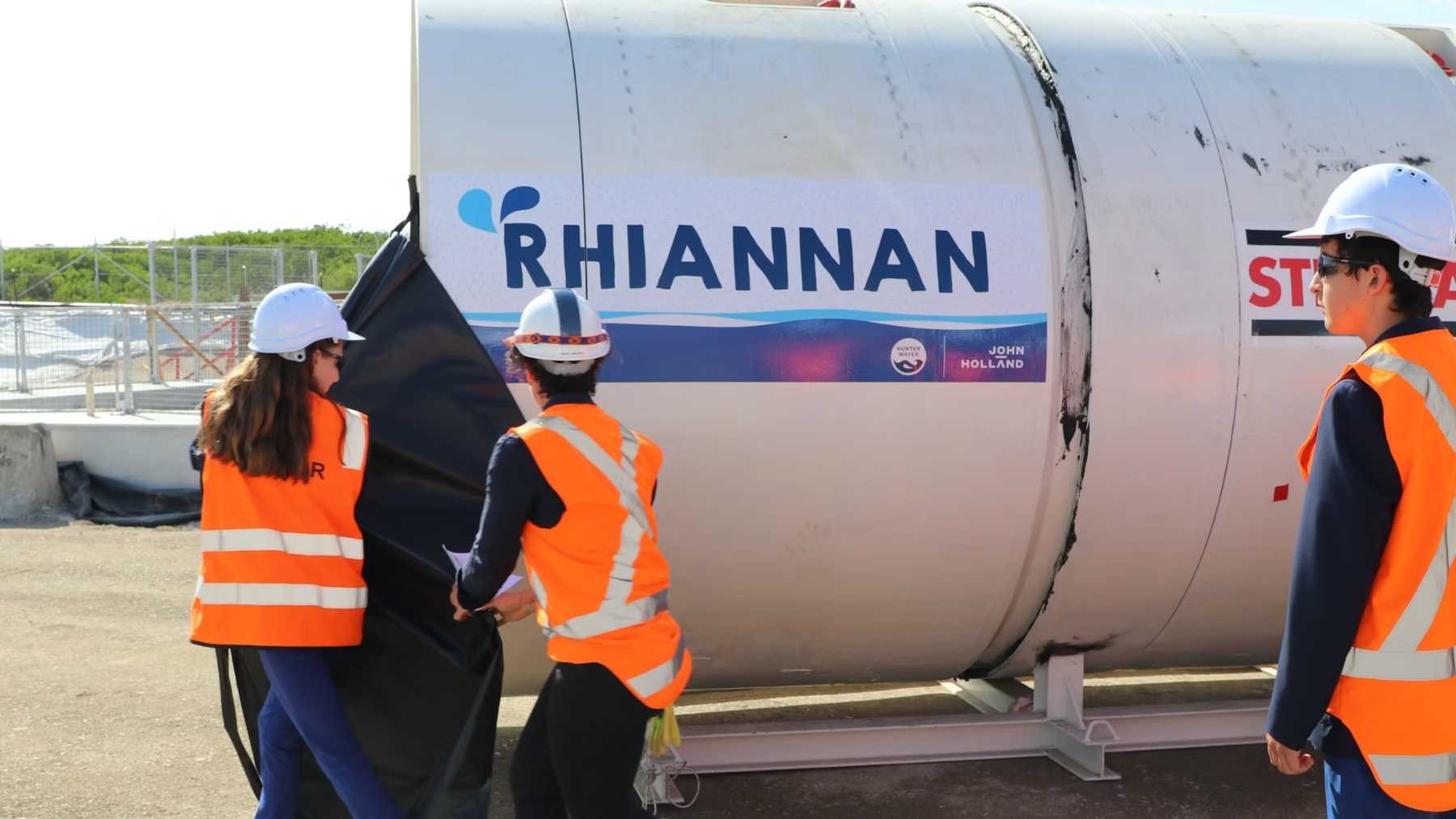
Hunter Water, the state-owned utility building a desalination plant at Belmont, announced on July 31 that it had finished the plant’s 2,723-foot (830-meter) seawater intake tunnel and pulled its 83-ton boring machine back out through the ocean floor. The machine’s name is Rhiannan, after Rhiannan Iffland, a cliff diver from Lake Macquarie with eight straight Red Bull Cliff Diving World Series titles and counting. Kids at two local schools picked it.
When I read “recovered from the ocean,” I pictured a crane, a chain and a lot of shouting. It’s a fair bit more delicate than that.
So how do you get a machine off the seabed?
You send divers, and you’ll send them more than once. Hunter Water says the retrieval ran as a planned sequence of offshore work spread over several weeks, so this wasn’t a one-morning job. Divers cleared debris from around the machine first. Then they positioned a support cradle and lined it up so the machine would settle into it. Once the head was sealed and stable, they connected a hydraulic recovery system that pushed all 165,000 pounds of it clear of the intake structure, and lifting gear took it from there.
Couldn’t they have left it down there? On plenty of tunneling jobs that’s exactly what happens, and the head gets grouted into the ground and written off. That wasn’t an option here, because Rhiannan finished its drive inside the intake structure itself, and that structure has to pass seawater into the pipe for as long as the plant runs. You don’t park 83 tons of steel in the mouth of your own intake.
Look at that intake structure for a second, because it’s what the machine came out into. It’s a concrete box roughly 49 feet wide and 49 feet tall (15 meters), built from precast rings lowered one at a time and secured underwater by divers, with about 30 feet of it buried in the seabed and 20 feet standing above the ocean floor. Those figures come from Hunter Water’s own marine works fact sheet. A jack-up barge sat about half a mile off Nine Mile Beach for the whole campaign, and helicopters ran crews out to it.
Rhiannan couldn’t back up, and that’s how these machines work
You can’t reverse one of these.
Rhiannan is a micro tunnel boring machine, and that’s a category most people never bump into. Picture a steel cutting head with no room inside it for a person. The operator sits on the surface in a control container reading sensors, and hydraulic jacks in the launch shaft shove a string of precast concrete pipe forward, with the machine riding on the nose of that string. The pipe’s the tunnel and the push rod at the same time. Nobody rides inside it, and once that string is moving forward the machine can’t come back the other way.
Which means the exit has to be designed in from the start. Hunter Water’s fact sheet, written before the tunneling started, already carried a line about divers retrieving the machine from the ocean. Nobody improvised this in July.
We’ve written up this class of machine twice already this year. A German cutting head ground through more than 2,000 boulders under Winnipeg, and a seven-foot machine crossed under a Seattle main street pushed by jacks parked in a shaft weeks behind it. Belmont’s pipe is bigger than Seattle’s and, as it happens, exactly the same 2.4 meters across as Winnipeg’s, which is 7.9 feet.
One caveat on that number, because it gets misread a lot. Hunter Water gives 2.4 meters as the diameter of the pipeline, not as a certified cutting diameter, and a boring head generally cuts a little wider than the pipe it’s pushing. The actual bore is a touch bigger than the pipe you’d stand up in.
The pipe is for drinking water, and none is moving yet
John Holland is designing and building the plant for Hunter Water, and the design number is 30 million liters a day, or 7.9 million US gallons. Hunter Water puts that at about 15 percent of the Lower Hunter’s average daily demand, and the plant’s scheduled to start producing in 2028.
Nothing’s flowing through the tunnel yet.
That gap matters, because 7.9 million gallons a day is a capacity, not a measured flow. Nobody’s run seawater through this pipe for real. What the region has today is a finished tunnel, a finished intake and a building full of pumps and membranes that haven’t been commissioned. If you live in the Hunter and you’ve been told the desalination plant is done, it isn’t; the hard offshore half is.
The build’s costed at A$530 million, roughly $383 million US at early-September exchange rates. The Newcastle Herald reports that figure has more than doubled from an original estimate of around A$250 million, and that the plant will add about A$90 a year, near enough $65, to a household water bill. Which is arguably the least surprising paragraph in this article. Desalination is expensive and coastal construction is expensive, and doing both at once with a barge and a helicopter shuttle was never going to come in cheap.
272 bags of somebody else’s rock
The intake structure doesn’t get to sit on the seabed and hope for the best. Hunter Water’s July project update says 272 rock bags go in around it to steady it against waves and current, 176 of them at 4.4 short tons apiece and 96 at 8.8. That’s roughly 1,600 tons of ballast on the ocean floor.
The rock inside came off another project. The bags were made and stored at the Kooragang yard, the same yard where the intake’s dome roof got assembled before it was floated out and set on top of the structure. Reusing fill isn’t going to win anybody an award, but hauling 1,600 tons of fresh quarry rock to a beach would’ve been the sillier way to do it.
Two things Hunter Water hasn’t published, in case you were wondering. It hasn’t named the make or model of the machine, which is a little unusual for a job like this, since the Winnipeg contractor named its machine down to the model number. And it hasn’t given a date for the recovery itself. July 31 is when the announcement went out, not necessarily the day Rhiannan broke the surface.
Hunter Water’s August community update lists the offshore marine works as complete and the jack-up barge as gone, back at the CTB yard in the Port of Newcastle after a stint off Belmont that the Newcastle Herald dates to January. Crews have started converting the shaft that launched Rhiannan into the pump station that’ll pull seawater the other way, and the plant’s still scheduled to make its first drinking water in 2028.
 @michaelreilly ROOKIE1 month ago