
Italy first approved a fixed link to Sicily in 1971. Fifty-five years later the current version, a €13.5 billion suspension bridge with a record 3.3-kilometer main span, is still working its way through Brussels and the Italian courts, and the opening target has already slid to 2034.
So you would be forgiven for assuming nothing is happening down there. It is happening. It is just happening at the other end of the line, and underground.
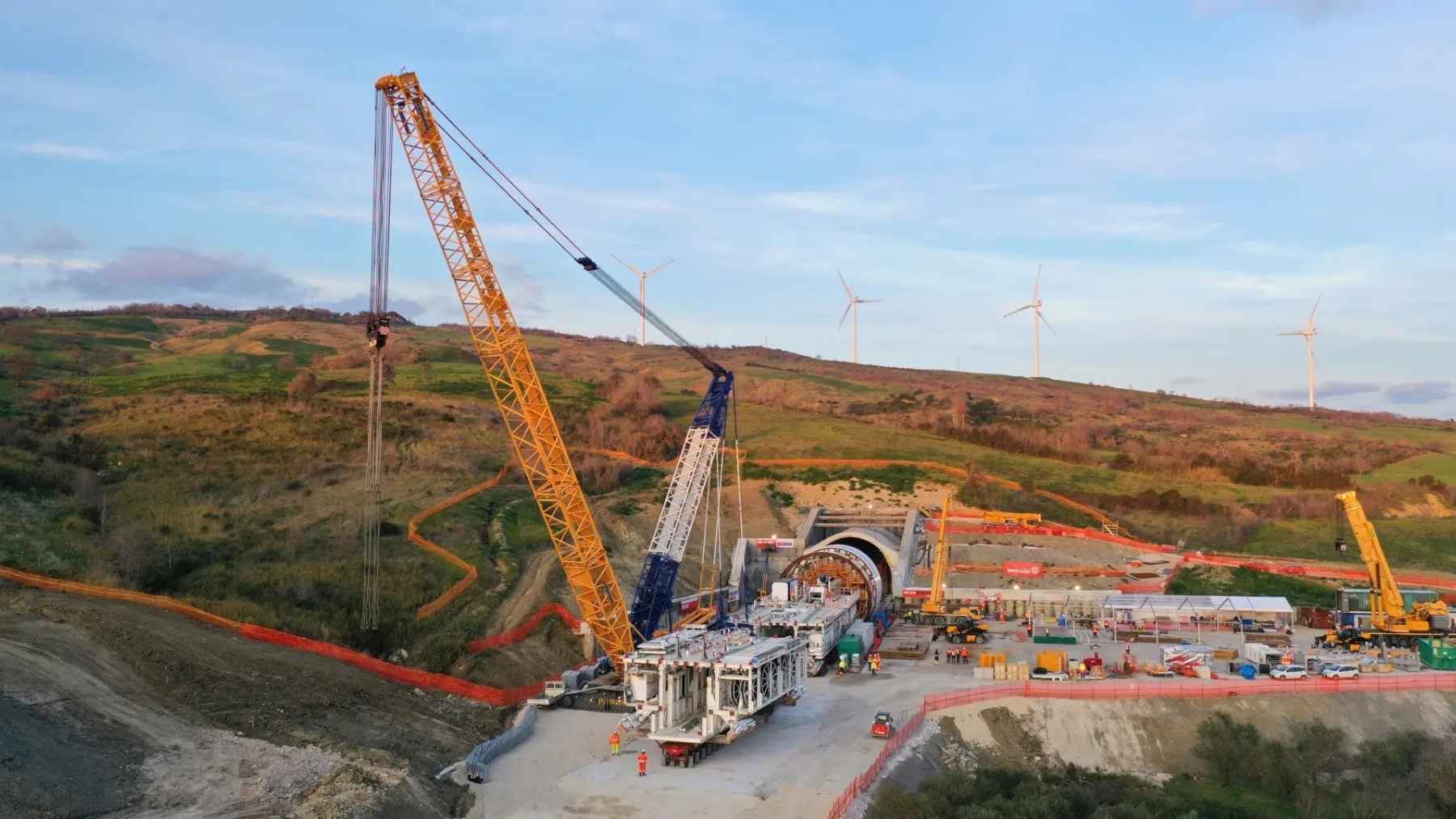
In the hills east of Salerno, four tunnel boring machines have spent months chewing through rock on the first built section of the high-speed railway that is meant to carry trains south toward that bridge. The largest of them is a 4,000-metric-ton machine named Partenope. It runs 18 electric motors rated at a combined 10 megawatts, and all of that goes into turning one cutting wheel 13.46 meters across.
It fired up on February 21, 2025. Seventeen months later it is still in the mountain.
Partenope is the biggest machine Webuild has ever run in Europe. It is not Europe’s biggest.
Those two things got blurred a lot when the machine launched, so it is worth pinning down. Webuild’s own announcement is careful with the wording: 13.46-meter cutting head, roughly 130 meters long, around 4,000 metric tons, the largest TBM the group has ever used in Italy or Europe.
The group. Not the continent.
The continental record belongs to a Herrenknecht earth pressure balance shield 15.87 meters in diameter, which broke through at the Santa Lucia road tunnel on the A1 between Bologna and Florence on June 8, 2020. That machine weighed 4,800 tonnes and drove 7.5 kilometers. Before it, the record sat with another Herrenknecht shield at the Sparvo tunnel, also in Italy, also on the A1.
Two and a half meters of diameter is not a rounding error when you are pricing cubic meters of excavated rock. And the record is about to move again, since Britain has ordered a 16.4-meter borer for the Lower Thames Crossing that will beat Santa Lucia when it goes under in 2028.
None of which makes Partenope small. A 44-foot cutting face on a railway tunnel is enormous. It is just not the number that outlet after outlet reported it as.
Ten megawatts, and every watt of it turns one wheel
The 10-megawatt figure is the rated output of those 18 motors, not what the machine actually pulls on an average shift. Rock hardness, advance rate and how many discs need swapping all move that number around.
Still, run flat out for a year, 10 megawatts works through roughly the same amount of electricity that 8,000 American households buy from their utility, using the EIA’s figure of 10,791 kWh per residential customer. That is the power budget for spinning a single wheel in the dark.
What that wheel is attached to is less a drill than a rolling factory. As the cutterhead grinds forward, the machine behind it is erecting the concrete segment rings that become the finished tunnel wall, so the bore comes out lined rather than raw. Webuild puts more than 100 specialized technicians on the machine to keep it running around the clock, seven days a week.
The bore itself is the 3-kilometer Saginara tunnel, single tube, double track, running through the Sele Valley between the towns of Campagna and Contursi Terme in the province of Salerno.
The other three moles are named after sirens, and one of them commuted from Paris
Tunneling superstition says you name the machine for luck, and the names are traditionally female. Webuild turned that into a public vote in late 2025, offering two pairs: Leucosia and Ligea, sirens said to have lived off the Gulf of Salerno, or Elvira and Olga, after the Salerno-born filmmaker Elvira Notari and the painter Olga Schiavo.
The sirens won. Which, given that sirens in the original story lure sailors onto rocks, is a bold branding choice for a rock-cutting operation.
Leucosia and Ligea match Partenope at 13.46 meters. Leucosia started on the Serra Lunga tunnel, a little over 800 meters, and then takes Acerra at 250 meters and Petrolla at more than 1.2 kilometers. Ligea is on Piano Grasso, 2.2 kilometers, with the 1.5-kilometer Contursi tunnel after that.
Acerra is worth a second look. At 250 meters, it is a bore not quite twice the length of the machine digging it.
The fourth machine is the odd one out. Mireille weighs 1,200 metric tons, carries a cutting head just over 10 meters across and runs 11 motors for 3,850 kW. It also has a résumé: it dug for the Grand Paris Express before Webuild’s equipment arm rebuilt it at Terni and sent it to Campania. In April it finished the Caterina tunnel, just over a kilometer, the first bore completed on the section.
The bridge these tunnels point at has slipped to 2034
This is where the project stops being a machine story and starts being an Italian politics story.
Italy’s Court of Auditors declined to register the interministerial committee resolution approving the bridge’s definitive design in October 2025. The government answered in February 2026 with a decree law resetting the administrative sequence and appointing new commissioners.
In March the Council of Ministers signed off on a revised schedule that pushed the timetable out to 2034 while leaving the headline investment at €13.5 billion, or roughly $16 billion. The lower house converted the decree into law on May 7, 160 votes to 110 with seven abstentions, after the government attached a confidence vote to block amendments. Buried in it: €2.787 billion of bridge money moved from the 2026 to 2029 window into 2030 to 2034.
As of July 16, Italy was reporting progress in talks with the European Commission over procurement and environmental requirements, with departments still assembling additional environmental information Brussels had asked for. Infrastructure Minister Matteo Salvini met senior officials from Stretto di Messina, the state concessionaire, the same week.
Nobody has been found to have broken any law here. What has happened is that the money moved to the back of the decade while the paperwork gets sorted.
The railway is worth digging whether or not the bridge happens
This is the part that gets lost when the bridge eats the coverage.
The section under construction, Lot 1A, runs 35 kilometers from Battipaglia to Romagnano, with 20 tunnels, 19 viaducts and a junction tying into the existing Potenza line. Eight of those tunnels are mechanized, which is the job the four machines are on. The consortium building it is led by Webuild with Pizzarotti, Ghella and Tunnel Pro, working for RFI, and it currently employs more than 1,400 people.
All of it sits on the Scandinavian-Mediterranean corridor, the EU’s Helsinki-to-Malta rail spine. That is the same corridor that runs through the Alps, where two German borers are finishing the Brenner Base Tunnel. Southern Italy is the missing tail of the same line.
Webuild also holds the €1.6 billion Paola-Cosenza contract further south, 22.2 kilometers of mostly underground double track built around the 15-kilometer Santomarco tunnel, with a 2032 target. Between the two lots the company expects to build about 60 kilometers of the Salerno-Reggio Calabria line.
None of that needs a bridge to be useful. Trains already run to Reggio Calabria. They just run slowly, on an alignment laid out in the 1800s.
FS Italiane’s project page still lists 2026 for completion of the first operational section between Battipaglia and Romagnano. Three of the four machines were still underground as of the last public update.
Nobody outside the site knows how much of Saginara is left
Webuild does not publish weekly advance figures on the Saginara drive, and neither does RFI. The last official word came on April 10, 2026, in the announcement that Mireille had finished Caterina, and it said only that Partenope is continuing through the Sele Valley hills.
So the honest answer to how far along it is: unknown, on a 3-kilometer bore that started 17 months ago, in geology the contractor has described as difficult.
The bridge gets the confidence votes, the court rulings and the rendering with the sunset behind it. The 10-megawatt cutting head up in the Salerno hills gets a press note every few months and a mention in the local papers. Only one of those two things is currently moving rock.