
Budget cuts in mining tend to follow a script. The company announces “capital discipline,” the contractors pack up, the machines get mothballed, and the hole in the ground waits for better commodity prices. Anglo American ran the first half of that script at its Woodsmith fertilizer mine in England, cutting planned spending to $200 million for 2025 and exactly zero for 2026.
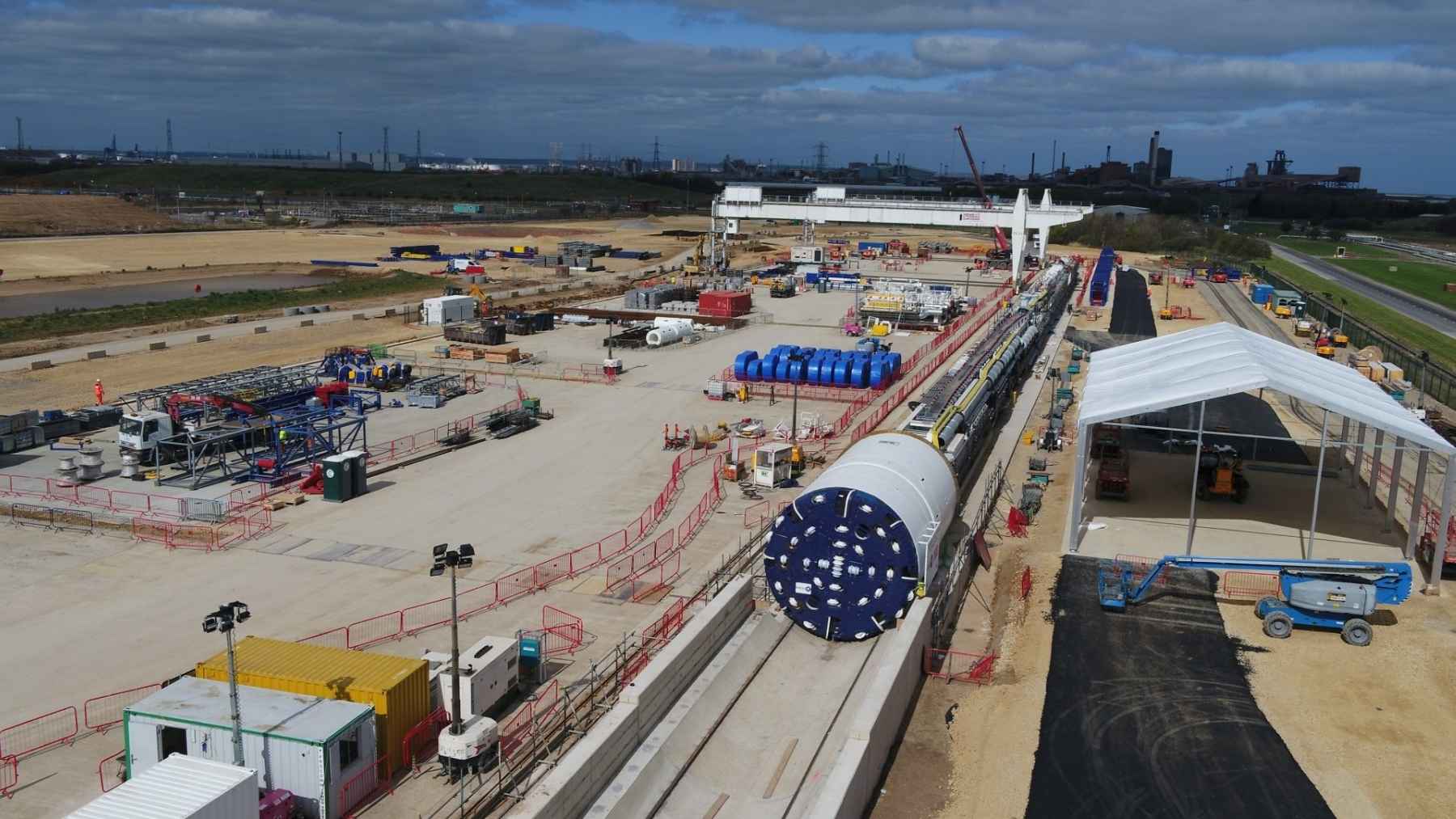
The machine down in the tunnel apparently never read it. In December 2025, the tunnel boring machine digging Woodsmith’s mineral transport tunnel under the North York Moors passed the 30 kilometer mark, 18.6 miles, extending a world record it already owned. That happened on a project whose owner had publicly zeroed out the following year’s budget.
And now the story has taken another turn. This month, Anglo American added a second engineering firm to a new round of feasibility studies for the mine. Companies do not usually pay two sets of engineers to study a project they intend to bury.
A world record, extended one ring at a time
The machine is called Stella Rose, a name picked by local schoolchildren, and she has been grinding northwest from the mine site near Whitby since April 2019. She is a single-shield Herrenknecht weighing 1,775 metric tons, cutting a hole just under 20 feet across with about 2,800 horsepower (2,100 kW) at the cutterhead. Strabag, the Austrian contractor running the drive, lines the bore down to a finished internal diameter of 16 feet.
The world record for the longest continuous drive by a single TBM stood at 25.8 kilometers, about 16 miles, until Stella Rose passed it in late 2023. Every ring since has been her extending her own record. New Civil Engineer reported the 30 kilometer milestone on December 19, 2025, which is the last hard progress figure Anglo American has put out.
The full tunnel runs 23 miles (37 km) from the mine to a processing plant at Wilton on Teesside, so as of December she had roughly four and a half miles left. Once finished, it will be the longest tunnel wholly within Great Britain. The Channel Tunnel is longer, but France owns half of it.
The tunnel exists because trucks were never an option
Woodsmith sits on what Anglo American describes as the largest known deposit of polyhalite on Earth, a naturally occurring mineral carrying potassium, sulfur, magnesium and calcium. Farmers can spread it as fertilizer without blending. The company markets the finished product as POLY4, and Fluor puts the target at 13 million metric tons per year once the mine runs at full tilt.
The catch is the address. The deposit lies under the North York Moors National Park, a protected landscape where nobody was going to approve a procession of ore trucks. So the ore never sees the surface there. It gets hoisted from the seam to an underground handling level, dropped onto a conveyor, and carried the full 23 miles to Teesside inside the tunnel, running at 13 mph an average of 820 feet below ground.
The invisibility act goes further than the tunnel. Headframes that would normally tower over a mine site have been sunk below ground, and the few surface buildings were designed to pass for farm barns with wood cladding. Anglo American is building one of the biggest mining projects in British history to be, for all practical purposes, invisible.
Getting at the polyhalite itself means two shafts over a mile deep, which will rank among the deepest commercial mine shafts ever sunk in Britain. They are being cut with Herrenknecht shaft boring roadheaders, a technology only two other projects worldwide have used, and never below one kilometer. It is a very different machine from the 3,500-ton borers Herrenknecht sent to Adelaide, but it comes out of the same German factory in Schwanau.
Then the owner turned off the money
The budget cut was collateral damage from a takeover fight. In the spring of 2024, BHP made a run at Anglo American, and after the bid collapsed, Anglo announced a slimmed-down strategy to convince shareholders it could deliver value on its own. On May 14, 2024, Woodsmith got the bill: capital spending cut to $200 million in 2025 and to nothing in 2026, on a project New Civil Engineer pegged at £7.2 billion, roughly $9 billion, all in.
The consequences were not subtle. By early 2025, Ground Engineering reported that around 800 people had left the project, including contractors and subcontractors, from a workforce that had numbered about 2,000. Sinking of the production shaft, the one that will actually hoist ore, was paused at 650 meters, about 2,100 feet down, and stayed paused.
What survived was a short list of jobs Anglo calls critical works. Stella Rose kept turning, slower than before. The service shaft kept going too, passing its halfway point in late 2024 and then grinding into the Sherwood Sandstone, a 120 MPa rock layer, around 17,400 psi, that cuts sinking rates roughly in half.
That sandstone work is not busywork. The rock data coming out of the service shaft feeds directly into the technical studies Anglo needs before its board will even consider restarting full construction. The actual spend also drifted above the announced number: by mid-2025, Anglo told investors it expected to put about $300 million into Woodsmith that year, with $184 million already out the door in the first half.
By December, project director Andrew Johnson was talking like a man running a going concern rather than a wind-down. “We currently employ 1,100 people in the area of which 75% are local,” he said when the 30 kilometer milestone landed.
Two engineering firms do not get hired to study a dead project
Which brings us to this month. On July 10, Anglo American appointed Stantec to the Woodsmith feasibility study team, covering hoisting systems, shafts, material handling and underground infrastructure, according to International Mining. Stantec joins Fluor, the Texas-based engineering giant Anglo brought onto the study in May.
“This project reflects the growing need to balance resource development with environmental stewardship,” said John Ord, who runs Stantec’s energy and resources business in the UK and Ireland. Strip the press-release varnish off and the practical point is simpler: Anglo is paying real engineering firms real money to figure out exactly how to finish this mine.
Anglo has told investors that three things have to happen before the board approves full development. The feasibility study has to be completed, using that hard-won sandstone data. A syndication partner has to come aboard to share the cost. And the group’s balance sheet debt has to come down. First production is expected around 2030, and the company floated a restart of full construction within two years back in mid-2025.
None of that is a green light, and the 2026 development budget technically still sits at zero. But mining companies have quietly walked away from half-dug holes before, and this is not what walking away looks like. Walking away looks like an auction of used tunneling equipment.
Modern mining keeps producing these strange half-speed spectacles. Australia runs drill rigs with nobody in the cab taking orders from 900 miles away, and a gold mine in the outback recently ran 155 straight hours with every engine switched off. Woodsmith’s contribution to the genre is a machine that broke a world record while her owner was deciding whether to keep paying the electric bill. As of December she was 4.5 miles from the sea. Whether she gets a budget to match her stubbornness is now a question for Fluor, Stantec, and Anglo American’s board.