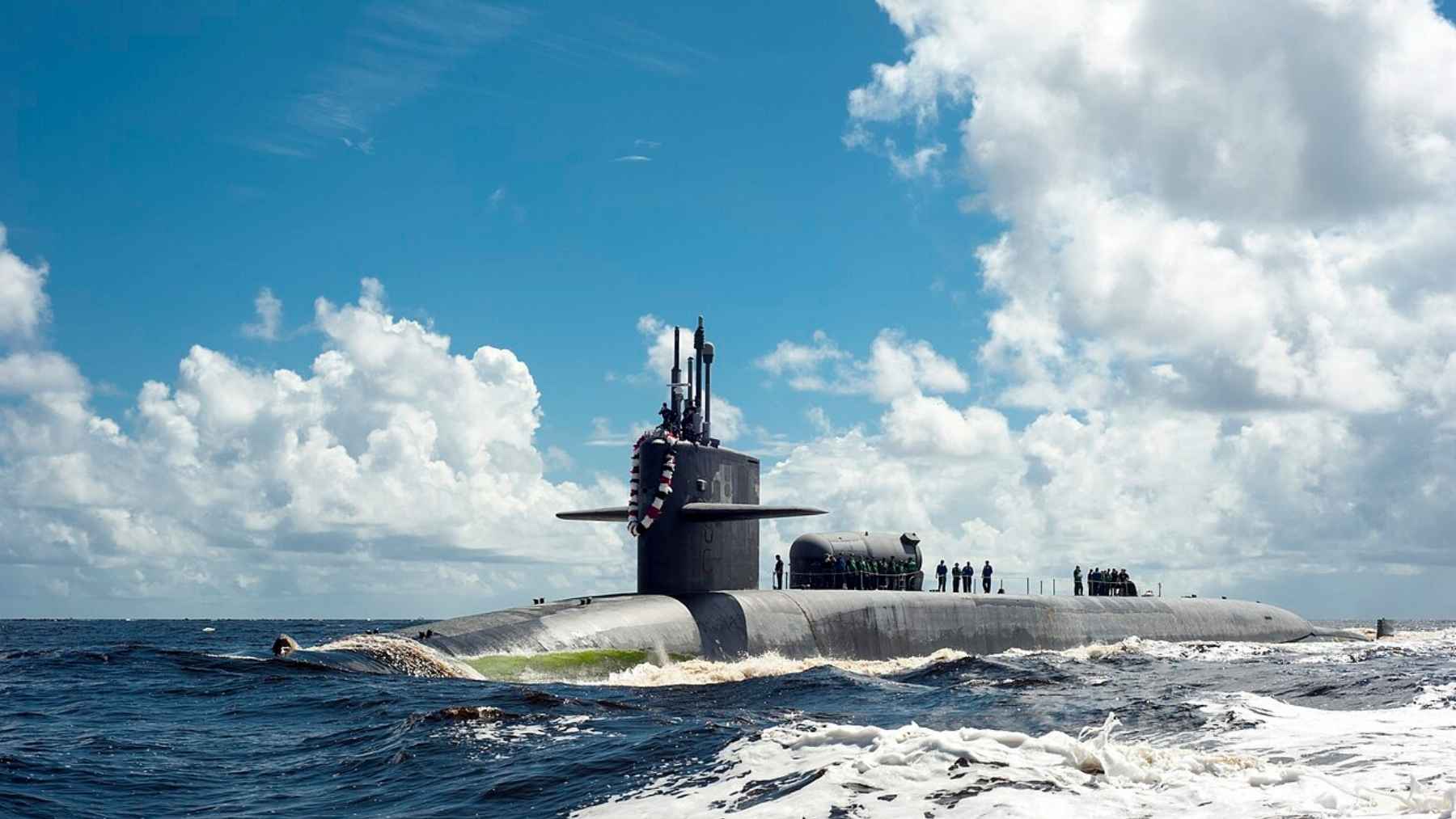

Every so often the Pentagon tells the world exactly where one of its submarines is, which is a strange thing to do with a boat whose entire job is that nobody knows where it is. The USS Georgia got that treatment more than most. The Navy put out photos of her running on the surface through the Strait of Hormuz, and when Iranian speedboats swarmed her escorts on one of those trips, a Coast Guard patrol boat ended up firing warning shots. She was the boat you showed people when you wanted them to count the missiles.
Now she’s home, and she’s not going back out.
Georgia tied up at Naval Submarine Base Kings Bay, Georgia, on July 27, and the Navy’s own caption on the photos called it her final return from operations. She’s 42 years old. USNI News reports that on this last patrol she was part of the U.S. strikes on Iran in Operation Midnight Hammer and Operation Epic Fury. The Navy hasn’t said when she left Kings Bay for that deployment, so I can’t tell you how long she was out, but the first of those two operations was more than a year before she came home.
So what exactly did the Navy send home?
She started life as something else entirely
Georgia was commissioned on February 11, 1984, as an Ohio-class ballistic missile submarine. That’s the kind that carries nuclear missiles and spends months hiding, and if you want to know how one of those actually throws a missile, we got into the mechanics of that this summer. She’s 560 feet long and 42 feet wide, and she displaces 18,750 tons submerged, according to the Navy’s fact file on the class. No American submarine has ever been bigger.
Then the Cold War ended and the Navy found itself with four more of these than it needed. Rather than scrap boats with plenty of reactor life left, it rebuilt the four oldest, Ohio, Michigan, Florida and Georgia, into something new. Georgia was redesignated a guided-missile submarine on March 1, 2004, went into Norfolk Naval Shipyard in early 2005 for a refueling and the conversion, and got back to Kings Bay in her new form in March 2008.
The rebuild is pretty simple to describe. An Ohio boat has 24 big missile tubes behind its sail. On the four converted boats, 22 of those tubes got a canister that holds seven Tomahawk cruise missiles each, and the other two became lockout chambers so Navy SEALs can leave and come back while the boat stays underwater. Seven times 22 is 154. That’s where the number comes from. It’s the maximum, though. TWZ notes they usually sailed with around 100, with the rest of the space going to gear for the special operators.
Basically, the Navy took a boat built to end the world and turned it into a boat built to open a war. And it worked. Georgia and her three sisters ended up working harder than almost anything else in the submarine force, because one of them parked off a coast is a lot of firepower that doesn’t need a runway or a carrier group.
“We answered the call,” Electronics Technician (Nuclear) 2nd Class Trenton Maybee, who ran the reactor, said in a Navy release carried by Navy Times.
She’s not actually gone yet
You’d think a final return means the boat is done. On paper, sort of. The Navy said the inactivation process would start July 31, and it did. But two days earlier the service had told TWZ that the real timeline had slipped by about a year.
Here’s what Lt. j.g. Mackenzie Jefferies Park, a spokesperson for Submarine Group 10, told them: Georgia stays at Kings Bay until she changes her home port to Norfolk in July 2027, and the inactivation happens at Norfolk Naval Shipyard, the same yard that converted her. After that she gets defueled and, eventually, recycled.
Which means the biggest submarine the United States ever built is going to spend a year tied to a pier in Georgia with 154 empty missile tubes, waiting for a shipyard slot. I don’t think that’s anyone’s first choice. It’s apparently just where the schedule landed.
Her sisters are lined up right behind her. According to TWZ, the Navy plans to retire Ohio in fiscal 2027, Florida in fiscal 2028 and Michigan in fiscal 2029. Ohio is the lead boat of the entire class and entered service in 1981, so she’s the oldest of the bunch. (Kings Bay, by the way, is also where the Navy swapped two of the ballistic missile versions between coasts earlier this month without moving their crews. The base has had a busy few months.)
So what carries the missiles now?
Nothing, if you want one boat to do it. The Navy’s answer is to spread the load across the Virginia-class attack submarines it’s already building. Newer Virginias get what’s called the Virginia Payload Module, an 84-foot section spliced into the middle of the hull with four large tubes in it. Each tube holds seven Tomahawks, same as on Georgia, so the module adds 28 missiles to the 12 a standard Virginia already carries up front. That’s 40 per boat.
Run the numbers and you need almost four of those to match what Georgia carried alone, and about 16 to match all four SSGNs at full load. USNI News puts it at about three and a half per Ohio, using a slightly higher count for the Virginia, but the Navy’s own figure is 40, and we used that same number when we looked at the Block V boat the Navy is turning into a seabed warfare submarine.
Frankly, that’s a worse trade than it looks like on paper, too. A Virginia is an attack submarine first. It’s supposed to be out tracking other submarines and shadowing surface groups, and every one you assign to hauling cruise missiles is one you’ve pulled off that job. An Ohio SSGN never had to do anything else.
The timing of all this is a little on the nose. On Wednesday, July 29, two days after Georgia came home and two days before her inactivation paperwork started, the Navy awarded General Dynamics Electric Boat and HII’s Newport News Shipbuilding a $42.1 billion contract for nine Block VI Virginias, every one of them with the payload module. Newport News will deliver six of the nine. The Navy also signed that day for a separate $29.5 billion award for five more Columbia-class ballistic missile submarines, the boats that take over the nuclear job from the Ohios that never got converted.
So the week the Navy sent home its 154-missile boat, it signed for nine boats that carry 40 apiece. If you’re wondering why it didn’t just build a new big one, so are a lot of people. There’s been talk for years of a large payload submarine based on the Columbia design, but no funded program exists, and the Columbia line already has its hands full getting the nuclear boats out on time.
The first Virginia with the payload module, the future USS Arizona, is set to deliver in 2028, according to USNI News. Georgia changes her home port to Norfolk in July 2027.