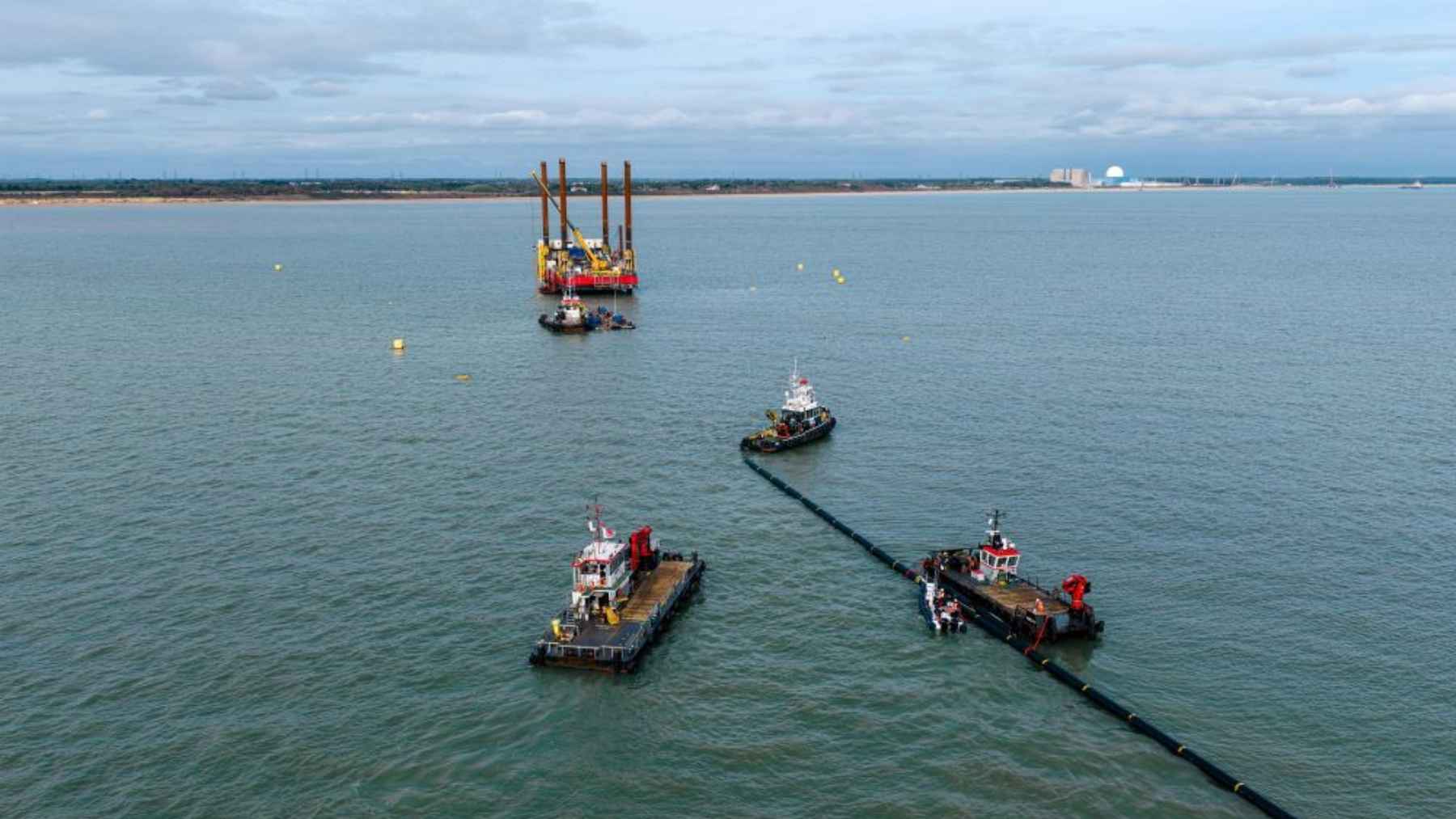

The last plastic pipe I bought came in a 10-foot stick from Home Depot, and I still had to fold the back seats down to get it home. So I’ve been thinking about logistics since Thursday, when ScottishPower Renewables announced it had taken delivery of two plastic pipes that run 5,883 feet each, in one piece, with no joints anywhere along them. You can’t put that on a truck. You can’t put it on a ship, either. The only way to move it was to cap both ends, float it, and tow it across the North Sea behind a tugboat.
Then they pulled both of them under a beach.
The pipes are cable ducts for East Anglia Two, a 960-megawatt offshore wind farm going up in the North Sea off the coast of Suffolk, England. Each one is 31.5 inches across and about 1.1 miles long, and both now sit in holes drilled from a field behind the low cliffs north of the village of Thorpeness, under the beach and out beneath the seabed. ScottishPower says they’re the longest continuous polyethylene ducts ever made, and that the combination of length and diameter makes this the biggest cable landfall of its kind in the UK. The announcement went out on October 15.
So how do you get a mile-long pipe under a beach?
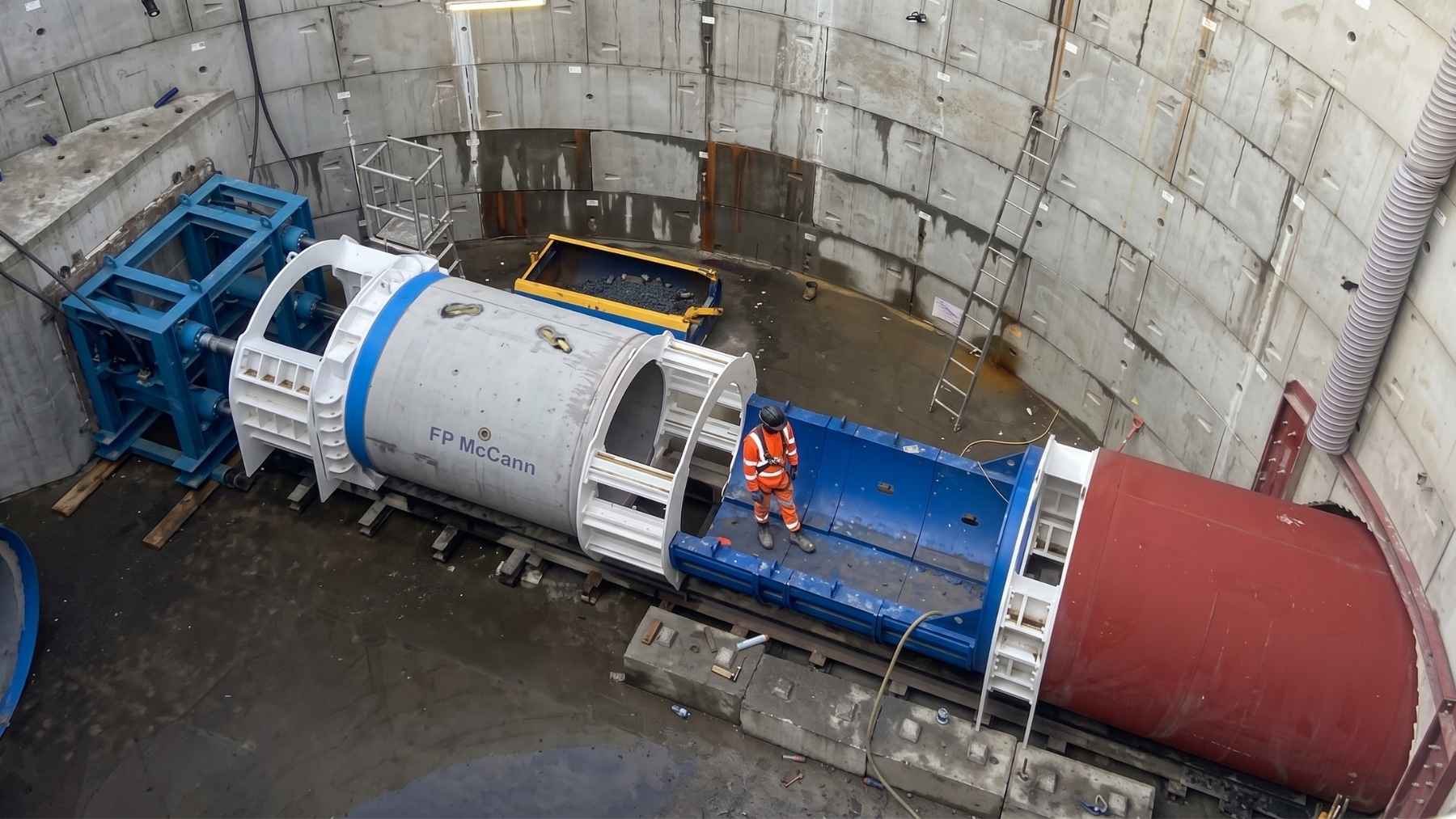
The technique is called horizontal directional drilling, and if you’ve ever seen a utility crew run a cable under a road without digging up the road, you’ve seen a small version of it. A rig on the surface pushes a steerable drill bit into the ground at a shallow angle, follows a planned curve underground, and pops out on the far side. Then the crew pulls progressively bigger reaming heads back through the pilot hole until it’s wide enough, and finally they drag the pipe in behind the last one. We covered a 330-foot version of this under a live rail line in London back in August. This one is 18 times longer and had the sea at the far end.
ScottishPower’s own planning documents, filed with the UK regulator before construction, spell out the geometry. The rig sits in a pit at least 279 feet back from the top of the cliffs, which are only about 33 feet high and made of sand and gravel. The bore runs somewhere between 49 and 66 feet below the base of those cliffs, under the beach, and punches out through the seabed well past the low tide line. The filings called for a hole of roughly 5,600 feet and said it wouldn’t go past 6,560, so 5,883 feet landed about where the engineers expected.
One detail runs backwards from what you’d expect. The rig drills from land toward the sea, but the pipe comes in the other way. Each duct is floated out to the offshore exit point, hooked to the drill string, and then the onshore rig reels it back in through the hole, with a support vessel holding the seaward end. So the drill goes out and the pipe comes home, and the whole thing runs around the clock while it’s happening.
Why go to this trouble instead of cutting a trench across the beach? Partly it’s the usual coastal stuff, since the beach is a protected site. But the filings also mention a neighbor you don’t want to annoy. Sizewell B, Britain’s only pressurized water reactor, sits a little way up the coast, and it pulls its cooling water out of this same stretch of sea. Trenching through the shallows would have stirred up sediment, and nobody wanted to explain that to a nuclear plant.
Why one piece and not a bunch of shorter ones welded together?
This is the actual record, and it’s a manufacturing one more than a drilling one. Pipelife, the company that made the ducts at its plant in Stathelle, Norway, extrudes big polyethylene pipe straight out of the factory and into the fjord. The pipe just keeps coming out, floating, until they decide to cut it. Martin Myhre, the project manager at Pipelife Norway, says 5,883 feet is the longest pipe the plant has ever made, and as far as I can tell from the company’s own materials, the previous ceiling was around 4,600 feet.
Plastic pipe can be welded. You heat the two ends, press them together and get a bead inside and out. It works fine in a trench. It’s a lot less fine when you’re hauling more than a mile of pipe through a mud-filled hole under tension, because every joint is a fatter spot that can snag and a weaker spot that can let go. Myhre’s version is that skipping the welds gives you a sturdier, more reliable duct for a job like this. Mine is that nobody wants to find out which weld failed 3,000 feet into a hole you can’t get into.
Getting the pipe to England was its own job. Pipelife capped the ends, and the whole thing was towed from Stathelle to Thorpeness by sea, which the company has done before with shorter pipe for wind farms in Scotland. Neither Pipelife nor ScottishPower has said how long the tow took, what each duct weighs, or what size rig did the pulling, which is a pretty odd set of things to leave out of a press release about a record. I’d guess the weight alone would make a decent headline.
Is the hole itself a record?
No, and I’d be careful with the word “record” here, because it’s being used in a narrow way. ScottishPower’s own filings note that single-shot directional drills of just over 1.9 miles already exist, and that the first 1.25-mile ones were done back in 2001. We wrote about a 9,695-foot bore under a river in Alberta last month. A 1.1-mile hole is a serious piece of work, but drillers have gone further.
What hasn’t been done before, going by what ScottishPower and Pipelife say, is pulling a polyethylene duct this long and this wide through one of those holes in a single unbroken piece. Ross Ovens, ScottishPower Renewables’ managing director for offshore, called it “three times the length of our other East Anglia projects,” which is a company-to-company comparison rather than a world one, but it’s still a fair bit of pipe. The drilling itself was run by a British contractor, OCU Group, and ScottishPower says that contract supports more than 80 jobs during construction.
And it’s two ducts, not one. Each export cable gets its own, so the whole exercise happened twice.
What’s going to run through them?
East Anglia Two is a £4 billion project, call it a bit over $5 billion, and it’ll put 64 Siemens Gamesa turbines on monopile foundations in the southern North Sea, about 20.5 miles off the Suffolk coast at the nearest point. Each turbine has a rotor 774 feet across, and the math puts them at 15 megawatts apiece. ScottishPower says the finished farm will generate enough for the equivalent of almost a million homes. It’s the company’s third wind farm in that patch of sea, and the first one, East Anglia One, has been running since 2020.
The ducts are empty right now. They’re the sleeve, and the high-voltage export cables that carry the power ashore still have to be threaded through them from the sea end, which is a separate operation with its own cable-laying vessel.
ScottishPower says the first of those export cables goes in during summer 2027, and the wind farm is working toward commercial operation in late 2028.