
There’s an old rule in heavy lifting: the crane has to be bigger than the job. Want to set a nacelle heavier than a loaded semi 500 feet in the air? You bring in a crawler crane with a lattice boom longer than a football field, you haul it to the site in pieces on dozens of trucks, and you pour a gravel pad big enough to park it on. That’s worked for decades. It’s also the main reason wind turbines haven’t gotten much taller than the cranes that build them.
A Danish company called Liftra thinks the crane should quit standing next to the tower and start climbing it instead. On September 21, at its own test site in Aalborg, the company ran the first full-scale demonstration of a machine it calls the LT1500 in front of more than 350 people from the wind business, and by Liftra’s account the crane did what it was built to do.
So what does “climbing” mean here, exactly?
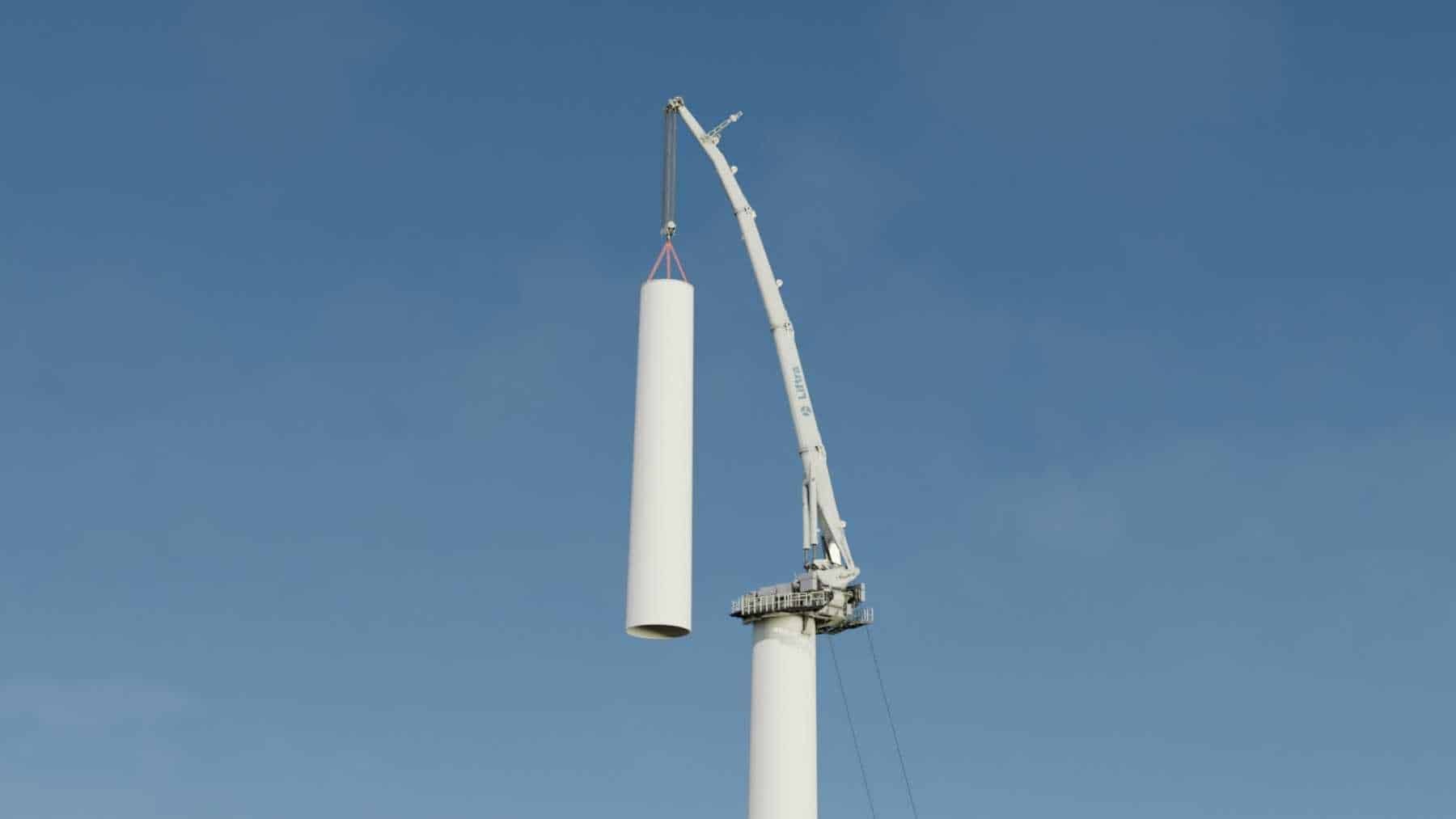
The LT1500 doesn’t sit on the ground with a boom reaching up. It clamps onto the tower and winches its own body up the outside of the steel, hauling the next piece of the turbine with it. Picture a lineman going up a utility pole on spikes, except the lineman is the crane. Liftra says it’s designed for hub heights above 656 feet and for parts weighing up to 132 tons, which covers the nacelle and rotor on the kind of 6-to-8-megawatt turbines the company says it’s aiming at.
The logistics are where I think this gets interesting. Liftra says the whole crane travels in 7 to 9 truckloads and works from a pad smaller than 9,700 square feet. In a January write-up the company put that against 40 to 60 trailer loads for a conventional crane and claimed the pad is about half the size, with 47 percent lower CO₂ emissions per job. Those are Liftra’s numbers, and I’d want to see them on a real wind farm before I quoted them to a developer. But even if the truck count lands somewhere in between, that’s a very different convoy rolling through a county road at 5 a.m.
So how does a crane climb a tower?
Wind turbine towers get built in sections, each one a steel tube that’s bolted to the next. The LT1500 uses the joint between those sections as a ladder rung. The bottom of the crane grabs the steel lip, called a flange, at the top of one section, then lifts the next section up and sets it in place. A hoist block rides up and latches onto the fresh section, and the crane winches itself up to the new flange. Then it does it again.
Repeat that enough times and you’ve built a tower with a crane that was never taller than the tower itself. Once the tube’s done, the same machine sets the nacelle, the hub and the blades from the top. Liftra’s own description says the climbing system comes out of the self-hoisting cranes the company already sells for swapping gearboxes and generators on turbines that are up and running, so the trick isn’t new. Using it to build the whole thing from the dirt up is.
That’s a lot of load going into the side of a tower, and you’d be right to wonder whether the steel likes it. Liftra ran finite element simulations on the flanges and tower walls a few years back, basically a computer model of where the stress goes when a crane hangs off the tube, and it says the tower doesn’t deform. I’ll take that as a reasonable starting point rather than a settled fact, because a simulation and a 650-foot tower in a crosswind aren’t quite the same thing.
What did it lift in Aalborg?
Here’s where I have to level with you. Liftra’s write-up says the crane “performed as intended” and leaves it at that. It doesn’t say what the LT1500 picked up during the demo, how heavy it was, or how high it went. Windletter, a Spanish wind-industry newsletter that went through the footage, says the video shows the crane coupling to the tower, climbing and lifting itself, with pieces of a small turbine, maybe a 1-megawatt machine by its estimate, laid out next to it.
So the 132 tons and the 656 feet are design targets. No one’s watched this crane put a nacelle on a hub that high yet, and I’d treat anyone who tells you otherwise with some suspicion. For a first public outing in front of customers, a crane that clamps on, climbs and comes back down without drama is frankly a pretty good day. It just isn’t the whole job.
Per Fenger, Liftra’s CEO, says the idea goes back to 2016 and the patent to 2018, and in the company’s own write-up he said the demonstration “went better than we could have planned.” Liftra also showed off its LT1200 self-hoisting crane and a second product called Skylark on the same day, which tells you the LT1500’s the headliner but not the only act.
The catch is the tower has to be built for it
You can’t roll the LT1500 up to any old wind farm. The crane needs an outside flange on each tower section to grab, and Liftra specifies one 2.4 inches tall and 2.2 inches wide on tubes between 11.5 and 21.3 feet across. Most towers in the ground today weren’t made with that lip, as far as I can tell, which means the turbine maker has to design it in from the start.
Which is why Vestas is in the room. The LT1500 was the subject of a Vattenfall roundtable at the WindEnergy Hamburg trade show on September 23, two days after the demo, with Fenger alongside Ulrika Ritzen, Vattenfall’s VP for onshore wind, and Juan Furones, who runs the onshore product line at Vestas. Vattenfall’s one of Europe’s biggest wind developers and Vestas is the biggest turbine maker outside China, or close to it, so if those two decide towers should come with a flange, towers will come with a flange.
Back in January, Liftra said the full-scale demo would happen at a Vattenfall site using towers built by Vestas. It ended up at Liftra’s own yard in Aalborg instead. The company hasn’t said why the plan changed, and I’m not going to guess. The development is backed by EUDP, the Danish government’s energy technology program.
Why does anyone need a hub 656 feet up?
Because the wind up there is better. Air near the ground gets churned up by trees, buildings and hills, and a few hundred feet higher it blows harder and steadier, so a turbine spends more of the year running at full output. The industry has been creeping upward for years, and the height of the biggest crane you can rent has been one of the walls it keeps hitting.
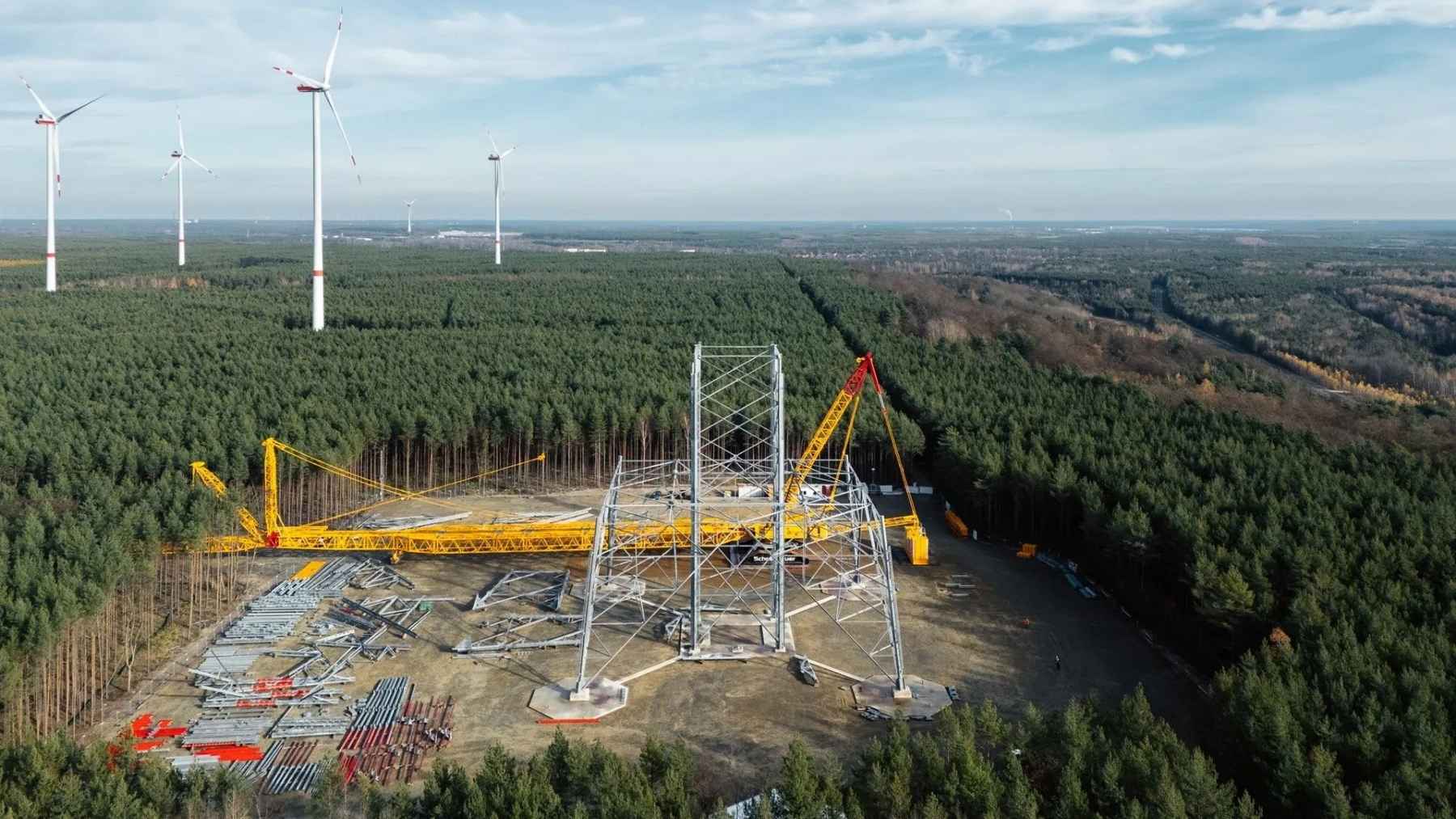
That wall is getting tested from a couple of directions this fall. On September 8, a German construction company and Vestas stood a turbine in Bavaria with its hub 653 feet off the ground, the tallest on land, on a tower built partly from precast concrete so the sections fit on normal trucks. A few hundred miles east, a different German outfit gave up on cranes entirely and is pushing an 827-ton turbine up a lattice tower with hydraulic jacks toward a 984-foot hub, because no crane on Earth can set it there.
The LT1500’s a third answer to the same problem: keep the steel tube everybody already knows how to build, and make the crane go up with it. The turbines spinning along I-80 in Iowa sit a good deal lower than 656 feet, so this isn’t a machine you’ll see on an American jobsite next year. But the direction of travel in this business is up, and a crane that arrives on eight trucks instead of fifty is arguably the more practical of the three ideas.
Liftra says onshore installations come first and that it wants to take the technology offshore later for turbine maintenance, on a sea-going platform it’s developing with the Spanish engineering firm Esteyco. The demo ran on September 21, and the next morning the company’s team was on the floor at WindEnergy Hamburg, where the show ran through September 25.