
There are basically two ways to get rid of a really tall chimney. You can take it apart from the top down, a few feet at a time. Or you can set off explosives at the base and let the whole thing fall over in a matter of seconds.
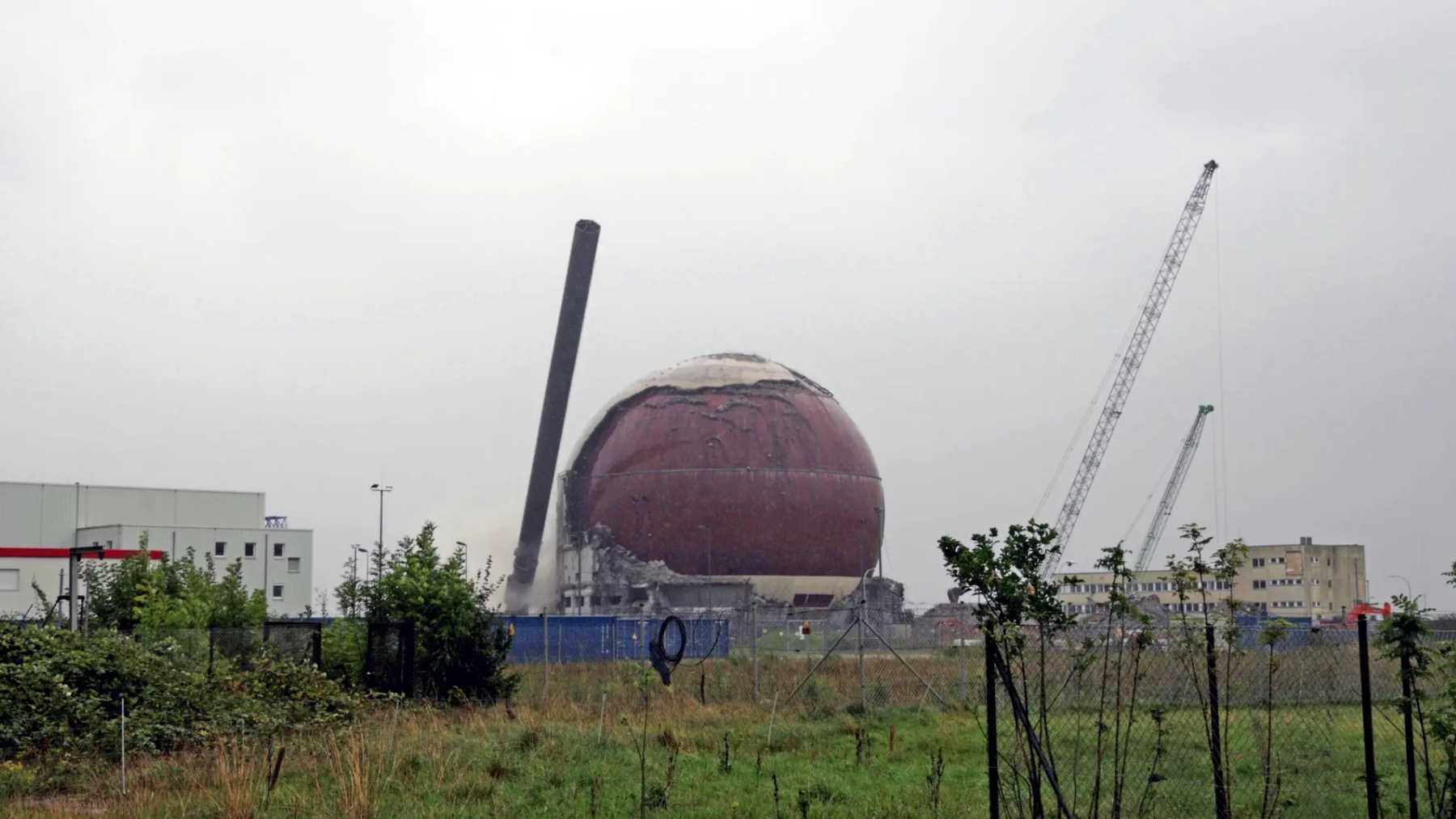
PreussenElektra went with option two. The German company owns the old Stade nuclear plant on the Elbe River, west of Hamburg, and on Friday, September 4, it had the plant’s 262-foot exhaust stack blown up.
Freimuth, the contractor that’s handling Stade’s demolition, brought in a specialist company for the blast itself. The charges went off around 1 p.m., and the stack tipped over onto its side within a few seconds, according to the Kreiszeitung Wochenblatt, a local paper. About 100 invited guests were on hand, watching from well back. That’s frankly more of a send-off than most chimneys get.
World Nuclear News quoted plant manager Marco Albers saying he was pleased the stack “could be brought down safely and as planned.”
I went looking for the stack’s weight and came up empty, so I can’t tell you exactly how much chimney hit the ground that day. Everything I’ve found, from the company and from the German press, gives its height and that’s about it.
So what was a stack doing at a nuclear plant?
If you grew up near a coal plant or a steel mill, a tall stack probably means smoke. Nothing burns in a nuclear reactor, though. So there isn’t any smoke to get rid of.
Stade’s stack was essentially the exit for the plant’s ventilation system. The plant cleaned its exhaust air and monitored it constantly, and the stack was where that air went out. It went up in 1970, so it’d already been standing for a while when the reactor first sent power to the grid.
The reactor itself was a 640-megawatt pressurized water design. It’s the same basic type as about two-thirds of the reactors licensed to operate in the US right now, going by the Nuclear Regulatory Commission‘s count.
In a reactor like that, the water around the core is kept under so much pressure that it can’t boil, and it heats a second loop of water that makes the steam for the turbine. This one ran for 31 years, and it’s been shut down for more than 20.
A 157-foot steel sphere is still standing
With the stack gone, the site’s down to an office building, some unused warehouses and the plant’s steel containment sphere, World Nuclear News reports.
If you’re not up on reactor anatomy, a containment vessel is the airtight shell that surrounds the reactor and its plumbing. It’s there to keep anything radioactive inside if something goes badly wrong.
Stade’s is a steel sphere 157 feet across, with walls about an inch thick. It sat inside a concrete reactor building, and demolition crews have spent the months since March 31 knocking that building down around it. We wrote about the 4.4-ton wrecking ball they used on the concrete back in August, and from the looks of things, it’s done its job.
Before any of that started, PreussenElektra used the empty sphere as the venue for a video and sound installation called ORBITALE. About 1,300 people went, the company’s 2025 annual report says, and apparently the acoustics inside an empty containment vessel are unlike anything else in Germany. As goodbyes to a power plant go, that’s a fairly classy one.
The sphere comes out next. It’s already been cleared to be cut up and recycled as scrap.
So why’s a regular demolition company allowed to knock all this stuff down?
Because the nuclear side of the job is basically finished. The fuel’s long gone. The reactor pressure vessel (the big steel pot the fuel sat in) and the most contaminated components came out more than a decade ago. Since then, the company’s checked the rest of the plant for contamination item by item, right down to the wall anchors in the office buildings, the Kreiszeitung Wochenblatt reports. The reactor building and the sphere got the same treatment, with more than 129,000 square feet of surfaces checked and over 500 samples analyzed, according to regional news site Die Niedersachsen.
Freimuth is handling what PreussenElektra calls the conventional demolition. That’s the stage where buildings that have been checked and cleared get torn down like any other old building, and the stack was part of it.
The Stade teardown has taken more than 20 years
In case you’re wondering how long all of this has taken, the company’s been taking Stade apart for about 21 years, and the conventional demolition only got going a few years ago.
The first batch of 17 buildings, totaling about 6.25 million cubic feet, is already gone. Two more phases are running side by side. One covers five building complexes and the other covers ten, according to World Nuclear News.
Once the remaining work is done, the site gets released from nuclear regulatory oversight. That’s when the regulators sign off and the property stops being run as a nuclear site. There’s one building that’s staying put, though: a storage facility for low- and intermediate-level radioactive waste.
Still, that’s pretty different from what you’d see at a lot of American plants. At San Onofre in California, for example, spent fuel’s sitting on site in sealed steel canisters, and it’ll stay there until the federal government finds somewhere to take it. Stade, as I mentioned, doesn’t have any spent fuel left.
PreussenElektra wants the steel sphere gone by the end of 2026 and the site released in fall 2027. If it hits both dates, World Nuclear News says that’ll make Stade Germany’s first fully dismantled commercial pressurized water reactor, roughly 24 years after it stopped making power.
Photo: Wolf-Christian Nerger/PreussenElektra