
If you’ve ever sat at a railroad crossing waiting for a freight train to clear, you’ve probably noticed that most of the cars look the same underneath. There’s a set of wheels near each end, which railroaders call a truck, and each truck has two axles. Coal hoppers, tank cars and graffiti-covered boxcars pretty much all get by on four.
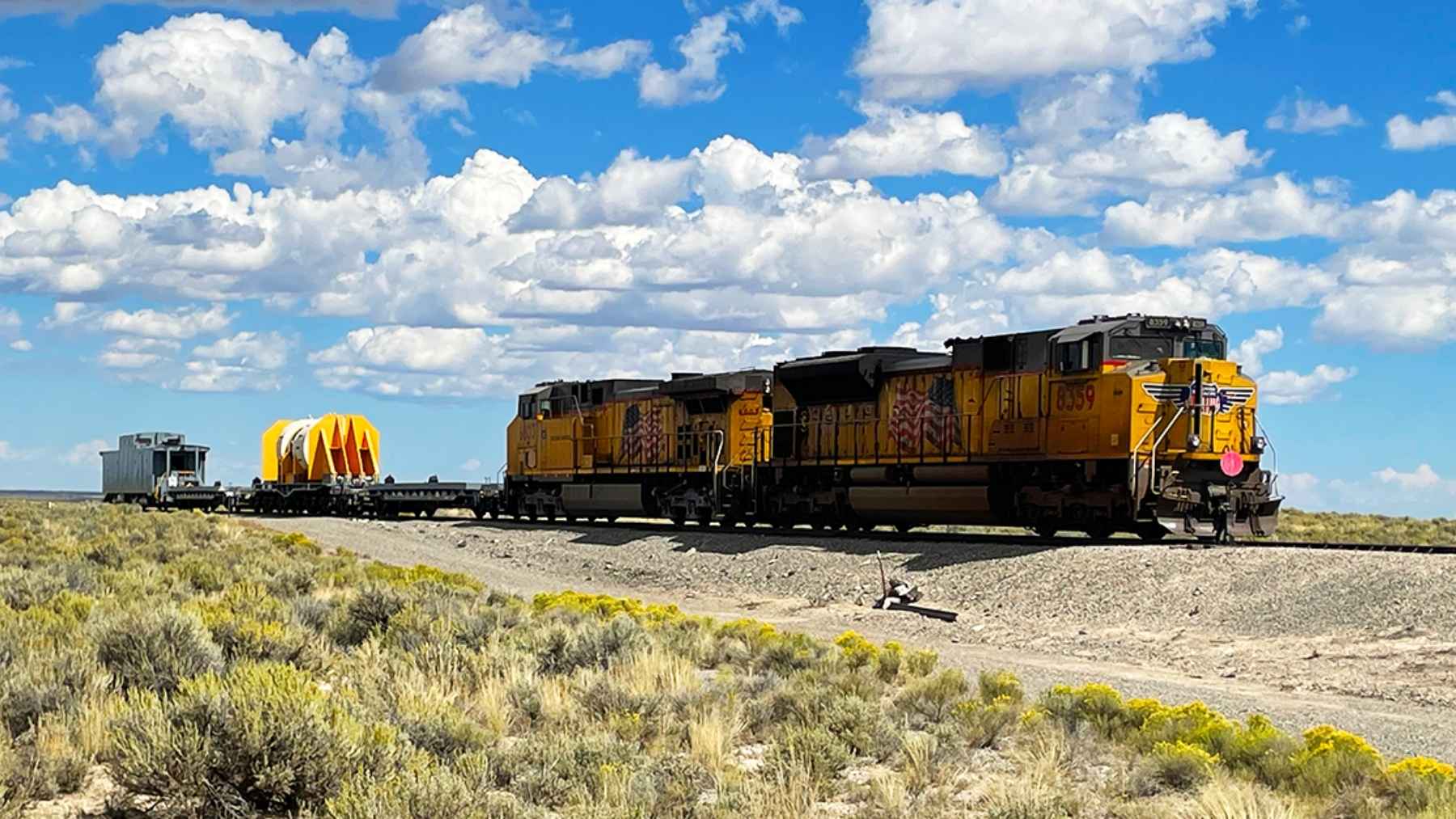
The Department of Energy needed a car for something a lot heavier than grain, so it built one called Atlas that rides on twelve axles. It’s 78 feet long, it’s designed to carry one spent nuclear fuel cask at a time, and the railroad industry cleared it to run on America’s freight network in May 2024.
It hasn’t hauled any nuclear fuel yet. Its first real job will be a trip from Virginia to Idaho, and in an August 25 update, DOE said work is underway in Idaho to refurbish the rail line that’s supposed to take that cask in. DOE now expects the shipment in late 2027.
What’s with all the axles?
Weight, basically. Atlas weighed 222,050 pounds empty on the test scales, so that’s about 111 tons of steel before anyone’s loaded a thing. DOE rates it to carry up to 480,000 pounds (240 tons) on top of that.
A normal four-axle car couldn’t spread that kind of load out. Atlas uses two span bolsters, which are basically giant steel beams that let each end of the car sit on three two-axle trucks instead of one. If you’ve ever seen a heavy equipment trailer with a whole row of axles under it, it’s the same idea.
Fully loaded in testing, Atlas put 709,050 pounds on the rails. If my math’s right, that’s about 59,000 pounds per axle. The four-axle buffer cars that ride next to it work out to about 65,750 per axle, so the car carrying the nuclear cask actually sits a little lighter on each axle than the plain flatcar beside it. I think that’s a pretty neat bit of engineering.
The buffer cars are basically rolling weights
Atlas doesn’t travel alone, either. According to DOE’s fact sheet, a full train has two locomotives, one to seven Atlas cars, two buffer cars and an escort car for armed guards and monitoring gear. The buffer cars keep some distance between the casks and the people on the train.
You’d think a buffer car could just be an empty flatcar. It can’t, apparently. Every car in these trains has to pass S-2043, the Association of American Railroads’ standard for hauling high-level radioactive material, and the certification report MxV Rail wrote for DOE says computer simulations showed an empty buffer car would fail its buff and draft curving test. Buff and draft are railroad terms for the shoving and yanking between cars as a train brakes and pulls. Put a light car in a curve with heavy ones shoving on it, and it can get pushed around more than you’d want.
DOE’s fix was pretty low-tech. Each buffer car got 196,000 pounds of steel plate welded on at the factory, which is 98 tons of dead weight that never comes off. It’s the railroad version of tossing sandbags in the bed of your pickup before winter, with a few more zeroes on the end.
The approval comes with a mileage requirement
To be fair to Atlas, it’s been through a lot. Its final exam was a four-day round trip between Pueblo, Colorado, and Scoville, Idaho, three years ago this month, loaded with 480,000 pounds of steel test weights standing in for a cask. DOE says the run came to 1,680 miles.
Testing wasn’t exactly drama-free. MxV Rail’s report says one axle climbed off the rail at 6 mph on a test curve with a dip built into one rail on purpose, and investigators found the test section itself was harsher than intended. Crews also found cracked welds on the big span bolsters, so the builder swapped in new ones.
Then there’s speed. With a light load, Atlas started “hunting” above 65 mph in testing. Hunting is the side-to-side wobble a set of train wheels can fall into at speed, kind of like a shopping cart wheel that starts shimmying when you push it too fast. It doesn’t matter much in practice, since the railroads’ own operating rules cap trains like this at 50 mph.
So is Atlas actually certified?
Sort of. DOE said the railroads had certified the whole system, and that’s how most of the coverage reported it. But the AAR’s letter to DOE says its equipment committee “conditionally approves” the Atlas train for restricted interchange service. Interchange is basically a railcar getting handed from one railroad to another. No single railroad covers the whole map, so that’s how pretty much anything crosses the country.
Full approval comes later. The letter says DOE can ask for it once representative cars have logged 100,000 service miles and passed another round of testing. As far as I can tell, that means real service miles, not laps around a test track. DOE hasn’t published a running total for the car, and I haven’t found anything saying whether the Idaho trip will count.
The conditional approval still lets Atlas carry radioactive cargo, so from the looks of things none of this is holding up the shipment. But for scale, the Virginia-to-Idaho run is more than 2,500 miles one way, according to E&E News. That’s about a fortieth of what the AAR wants to see. Frankly, it’s a bit like a teenager with a learner’s permit logging supervised hours, except this teenager weighs 111 tons.
So why hasn’t it hauled anything yet?
Mostly because there’s been nowhere to send the fuel. The US is sitting on about 105,000 tons (95,000 metric tons) of spent nuclear fuel, spread across about 75 sites in over 30 states, according to a DOE fact sheet from last year. Some of it sits at plants that don’t even run anymore, like Oyster Creek in New Jersey.
The federal government is legally responsible for all of it, but the Yucca Mountain repository in Nevada was never built, and DOE has said Congress would have to amend the Nuclear Waste Policy Act before it could build a federal interim storage site. That’s pretty much why Atlas has been waiting around. It’s still a slightly awkward look for a system DOE says took ten years and about $33 million to develop, buffer cars and escort car included.
The first trip takes the long way around
The first cask belongs to a research project. It’s been sitting full of high-burnup fuel at Dominion Energy’s North Anna plant in Virginia for almost a decade, as part of a study DOE runs with the Electric Power Research Institute (EPRI). High-burnup fuel basically stayed in the reactor longer so the utility could squeeze more energy out of it, and the cask is wired with temperature sensors to show how that fuel holds up in storage.
So far, so good. “Temperatures in the cask have been lower than were predicted,” Joe Faldowski, a senior program manager for used fuel and high-level waste at EPRI, told E&E News. DOE says 62 US nuclear plants cite this project in their storage licenses, so what’s inside that cask matters well beyond Virginia.
The next step is opening it up, which takes a hot cell. That’s a heavily shielded room where researchers work on the fuel through thick leaded windows with mechanical arms. Idaho National Laboratory has those.
Getting there won’t be quick. E&E News reports the cask weighs 180 tons, and the trip should take about a week. The cask is also 12 feet wide, so instead of cutting through Appalachia and its low overpasses and tunnels, the likely route drops south into the Carolinas and Georgia first, then swings back north and west.
DOE says Idaho hasn’t received a shipment like this one in more than 20 years. The Navy has been sending its own spent fuel across the country by rail for over 60 years, but it does that on unmarked cars without telling states ahead of time.
On the Idaho end, the cask is headed to the Idaho Nuclear Technology and Engineering Center (INTEC), part of the INL site. According to DOE’s August 25 update, the site’s cleanup contractor proposed reusing INTEC’s existing rail line because it’s cheaper and more efficient, and DOE says that line will handle future used fuel shipments in and out of the site as well. I’d argue that part matters more than this one cask.
If the schedule E&E News laid out in February holds, people along the route could get their first look at Atlas next spring, when DOE is likely to run a dress rehearsal with an empty cask borrowed from EPRI. The real shipment is expected in late 2027, according to DOE’s August 25 update.