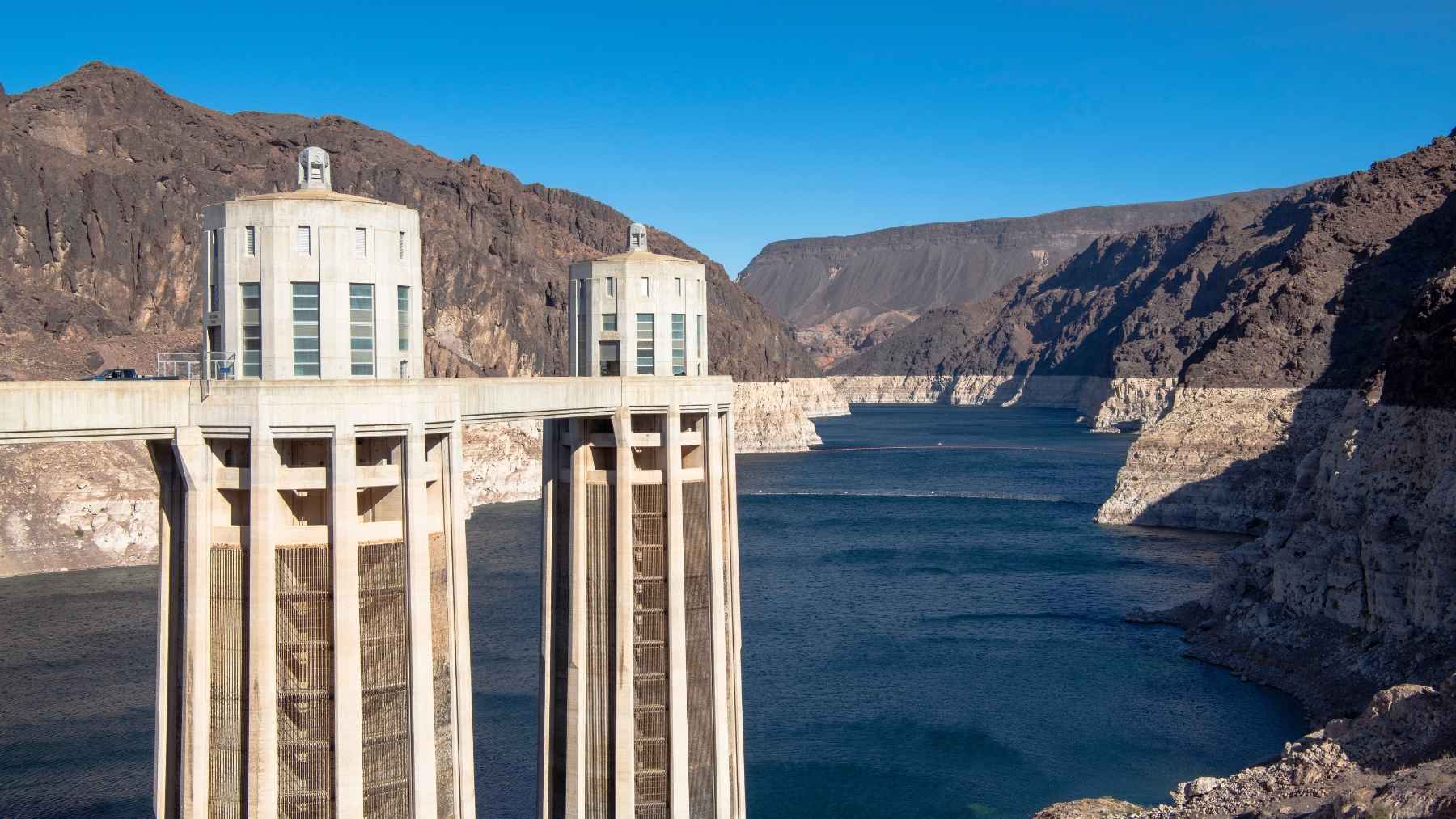

If you’ve typed “Lake Mead” into a search bar this month, you’ve probably been told the lake already dropped below 1,035 feet. There’s a video with a title saying it happened on October 3. It didn’t. I pulled up Reclamation’s own gauge before writing this, and the reading for October 16 was 1,037.4 feet, down a tenth of a foot from the day before and about three-tenths from the week before.
So the lake is still 2.4 feet above the line. When we first wrote about this three weeks ago, the cushion was about 3 feet. The lake has eaten roughly half a foot of it since then, which is about what you’d expect for October.
What’s changed is the forecast. Reclamation published its October 24-Month Study on October 15, and that’s the document that decides, on paper, when Hoover Dam loses most of its power plant. The new numbers aren’t kind.
So what’s actually in the new forecast?
The 24-Month Study is a rolling two-year projection for every big reservoir on the Colorado River, redone every month. Reclamation ran the October model on October 8, and in the most probable case it has Lake Mead finishing October at 1,035.29 feet. That’s still above the line, barely. By the end of November the lake sits at 1,033.97, under it for the first time.
From there the model has the lake bobbing just under the line all winter: 1,034.52 at the end of December, 1,034.33 in January, 1,033.64 in February. Then spring irrigation demand kicks in and it drops hard, to 1,027.24 in March, 1,019.35 in April and a low of 1,007.73 next July. At no point before September 2028 does the study put the lake back above 1,035 feet.
Reclamation also runs a drier scenario, the one it says 90 percent of years will beat, and that version crosses the line this month, at 1,034.98 feet on October 31. It bottoms out at 1,003.87 feet next July and keeps sliding to 982 feet by the summer of 2028.
Both scenarios land in the same place. The question isn’t whether the lake crosses 1,035, it’s whether it happens in the last few days of October or the first few of November.
What breaks at 1,035 feet, and why
Hoover runs 17 generating units, and 12 of them are the original design, built for a lake that could sit as high as about 1,221 feet. Water pressure at a turbine depends on how far the water drops to reach it, and that distance has gotten a lot shorter. Reclamation’s table lists the static head at 391.5 feet in September, versus close to 590 feet with a full lake.
Push a turbine too far below the head it was designed for and the water flowing through it starts behaving badly. Pressure in parts of the runner falls low enough that the water briefly turns to vapor, those bubbles collapse against the steel, and every collapse chips a tiny pit out of the blade. That’s cavitation. Do it for a few months and you’ve sandblasted your own turbine from the inside.
A couple of readers pushed back on that explanation last time, arguing cavitation is a turbulence problem rather than a pressure problem. Fair enough on the mechanics, since the bubbles form in the flow inside the machine, not because the lake is “low pressure.” But the reason the flow goes wrong is the lost head, and Hoover’s intakes sit far below the surface, so air getting sucked into the pipes isn’t the issue here.
Eric Witkoski, executive director of the Colorado River Commission of Nevada, told the Las Vegas Review-Journal in April that at 1,035 feet only five of the 17 units can generate, and one of those five is out of commission for repairs. So, four. Those five are the “wide-head” units, designed to run on a much shorter water column, down to somewhere near 950 feet.
Reclamation’s own table doesn’t flip a switch
I expected the Hoover page in the October study to show a cliff the month the lake crosses. It doesn’t, quite. The agency lists the plant’s effective generating capacity month by month, and the drop comes in steps.
Between those steps the study keeps the plant at 914 to 938 megawatts from November through January, with 71 to 74 percent of units available, and lets March bounce back to 855.9 before the floor drops out in April. The 24 percent of units available from April is four of 17, which lines up with Witkoski’s five wide-head turbines minus the broken one. The 18 percent in October 2027 is three.
Why does the model keep most of the fleet running through a winter when the lake is already under 1,035? I can’t tell you from the table alone. The study’s notes say Hoover’s capacity is “adjusted based on estimated effective capacity and plant availability” and that unit capacity tests will be run as the lake drops, which reads to me like a plan to find out how far each old turbine can be pushed before the pits get too deep. The numbers are a schedule, not a measurement.
One more thing in that table that tripped me up. The study projects Hoover generating 208 million kilowatt-hours in October, which is more than September’s 190, even though October’s capacity is lower. That’s because capacity’s how much the plant can push at any one moment and energy is what flows through it over the month, and Reclamation has a bigger water release scheduled for October. A smaller plant running flat out can beat a bigger one running part-time.
Why the water keeps coming down
Lake Mead’s last in line. Reclamation has set the release from Lake Powell at 6 million acre-feet for the water year that started October 1, the bottom of a 6-to-7 range that the new operating rules allow for a reservoir this low. An acre-foot is a foot of water over an acre, about 326,000 gallons. To keep Powell itself above its own turbines, the agency’s also moving 1 million acre-feet down from Flaming Gorge in Wyoming, and that water stops at Powell.
Mead gets whatever Powell sends plus whatever trickles in from the side canyons, and it’s got to send 8 million acre-feet downstream to Arizona, California, Nevada and Mexico over the year. The lake holds about 6.8 million acre-feet right now, a little over a quarter of what it can hold when full. It’s still the biggest reservoir in the country by capacity, though as a reader rightly pointed out, several Missouri River reservoirs are holding more actual water than Mead at the moment.
In the drier scenario, Powell itself gets down to 3,490.99 feet in February 2028, which is a foot above the elevation where Glen Canyon Dam can’t generate at all. That’s a separate story, and we’ve covered it.
The fix is still years away
Reclamation freed up $52 million in May to replace up to three of the old turbines with wide-head units. Good news, in principle. Witkoski’s timeline from April is less cheerful: the first project adds two new turbines and can’t finish before October 2028, repairing the broken wide-head unit has a target of September 2029, and two more turbines might land in 2031 if the money holds up. “You can’t just go to GE and tell them you need a turbine,” he said.
He also said, back then, that the funds were still being held up. I can’t find a Reclamation announcement since May confirming the contracts are signed, so as far as I can tell the 2028 date’s still the earliest anything new spins. Which means the four working low-water turbines carry the plant on their own for most of two years, and the study’s 300-megawatt plateau through 2027 is basically what those four machines can do.
Does that mean the lights go out in Vegas or Phoenix? No. Utilities buy the difference on the open market, at a higher price, and the Metropolitan Water District of Southern California told the Review-Journal it has reserves to smooth that out for a while. Your bill’s where this shows up, not your light switch.
Reclamation’s daily gauge updates every morning, and the reading for October 16 was 1,037.4 feet. The November 24-Month Study, the one that will show whether the line has been crossed, is due around November 15.